World Heritage
Cultural Landscape of Sintra
Mountains, palaces and Romantic gardens in a landscape that UNESCO classified in 1995 as the first European site in the "cultural landscape" category.
- UNESCO
- World Heritage
Sintra is not a monument, but a landscape — and it was precisely as a landscape that UNESCO classified it, in 1995, in one of the first European uses of that category. What is protected here is the inseparable relationship between a humid, wooded range of hills and the buildings that, over a thousand years, held dialogue with it.
Layers of a mountain range
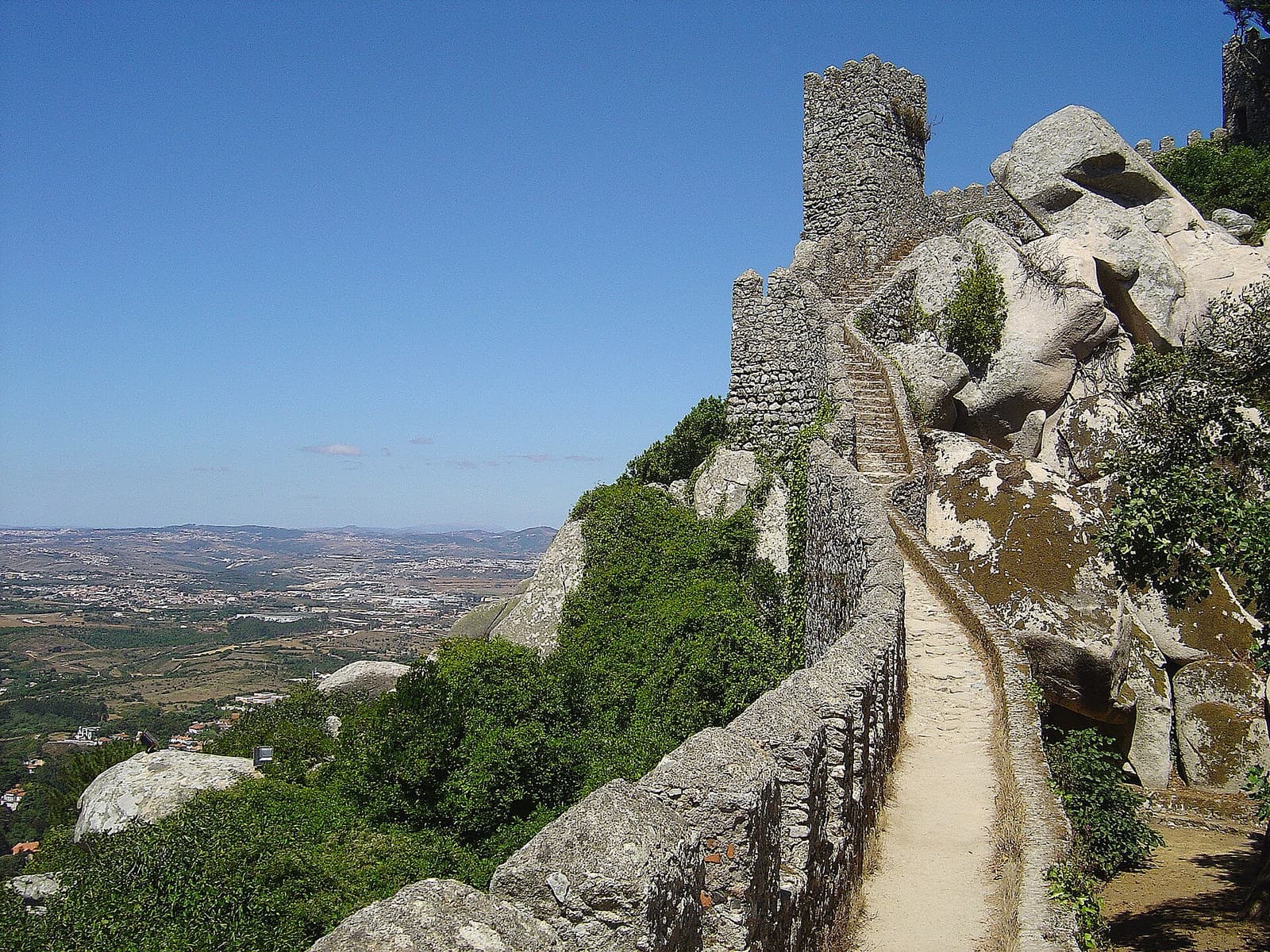
The Sintra range was, successively, a place of pre-Roman cult, a Muslim frontier and a royal retreat. The Castle of the Moors, of Islamic origin, runs along the crest like a wall of grey stone among the trees. Further down, the National Palace of Sintra, with its two unmistakable conical chimneys, was the summer residence of the Portuguese kings for centuries.
The Romantic invention
The great transformation is of the nineteenth century. In the 1800s, Sintra becomes the setting par excellence of Portuguese Romanticism. King Ferdinand II raises the Pena Palace over the ruins of a monastery — an eclectic fantasy of towers, colours and mingled styles — and has a park planted around it with species brought from all over the world. Byron had called Sintra a “glorious Eden”; the nineteenth century took the metaphor seriously.
Pena is perhaps the purest example of Romantic architecture in Portugal: a building that does not seek historical truth, but emotion — the free quotation of every past at once.
Estates and gardens
Around the royal palaces, the aristocracy and the bourgeoisie filled the range with estates (quintas) whose gardens were rich in water and shade — the Regaleira, with its initiatic symbolism, Monserrate, with its botanical garden. It is this density of buildings and gardens, fused into the forest, that gives Sintra its unique character.
Landscape as heritage
The classification of Sintra inaugurated, for Portugal, a decisive idea: that heritage can be an entire landscape, the result of the combined action of nature and culture over time. To protect Sintra is not to conserve a building, but to manage a balance — between the range, the built fabric and the enormous pressure of those who wish to visit it.