Intangible Heritage
Falconry, a Living Human Heritage
Falconry in Portugal, centred on the Royal Falconry of Salvaterra de Magos, inscribed as UNESCO Intangible Cultural Heritage of Humanity.
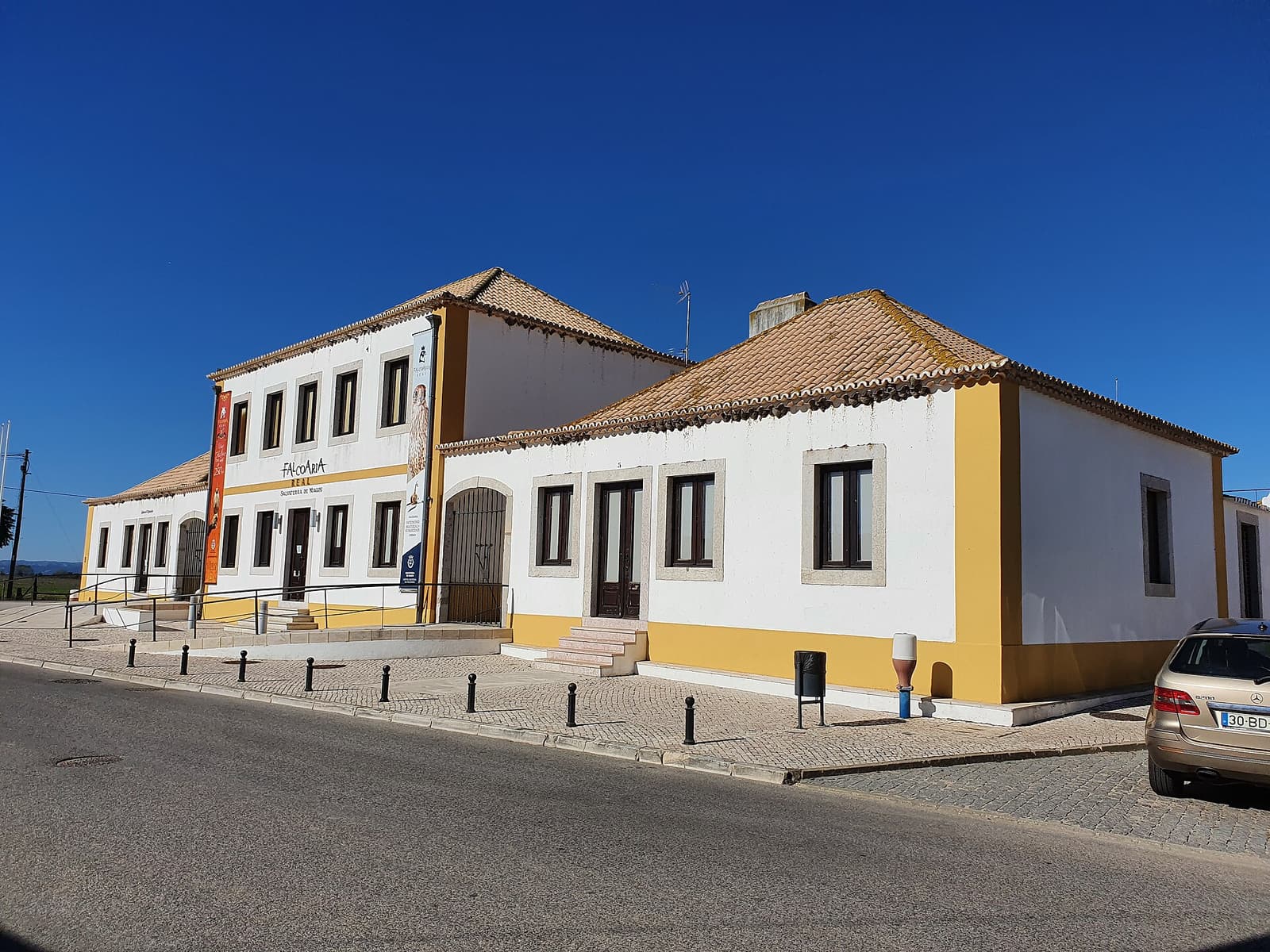
- Location
- Salvaterra de Magos, Santarém
- Built
- século XVIII
- Style
- Pombalino
- UNESCO
- Intangible Heritage · since 2021
Falconry — the art of breeding, training and flying birds of prey for the hunt — is one of humanity’s oldest cultural traditions, with an unbroken thread of transmission stretching across millennia. In Portugal, this practice finds its fullest expression in the Ribatejo town of Salvaterra de Magos, in the district of Santarém, where the court maintained its royal falconry. The multinational element «Falconry, a living human heritage» forms part of the Representative List of the Intangible Cultural Heritage of Humanity of UNESCO, under reference number 01708 — a nomination that, after the 2021 extension, brings together twenty-four States from four continents.
A nomination shared by many peoples
Few elements of the world’s intangible heritage are so genuinely transnational. Falconry was first inscribed in 2010 and has been progressively extended as new countries join: Portugal joined in 2016, at the 11th session of the Intergovernmental Committee held in Addis Ababa, and in 2021 the group grew to twenty-four nations, from the United Arab Emirates to South Korea, from Mongolia to Spain. It is the element with the largest number of associated States in the entire UNESCO list, testimony to a practice that, born of the need to obtain food, became a way of relating to nature shared by cultures very distant from one another.
Falconry is not inscribed in a monument or an object: it lives in the relationship between the falconer and the bird, in a knowledge passed down from generation to generation that no stone could ever keep.
The Royal Falconry of Salvaterra de Magos
Portugal’s link to royal falconry has its epicentre in Salvaterra de Magos, where the Royal House established its hunting reserve and the corresponding falconry. In the eighteenth century, within the setting of the Royal Palace, a singular building was raised — the Falconry proper —, of centralised and symmetrical plan, arranged around an inner courtyard and equipped with a circular dovecote containing some three hundred niches intended to house the pigeons used in training the falcons.
This construction, of Pombaline design and inspired by the Dutch falconries of the eighteenth century, is today regarded as a unique example in the Iberian Peninsula. Not by chance: during the reign of Dom José I, the most renowned European falconers, coming above all from the Low Countries, served in the royal falconry, and many settled permanently in the town, raising families and rooting locally a knowledge that would otherwise have been lost. Restored and turned into a museum, the Royal Falconry is today a place where the practice remains alive, with birds, demonstrations and activities to pass it on to new practitioners.
Meaning and safeguarding
The UNESCO inscription recognises falconry not as a spectacle but as a social and heritage practice linked to the conservation of species, to the ethological knowledge of the birds, and to a vocabulary, gestures and implements of its own that constitute a genuine cultural body. In Portugal, the nomination was led by the Municipality of Salvaterra de Magos in partnership with the University of Évora and the Portuguese Falconry Association, bringing together local administration, academic research and the community of practitioners.
Alongside other expressions of Portuguese intangible heritage recognised internationally — such as Cante Alentejano or the Mediterranean diet —, falconry belongs to the body of living traditions that Portugal shares with World Heritage. Its safeguarding depends less on measures of physical protection than on the continuity of learning: as long as there are falconers to teach their craft, the element will remain, by definition, a living human heritage.
Frequently asked questions
- When was falconry recognised by UNESCO?
- Portugal joined the element «Falconry, a living human heritage» in December 2016, during the 11th session of the Intergovernmental Committee, held in Addis Ababa. The element was subsequently extended in 2021, coming to bring together 24 States while retaining reference number 01708 on the Representative List of the Intangible Cultural Heritage of Humanity.
- Where can falconry be visited in Portugal?
- The main centre is the Royal Falconry of Salvaterra de Magos, in the district of Santarém. The complex, commissioned in the eighteenth century beside the former Royal Palace, preserves the dovecote and the facilities for breeding and training birds of prey, and is today a museum space and a place of living practice of falconry.
- How many countries make up the falconry element?
- The element «Falconry, a living human heritage» is a multinational nomination that, after the 2021 extension, brings together 24 member States — the largest number of countries associated with a single element on the UNESCO Intangible Heritage lists.