Tentative List
Águas Livres Aqueduct (UNESCO Tentative List)
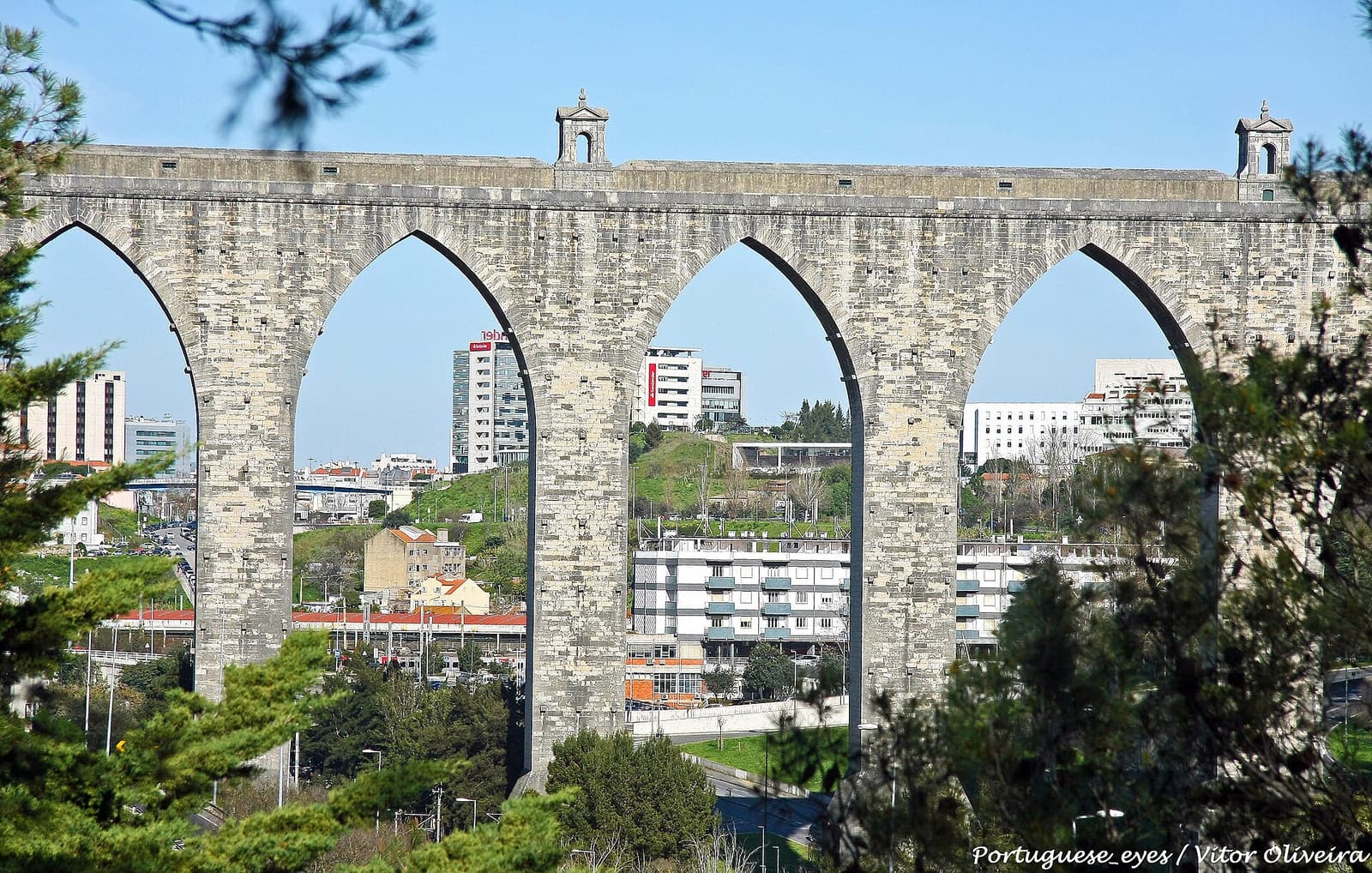
The Águas Livres Aqueduct, an eighteenth-century hydraulic system that supplied Lisbon, on Portugal's UNESCO World Heritage Tentative List since 2017.
- Location
- Lisboa, Lisboa
- Built
- 1731–1799
- Style
- Barroco
- UNESCO
- Tentative List
The Águas Livres Aqueduct is one of the most remarkable works of hydraulic engineering in eighteenth-century Portugal and is one of the elements on the national Tentative List for UNESCO World Heritage, to which it was added on 31 January 2017. The Tentative List brings together the properties that the Portuguese State considers to possess outstanding universal value and which may, in the future, be the subject of a formal nomination to the World Heritage List.
Commissioned by King João V, the aqueduct was intended to resolve the chronic problem of supplying drinking water to Lisbon, drawing on the springs of the Águas Livres basin, in the region of Belas and Caneças, to the north-west of the city. The works, financed by the Real de Água tax levied on essential goods such as wine, olive oil and meat, extended from 1731 to 1799.
Engineering and architecture
The complete system stretches for about 58 kilometres across the assembly of collection, conveyance and distribution, running through underground galleries, open-air sections and imposing arcades. Its most celebrated image is the crossing of the Alcântara valley, in Campolide, with 35 arches, among which stands out the so-called Arco Grande, about 65 metres high and with a span of nearly 29 metres — the tallest pointed stone arch built anywhere in the world.
The work brought together the expertise of first-rate engineers and architects, among them Manuel da Maia, Custódio Vieira, António Canevari and Carlos Mardel, the latter responsible for the design of the terminal reservoir, the Mãe d’Água das Amoreiras. The late Baroque idiom of the ensemble coexists with solutions of a classical and neoclassical character, in an erudite dialogue between Roman tradition and eighteenth-century technique.
The Águas Livres Aqueduct survived almost unscathed the earthquake of 1755, which devastated much of Lisbon — eloquent testimony to the soundness of its design.
Heritage value and nomination
The proposed inscription rests on criteria (i), (ii) and (iv) of the World Heritage Convention, emphasising that the system represents a synthesis of knowledge drawn from Classical Antiquity, the European Renaissance and the technology of the eighteenth century. It was the last great classical aqueduct built on a global scale and remained in operation until 1968, when it was decommissioned for supply purposes.
Classified as a National Monument, the aqueduct can today be walked along one of its sections, offering a singular perspective over the city. The monument itself is treated in greater detail on the page dedicated to the Águas Livres Aqueduct, and falls within the broader typology of the aqueducts of Portuguese heritage.
Place on the Tentative List
The presence of the aqueduct on the Tentative List reflects the growing recognition of the value of Lisbon’s hydraulic heritage and urban landscape. Other nominations from the capital are also part of this group, namely Pombaline Lisbon, proposed for the rationalist reconstruction of the city after 1755. Together, these nominations highlight Lisbon’s role as a laboratory of engineering, urban planning and architecture throughout the eighteenth century.
Frequently asked questions
- Is the Águas Livres Aqueduct a UNESCO World Heritage Site?
- No. It has been on Portugal's Tentative List since 31 January 2017, meaning it is a candidate proposed by the State for a future inscription on the World Heritage List, but does not yet hold any formal designation.
- When was the aqueduct built?
- The works were carried out between 1731 and 1799, by order of King João V, with the involvement of engineers and architects such as Manuel da Maia, Custódio Vieira and Carlos Mardel.
- What is the largest arch of the aqueduct?
- The section spanning the Alcântara valley, in Campolide, with 35 arches. The largest, the Arco Grande, reaches about 65 metres in height, making it the tallest pointed stone arch in the world.