Monuments
Águas Livres Aqueduct (Lisbon)
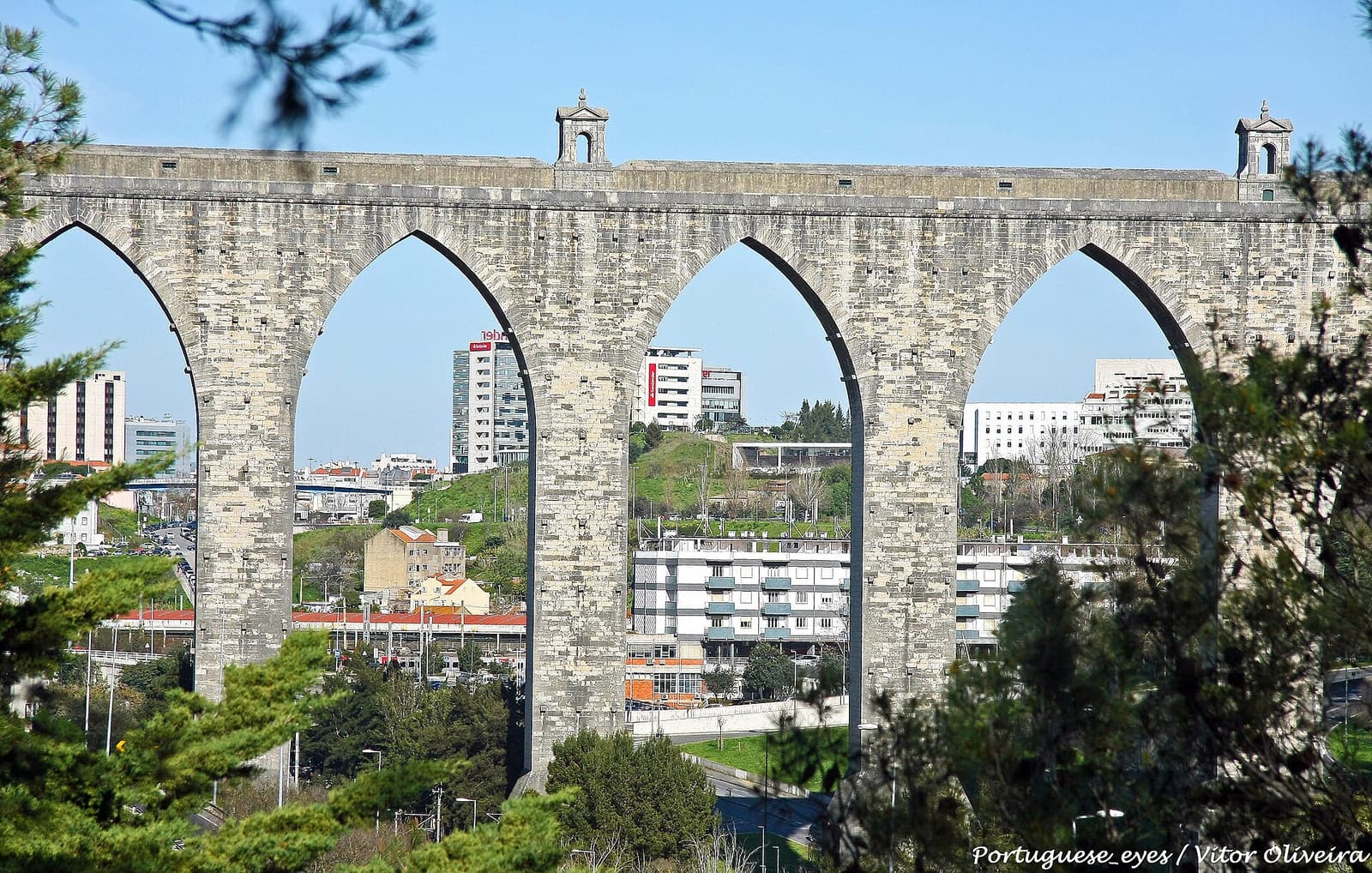
The Águas Livres Aqueduct in Lisbon, a monumental hydraulic engineering feat from the João V era in the 18th century, featuring the world's largest ogival…
- Location
- Lisboa, Lisboa
- Built
- 1731–1799
- Style
- Barroco joanino
The Águas Livres Aqueduct is the most ambitious hydraulic engineering project of 18th-century Portugal and one of Lisbon’s most recognizable landmarks. Designed to address the chronic shortage of drinking water in the capital, it transports water from springs in the Belas region (Sintra municipality) to the city center, overcoming valleys and slopes across dozens of kilometers. Its most celebrated section — the monumental arcade spanning the Alcântara valley — became a symbol of the ambition and scale of King João V’s reign.
A Royal Commission
Construction was ordered by royal decree of João V in 1731, partially funded by a special tax on consumer goods (the “real de água”). Initial direction fell to Italian architect António Canevari, but the definitive design was primarily the work of successive Portuguese military engineers and architects, notably Manuel da Maia and Sergeant-Major Custódio Vieira, responsible for the grand Alcântara valley crossing from 1736. Later, Hungarian-born architect Carlos Mardel took over construction and modified part of the route, establishing the terminal reservoir in the Amoreiras district.
The project spanned several decades. The main channel, approximately fourteen kilometers long, begins at the Mãe de Água Velha in Belas and ends at the Mãe de Água das Amoreiras reservoir in Lisbon; including distribution galleries and branches, the entire system exceeds fifty kilometers. This integrated system of collection, conduction, and distribution makes the aqueduct one of the most remarkable public works of the Portuguese city in the modern era.
The Great Alcântara Arch
The Alcântara valley crossing is the section that made the monument famous. Spanning about 941 meters, the arcade comprises dozens of arches — some round, others ogival — among which stands the world’s largest ogival stone arch, approximately 65 meters tall with a 29-meter span. The choice of the Gothic-inspired ogival arch wasn’t merely decorative: it allowed greater heights to be achieved with less lateral thrust, an ingenious structural solution for the valley’s depth.
In a city that would be devastated just years later, the aqueduct stood firm: on November 1, 1755, the great earthquake shook Lisbon without causing significant damage to the arcade, eloquent proof of the quality of stonework and structural calculations.
The structure’s solidity allowed it to continue supplying the city until 1968. This resilience contrasts with the destruction that befell much of Lisbon’s housing stock and landmarks like the Carmo Church, whose Gothic ruins remain as seismic memorials.
Baroque Language and Classification
Stylistically, the aqueduct belongs to Joanine Baroque, though its expression is more restrained than contemporary religious architecture, favoring structural clarity and monumentality. The Mãe de Água das Amoreiras, a vast reservoir covered by stone vaults, and the markers and ventilation shafts along the route embody this sober yet powerful language.
Designated a National Monument since 1910, the complex now forms part of Lisbon’s water museum heritage, with sections of the arcade walkable and reservoirs visitable. The aqueduct also features on Portugal’s Tentative List for World Heritage, recognizing its universal value as a masterpiece of Enlightenment-era hydraulic engineering. It thus joins the rich built heritage of the Lisbon and Tagus Valley region and the long tradition of Portuguese aqueducts.
Frequently asked questions
- What is the largest arch of the Águas Livres Aqueduct?
- The largest arch spans the Alcântara valley, reaching approximately 65 meters in height with a 29-meter span. It is considered the world's largest ogival stone arch.
- Did the aqueduct survive the 1755 earthquake?
- Yes. The Águas Livres Aqueduct withstood the 1755 earthquake without significant damage and continued supplying water to Lisbon until 1968.
- Can the aqueduct be visited?
- Yes. Visitors can walk along the arcade spanning the Alcântara valley and explore the Mãe de Água das Amoreiras reservoir, both part of Lisbon's water museum circuit.
Sources
Keep exploring
Heritage nearby
More places to discover from here. Approximate straight-line distances, within 50 km.