Periods & Styles
Megalithic Art in Portugal
Megalithic art in Portugal: carvings and paintings on dolmens, menhirs and stone circles of the Neolithic and Chalcolithic, above all in the Alentejo and the Beira.
- Built
- c. 5000–2000 a.C.
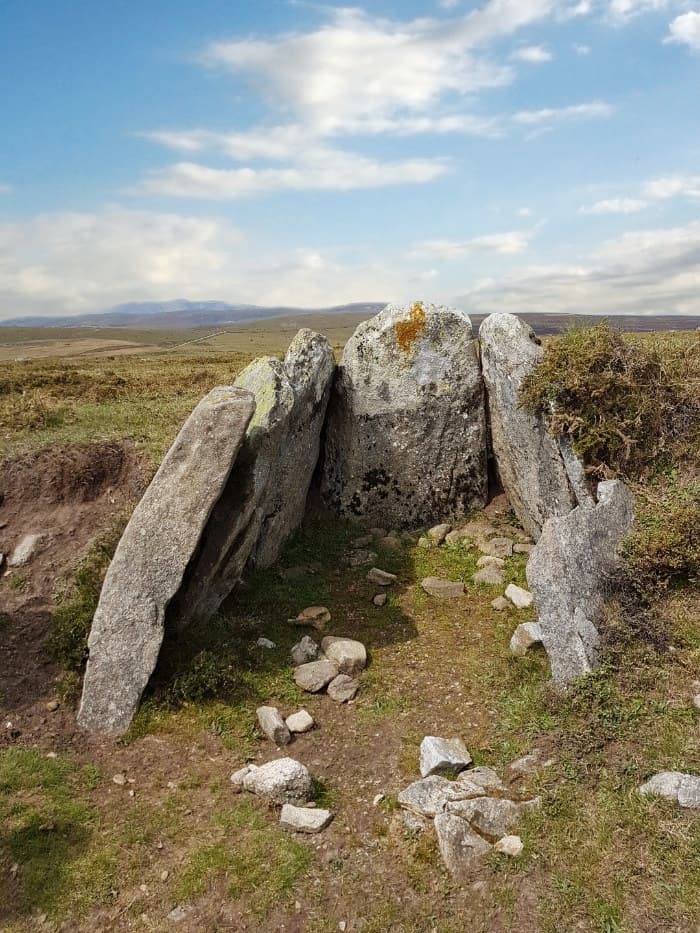
Megalithic art designates the body of carvings and paintings that decorate the great stone monuments raised in Portugal between the early Neolithic and the Chalcolithic, roughly between 5000 and 2000 BC. It is not an autonomous art but a symbolic language inseparable from the architecture that bears it: the orthostats of the dolmens, the shafts of the menhirs and the monoliths of the stone circles. The agropastoral communities that settled in the territory impressed upon these surfaces a vocabulary of signs that still defies the interpretation of archaeologists, and whose antiquity far exceeds that of more celebrated European monuments.
Supports and techniques
Portuguese megalithic art is expressed across three great supports. On the menhirs — vertical blocks sometimes several metres tall — one finds reliefs and carvings with crosiers, axes and serpentine forms, often associated with stylised anthropomorphic representations. On the stone circles, enclosures formed by dozens of monoliths, some orthostats display circular motifs, racquet shapes and pecked crosiers, as occurs on several monoliths of the great enclosure of the Herdade dos Almendres, near Évora. Finally, on the dolmens, funerary chambers of polygonal plan, decoration appears above all in the interior, in red and black paintings applied to the orthostats.
The crosiers carved on the Alentejan menhirs — interpreted as insignia of power or command — link Portuguese megalithism to symbolic traditions that extend from Brittany to the Iberian Peninsula.
Motifs and meanings
The iconographic repertoire combines geometric schemes (zigzags, lattices, triangles, series of dots), abstract symbolic motifs and semi-naturalistic figurations. The crosiers and axes, recurrent on the menhirs and statue-menhirs, are read as attributes of prestige and authority. Other signs — such as solar discs and lunar crescents — suggest astronomical and cosmological concerns, consistent with the careful orientation that many enclosures reveal in relation to the rising Sun at the equinoxes. The very deposition of the dead was accompanied by chromatic symbolism: in the chambers of the dolmens, the bodies were sometimes covered in red ochre, associating the colour with death and regeneration.
The great clusters
The Alentejo concentrates the most expressive holdings. In the district of Évora alone, more than a hundred isolated menhirs, several dozen stone circles and hundreds of dolmens are known, many of them engraved — an ensemble that makes this region one of the largest reserves of megalithic art in Europe. Around Reguengos de Monsaraz, the dense megalithic complex of the Monsaraz region brings together menhirs, stone circles and decorated dolmens within a single ritual territory.
Outside the Alentejo, the Dolmen of Antelas stands out, in Oliveira de Frades, district of Viseu, classified as a National Monument and discovered in 1956. Its red and black paintings, with wavy lines, lattices and anthropomorphic figures, dated to the end of the 5th / beginning of the 4th millennium BC, make it one of the most important examples of megalithic painting in all of Europe. Together, these clusters form part of the long tradition of Iberian megalithism and constitute one of the inaugural chapters of Portuguese prehistoric art, predating writing and the first temples by millennia.
Frequently asked questions
- What distinguishes megalithic art from megalithic architecture?
- Architecture refers to the construction of the monuments — dolmens, menhirs and stone circles —, whereas megalithic art designates the carved or painted decoration applied to their stone blocks, with geometric, symbolic and anthropomorphic motifs.
- Where is the most significant megalithic art in Portugal found?
- Above all in the Alentejo, around Évora and Reguengos de Monsaraz, with its engraved menhirs and stone circles, and in the Beira Alta, where the Dolmen of Antelas, in Oliveira de Frades, preserves red and black paintings in the funerary chamber.
- How old is Portuguese megalithic art?
- The first menhirs and stone circles were raised in the early Neolithic, around 7,000 years ago, and the megalithic tradition continued through the middle Neolithic and the Chalcolithic, roughly between 5000 and 2000 BC.