Places
Óbidos — The Walled Town of Queens
Óbidos, a medieval walled town in the Leiria district: castle, intact urban walls, whitewashed houses, and the tradition of the Town of Queens.
- Location
- Óbidos, Leiria
- Built
- Séculos XII–XVI
- Style
- Medieval (gótico e românico)
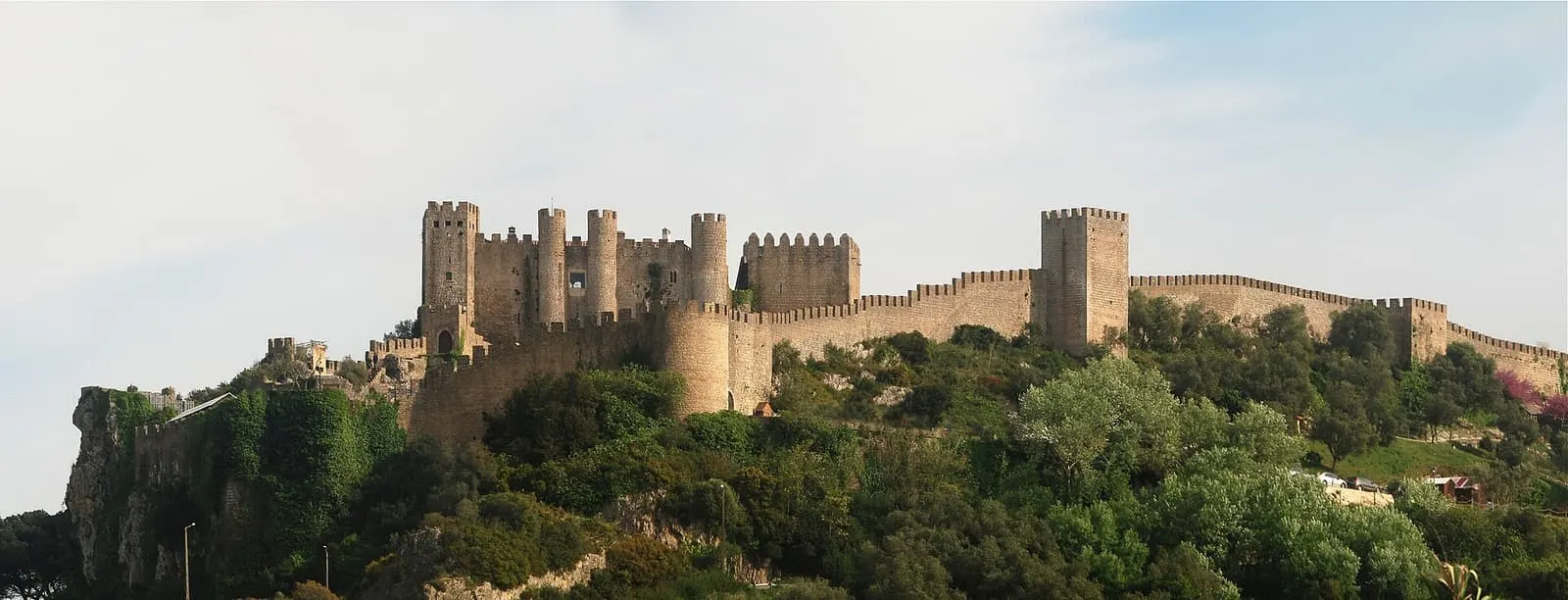
Few places in Portugal encapsulate the idea of a medieval town as well as Óbidos. Perched on a hill overlooking the western plains in the Leiria district, it preserves an almost intact walled enclosure embracing a labyrinth of narrow streets, whitewashed houses with blue or yellow trim, and climbing flowers. It is an urban ensemble that has endured nine centuries without losing its human scale or the coherence of its medieval design.
From Roman origins to Christian conquest
The site’s occupation predates the town we know today. Nearby lay Eburobrittium, a Roman civitas where remnants of a forum and baths have been excavated. After the 8th century, the Moors established a fortification atop the hill, taking advantage of its dominant position over the Óbidos Lagoon and coastal routes.
The town was taken from Muslim forces in 1148, during the expansion following Afonso Henriques’ conquest of Lisbon. In 1195, King Sancho I granted it a charter, establishing its status as a municipality. Subsequent reigns reinforced its fortifications: King Dinis remodeled the castle and walls, and King Fernando ordered the construction of the keep that still dominates the town’s silhouette today.
The Town of Queens
The most unique aspect of Óbidos’ history is its connection to the queens of Portugal. From the 13th century onward, the town and its lands frequently became part of the House of the Queens, offered as dowries or appanages to royal consorts. Tradition holds that King Dinis gifted it to Queen Isabel, and the list of noblewomen who oversaw it includes names like Philippa of Lancaster, Eleanor of Aragon, and Eleanor of Avis.
The queens’ care explains much of what survives: it was through royal female initiative that fountains were built, churches reconstructed, and water supply ensured to the town atop the hill.
In this spirit, Catherine of Austria, wife of King João III, commissioned the construction of the aqueduct in 1573, which, over roughly three kilometers, channeled water by gravity from the Usseira springs to the fountain in Santa Maria Square. Its successive arches still flank the town’s entrance.
The heritage within the walls
Inside the walls, the Castelo de Óbidos is the centerpiece—a complex of medieval towers and curtain walls that, since 1951, houses one of the country’s first historic inns. The town thus embodies the tradition of Portuguese walled towns, where urban walls are not just defenses but structuring elements of the landscape and collective memory.
The main entrance is through the Porta da Vila, with its 18th-century tile-covered oratory. Midway along Rua Direita stands the Igreja de Santa Maria, where, according to tradition, the young Afonso V married his cousin Isabel of Coimbra in 1444; its interior features tile panels and paintings attributed to Josefa de Óbidos, one of the greatest painters of the Peninsular Baroque, who lived and worked in the town.
Today, Óbidos combines rigorous preservation of its houses with a vibrant cultural life—from the Medieval Fair to the International Chocolate Festival and the literary festival FOLIO, which earned it UNESCO recognition as a Creative City of Literature. A few kilometers away, the nearby spa town of Caldas da Rainha extends this heritage geography linked to Portuguese queens in the western region.
Frequently asked questions
- Why is Óbidos known as the Town of Queens?
- Since the reign of King Dinis, Óbidos was frequently part of the dowry or lands of the House of the Queens of Portugal. Several queens—from Queen Isabel to Catherine of Austria—promoted works and improvements in the town, which became linked to the protection and heritage of royal consorts.
- When was Óbidos taken from the Moors?
- The town was conquered from the Moors in 1148, during the expansion of Afonso Henriques after the capture of Lisbon. It received its charter from King Sancho I in 1195.
- Is it possible to walk along Óbidos' walls?
- Yes. The medieval walls remain largely intact, and the wall walk can be traversed on foot in a circuit around the town, offering views of the whitewashed houses and the plains of Várzea da Rainha. The path lacks guardrails in some sections, requiring caution.
Sources
Keep exploring
Heritage nearby
More places to discover from here. Approximate straight-line distances, within 50 km.