Monuments
Óbidos Castle
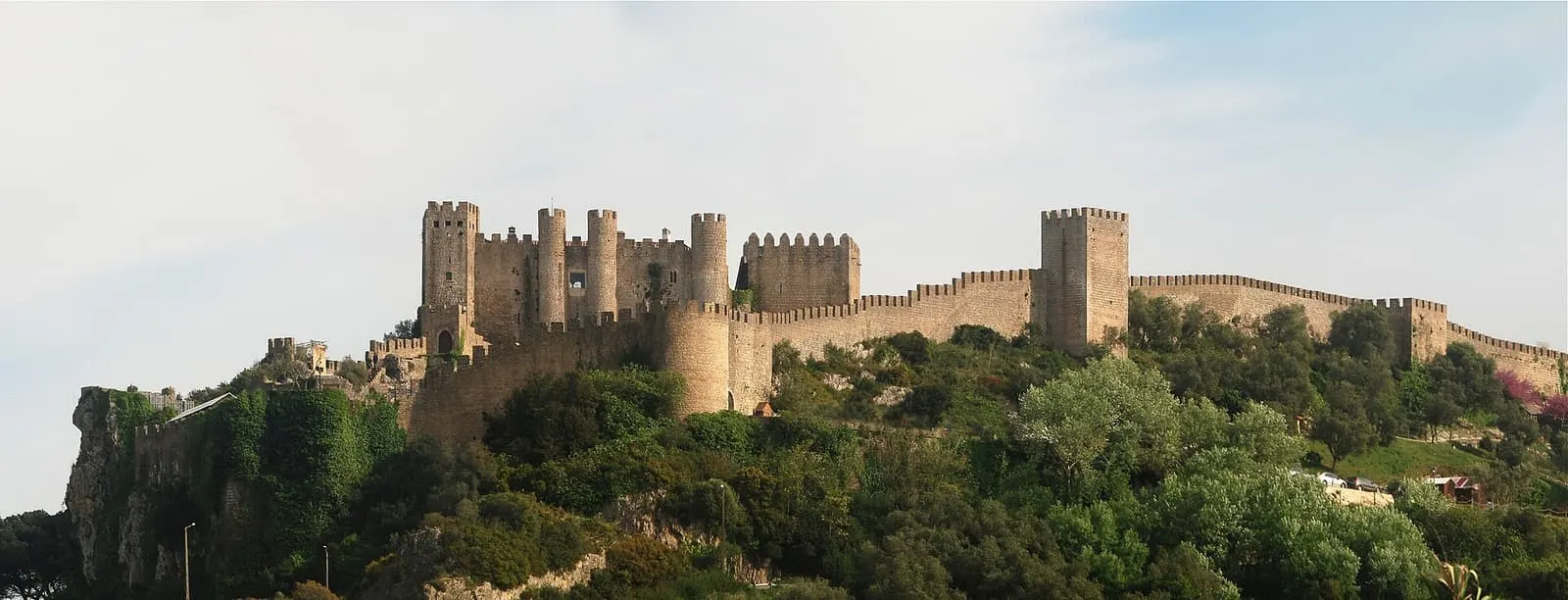
Óbidos Castle: medieval fortress and town walls of the 'town of the queens', a National Monument in western Portugal, today a historic inn in Óbidos.
- Location
- Óbidos, Leiria
- Built
- séc. XII–XIV
- Style
- Românico, Gótico, Manuelino e Barroco
Óbidos Castle crowns the hill on which stands one of the best-preserved medieval towns in Portugal. More than an isolated fortress, the complex comprises the castelejo — the military stronghold proper — and the town walls, a ring of ramparts that entirely encloses the white houses. Located in the west of the country, in the municipality of Óbidos (district of Leiria), it has been classified as a National Monument since 1910.
From the Reconquista to the queens’ dowry
The site is thought to have been occupied successively since prehistory, with fortifications attributed to the Muslim period. Within the framework of the Reconquista, after Santarém and Lisbon were taken in 1147, the forces of King Afonso Henriques met fierce resistance at Óbidos, which fell only by a ruse on 10 January 1148. The castle is documented from 1153 onward.
The town’s destiny was sealed in 1282, when King Dinis gave it to Queen Saint Isabel as a wedding present. From that gesture onward, Óbidos became part of the dowry of every queen of Portugal, a status it retained until 1834 and which earned it the name “town of the queens”. It was under King Dinis that much of the military structure was consolidated, including the imposing keep.
The originality of Óbidos lies not in a tower or a gateway, but in the rare fact that the wall continues to embrace the entire town, turning the settlement into a continuous monument that can be walked on foot.
A palimpsest of styles
The successive building campaigns left within the enclosure a superimposition of architectural languages. To the Romanesque and Gothic matrix of the medieval fortress were added Manueline refinement — visible in windows, portals and sixteenth-century heraldry — and Baroque elements introduced after the damage of the 1755 earthquake. The result is a palimpsest that can be read in the stones, from the seigneurial palace to the battlements.
The town walls, with a perimeter of about a kilometre and a half, are punctuated by turrets and gates, the Porta da Vila, faced with eighteenth-century tilework, being the most famous entrance. This use of azulejo work as a decorative language places Óbidos within a tradition that runs throughout Portuguese heritage.
From ruin to inn
A victim of neglect and of the 1755 earthquake, the castle was the subject of major restoration campaigns from 1932 onward. In 1951, the keep was converted into a historic inn, becoming one of the first national examples of the rehabilitation of a military monument for tourist purposes. Today, the complex is one of the most visited heritage destinations in the country.
For its scale and state of preservation, Óbidos Castle ranks among the landmarks of medieval Portuguese military architecture, alongside fortresses such as Leiria Castle, with which it shares the historic frontier of Estremadura, or the emblematic São Jorge Castle, in Lisbon.
Frequently asked questions
- Can you stay overnight at Óbidos Castle?
- Yes. The keep was converted into a historic inn in 1951, and it is possible to spend the night within the fortified enclosure. The town walls and ramparts are freely accessible.
- Why is Óbidos called the 'town of the queens'?
- In 1282, King Dinis gave Óbidos to his wife, Queen Saint Isabel. From then on, the town and its castle formed part of the dowry of the queens of Portugal until 1834.
- When was it conquered from the Moors?
- Óbidos was taken by King Afonso Henriques on 10 January 1148, by means of a stratagem, in the context of the Reconquista that followed the conquest of Lisbon.
Sources
Keep exploring
Heritage nearby
More places to discover from here. Approximate straight-line distances, within 50 km.