Monuments
Palace of the Counts of Vila Flor
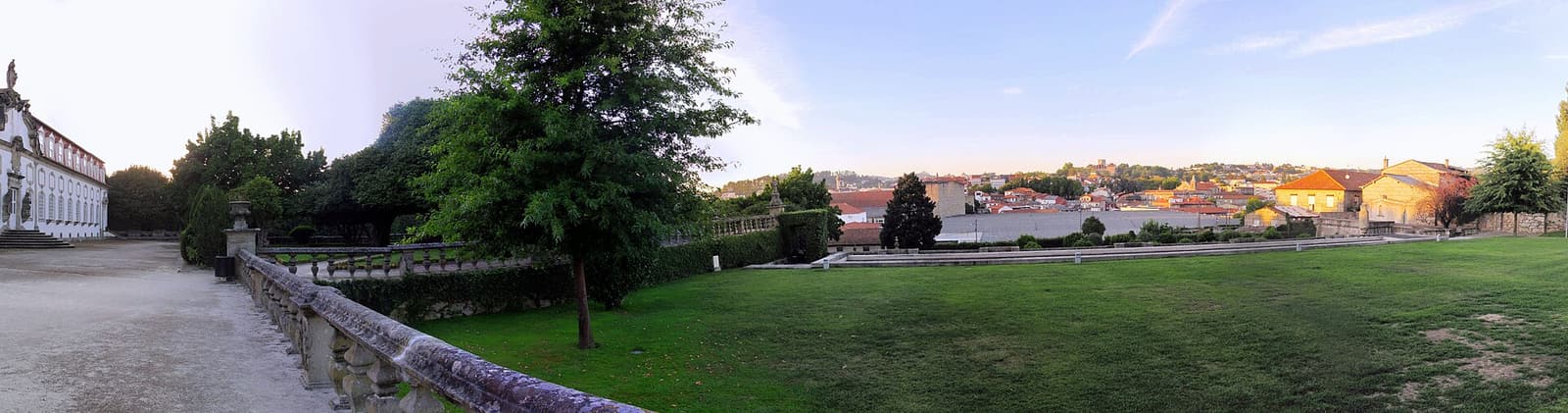
18th-century Baroque palace in Guimarães, in the parish of Urgezes, now the Vila Flor Cultural Centre, overlooking landscaped gardens facing the Toural square.
- Location
- Guimarães, Braga
- Built
- século XVIII
- Style
- Barroco
The Palace of Vila Flor, in Guimarães, is an 18th-century Baroque manor house located in the parish of Urgezes, on terraced gardens descending towards the historic centre of the city. Commissioned by the nobleman Tadeu Luís António Lopes de Carvalho de Fonseca e Camões, the building combines the sobriety of 18th-century civil architecture from Minho with the scenic staging typical of the Baroque, organised around a main façade facing a vast terraced garden, punctuated by staircases, statuary, and ponds.
History
Construction began in the first half of the 18th century and was continued, after the death of its promoter, by the Jordão family. In 1750, its gardens hosted the celebrations commemorating the acclamation of King D. José I, an episode that links the palace to the city’s great ceremonial events. Later, the property passed to the House of the Counts of Vila Flor, a title that eventually fixed the name by which the manor is known today.
The 19th century brought it significant symbolic importance. In 1853, Queen D. Maria II was hosted here, and by decree of 23 June of that year, the town of Guimarães was elevated to the status of a city. Decades later, in 1884, the palace hosted the First Industrial and Commercial Exhibition of Guimarães, an event that documented the economic vitality of a city then in full industrial development. In 1976, the complex was acquired by the Guimarães City Council and even temporarily housed the initial facilities of the University of Minho.
From Manor House to Cultural Centre
In the first decade of the 21st century, the local authority promoted the complete restoration of the palace and its gardens, completed in 2005. The intervention preserved the Baroque manor house and added, from scratch, a new building for performances and concerts, which came to coexist with the 18th-century pre-existence without altering its character. From this ensemble emerged the Vila Flor Cultural Centre, equipped with two auditoriums — one with around 800 seats and another with approximately 200 — and featuring a regular programme of music, theatre, and dance.
The operation became one of the pillars of Guimarães’ bid and programme as European Capital of Culture in 2012, affirming the model of heritage reuse as active cultural infrastructure. Today, the palace is part of the city’s monumental itinerary, alongside landmarks such as the Guimarães Castle and the Palace of the Dukes of Bragança, reinforcing the ensemble that makes Guimarães one of the densest historic centres in northern Portugal.
Heritage Significance
The Palace of Vila Flor illustrates the continuity between Baroque aristocratic architecture and contemporary uses of built heritage. Its articulation between manor house, terraced garden, and new cultural facility constitutes a recognised example of careful adaptation, where the aristocratic and ceremonial memory of the building remains legible while serving a public and cultural function. The complex is listed in the Portuguese architectural heritage information systems and is part of the extended area of Guimarães’ historic centre.
Frequently asked questions
- What is the Palace of Vila Flor today?
- It is the headquarters of the Vila Flor Cultural Centre in Guimarães. The 18th-century Baroque manor house was restored in 2005 and now coexists with a new performance building, equipped with two auditoriums, erected in the former gardens.
- Where is the Palace of Vila Flor located?
- In the parish of Urgezes, in Guimarães, Braga district, near Avenida D. Afonso Henriques and close to Largo do Toural.
- Why is it called the Palace of the Counts of Vila Flor?
- The title of Count of Vila Flor became associated with the property in the 19th century; the manor house was commissioned by the nobleman Tadeu Luís António Lopes de Carvalho de Fonseca e Camões and later inherited by the Jordão family.
Sources
Keep exploring
Heritage nearby
More places to discover from here. Approximate straight-line distances, within 50 km.