Themes
Gilded Woodcarving
Portuguese gilded woodcarving: sculpted wood covered in gold leaf on Baroque altarpieces, from the national style to the Joanine and Rococo periods.
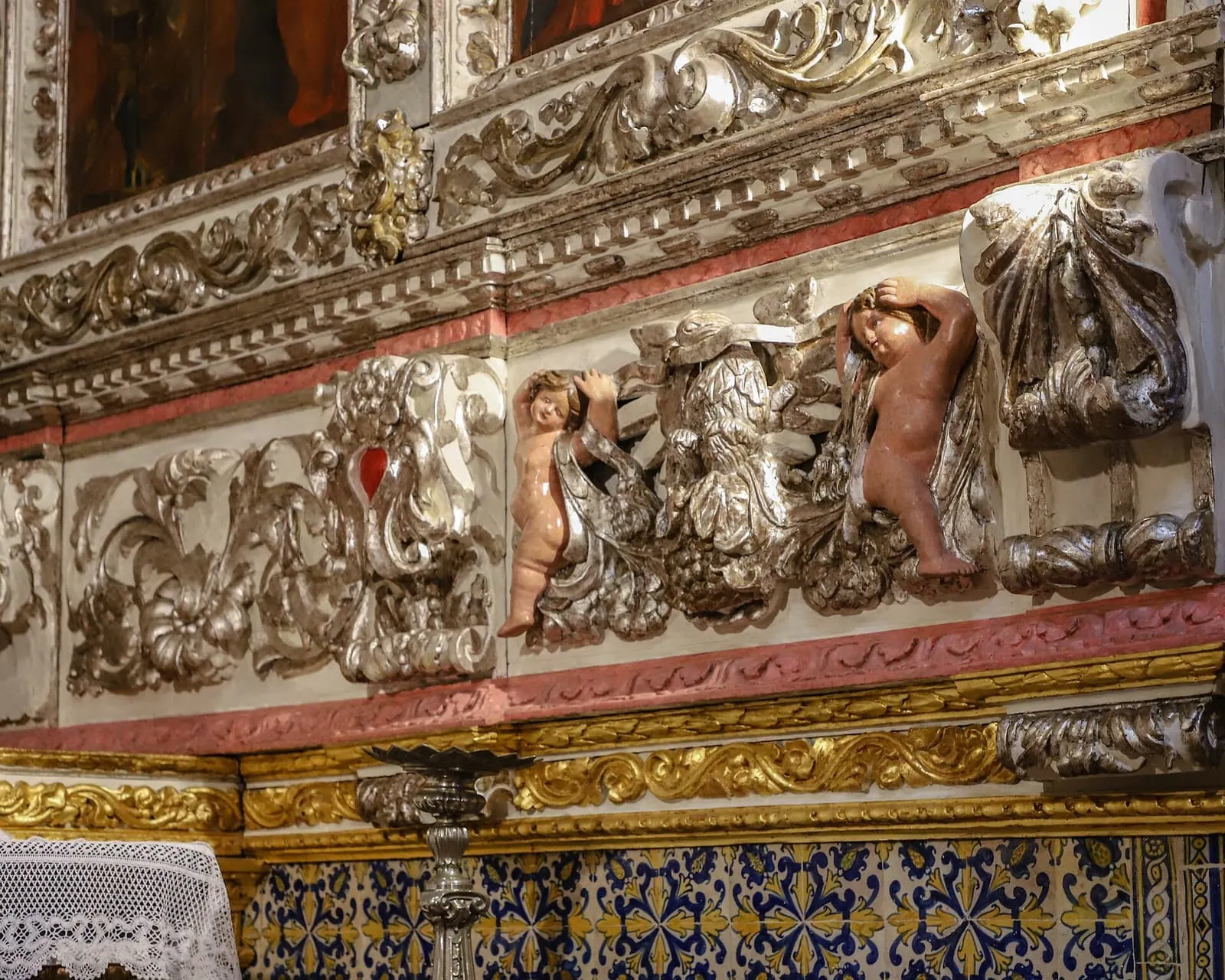
Gilded woodcarving is the art of carving wood and covering it with gold, transforming the interiors of Portuguese churches into luminous settings. Alongside azulejo tiles, it stands as one of the most original creations of the nation’s artistic heritage: not an imported technique applied unchanged, but a distinct language, matured over more than a century and elevated to a virtuosity rarely matched in Europe.
Its origins predate the Baroque. Already in the Gothic period, and especially during the Manueline and Renaissance eras, altarpieces were gilded following models from sculpture and goldsmithing. However, it was in the challenging context following the Restoration of 1640 that gilded woodcarving found its decisive role. In times of scarce resources, covering an altar with carved and gilded wood was more economical than commissioning painted panels or sculptural groups—and the effect of magnificence was nonetheless overwhelming.
From the national style to Rococo
Historiography distinguishes several successive phases, each with its own ornamental grammar.
The national style, which emerged between the second half of the 17th century and the early 18th century, is defined by twisted columns, abundantly covered with acanthus leaves, grape clusters, and birds—often the Eucharistic pelican—and by crowning concentric arches. It was during this phase that Portuguese woodcarving clearly distinguished itself from Spanish models.
Next came the Joanine style, associated with the reign of João V and Brazilian gold. Ornamentation multiplied, angels became almost sculptural, swags, false drapery, and garlands appeared, and gold coexisted with white polychromy. This was the peak of opulence, with woodcarving covering entire vaults and walls. This impulse, explored in depth on the page dedicated to Joanine Baroque, finds its most famous expression in Porto.
By the mid-18th century, the taste for Rococo in Portugal prevailed: compositions lightened, motifs became asymmetrical—shells, ribbons, flowers, and garlands—and white backgrounds highlighted selective gilding. Finally, with Neoclassicism, woodcarving lost prominence and returned to the sobriety of classical repertoires.
In a land without major marble quarries, it was wood covered in gold that gave Portuguese churches their splendor—a wealth born of carvers’ skill, not rare stone.
The technique of gilding
The process was demanding and workshop-intensive. Over the carved wood—typically chestnut or oak—a layer of plaster was applied, followed by bole (a reddish clay), which served as a bed for the gold. The extremely thin beaten gold leaf was then laid and burnished, producing the characteristic metallic shine. The scale of the undertaking could be colossal: in Porto’s Church of São Francisco, an interior almost entirely covered in woodcarving, nearly one hundred kilograms of gold are said to have been used.
This production mobilized a network of crafts—carvers, assemblers, gilders, polychromers—and gave rise to regional centers of great creativity, particularly in the North. At its peak, woodcarving was the centerpiece of Baroque architecture in Portugal, integrating with painting, sculpture, and azulejos in a unified decorative program.
A legacy that endures
Gilded woodcarving accompanied Portuguese expansion, flourishing intensely in Brazil, where it developed remarkably vibrant local variants. In Portugal, an immense heritage survives, from the humblest chapels to grand urban churches, and it remains an essential chapter of Portuguese decorative arts. Preserving and studying it means understanding an era when faith, gold, and artisans’ ingenuity merged into one of the most luminous episodes in European art.
Frequently asked questions
- What is gilded woodcarving?
- It is ornamental sculpture in carved wood covered with gold leaf, used primarily in altarpieces, pulpits, and interior decorations of Portuguese Baroque churches. Alongside azulejo tiles, it became one of the most original expressions of national art.
- What are the phases of gilded woodcarving in Portugal?
- Four major periods are distinguished: the national style (c. 1640-1700), with twisted columns and foliage; the Joanine style (c. 1700-1750), marked by sculptural exuberance; the Rococo (c. 1750-1780), with asymmetrical motifs and white backgrounds; and the Neoclassical, signaling ornamental decline.
- Was the leaf actually made of gold?
- Yes. The carved wood—typically chestnut or oak—was prepared with plaster and bole, upon which beaten gold leaf was applied. In Porto's Church of São Francisco, nearly one hundred kilograms of gold are said to have been used.