Periods & Styles
Rococo in Portugal
Rococo in Portugal: the light and asymmetrical taste of the mid-18th century, featuring André Soares, gilded woodcarving, and the churches of Braga and the North.
- Built
- c. 1740–1780
- Style
- Rococó
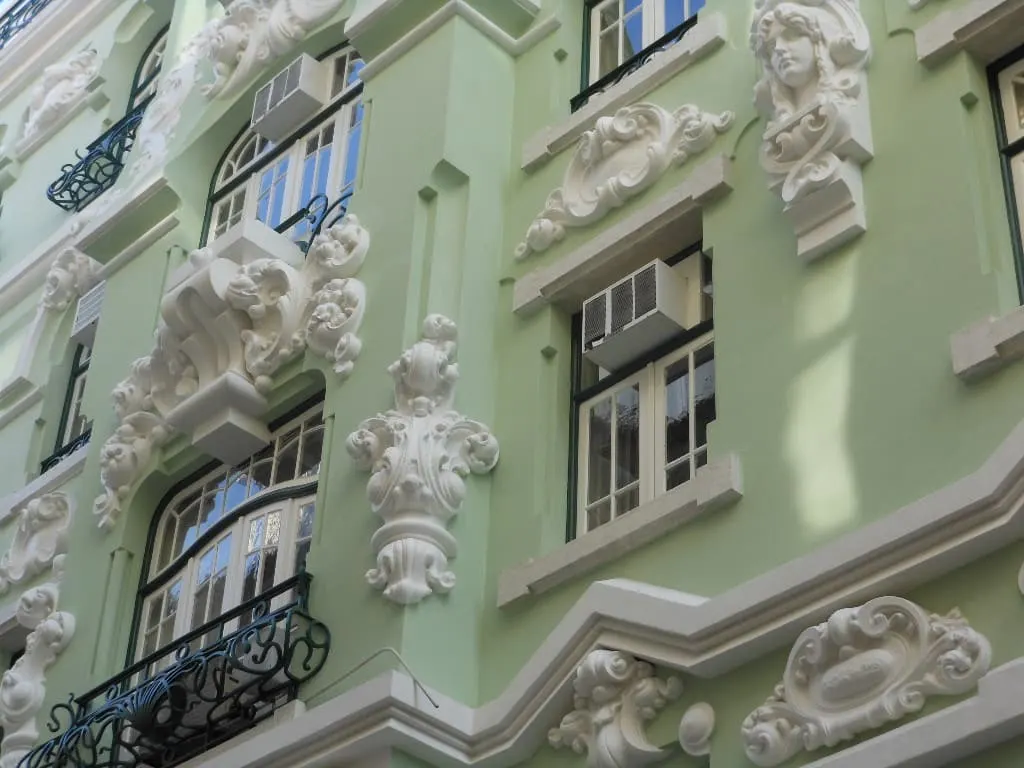
Rococo arrived in Portugal around 1740 as a final inflection of Baroque taste: lighter, more intimate, and decidedly asymmetrical. The term derives from the French rocaille—the work of shells and irregular stones that adorned grottoes and fountains—and it is in this grammar of shell motifs, scrolls, and acanthus leaves that its signature lies. Instead of the solemn monumentality of Joanine Baroque, Rococo seeks grace, undulating movement, and surprise, in decoration that seems never to rest.
A Portuguese version, from granite to woodcarving
Unlike in France or Bavaria, Rococo in Portugal was never a fully developed court style. Instead, it adapted to the country’s temperament and materials: the dark granite of the North, carved into dynamic frames, contrasts with the whitewashed walls, giving façades a graphic and vigorous design. Inside churches, gilded woodcarving reaches one of its most inventive moments, with sinuous altarpieces, angels in motion, and ornamental profusion covering entire walls in gold.
Portuguese Rococo is less an imported style than a translation: Parisian rocaille, filtered through German engravings from Augsburg, gains in Braga the hard temper of granite and the glow of gilded woodcarving.
Braga and the Northwest, capitals of Rococo
The great center of national Rococo was Minho, and particularly Braga. The devastation of Lisbon by the 1755 earthquake—and the urgency of Pombaline reconstruction, already more sober in style—shifted the creative energy of the period to the intact North. The central figure was André Soares (1720–1769), a self-taught Braga native who developed his vocabulary from Central European prints and imposed it with extraordinary coherence. His works include Casa do Raio (1754–1755), the exuberant façade of Igreja dos Congregados, Casa da Câmara, Arco da Porta Nova, and the sanctuary of Santa Maria Madalena da Falperra.
Around Soares, an entire school formed. The Benedictine friar Frei José de Santo António Vilaça executed, between 1757 and 1760, the woodcarving of the Monastery of São Martinho de Tibães—a major reference for wood sculpture of the time—and spread the taste throughout Entre-Douro-e-Minho. The monumental staircase of Bom Jesus do Monte, with its terraces and allegorical fountains, also belongs to this universe of staged devotion. In Porto, the theatrical lesson of Nicolau Nasoni had already prepared the ground for the rocaille taste.
Lisbon, Queluz, and the twilight of the style
In the South, Rococo had a more restrained expression. Its greatest monument is the Palácio Nacional de Queluz, begun in 1747 for the Infante Dom Pedro: Mateus Vicente de Oliveira designed the main body, and the Frenchman Jean-Baptiste Robillon created the west wing and gardens, in a refinement of Versailles-inspired elegance that is the closest Portugal came to a European-style palace Rococo. In Lisbon, some churches built after the earthquake and decorative elements of the Basilica da Estrela prolonged the taste until the end of the century.
By the 1770s and 1780s, curves and asymmetry gave way to straight lines, symmetry, and the restraint of Neoclassicism, which, with the Royal Academy and the reign of Dona Maria I, definitively closed the cycle. Yet Rococo left a singular legacy: the Braga ensemble by André Soares ranks among the masterpieces of the style on a European scale and establishes Braga as one of the cities where rocaille took deepest root outside its French cradle.
Frequently asked questions
- Who was the main architect of Portuguese Rococo?
- André Soares (1720–1769), a native of Braga, is considered the foremost figure of Rococo in Portugal. Self-taught, he translated the grammar of rocaille into granite and woodcarving, with works such as Casa do Raio, Igreja dos Congregados, and the Falperra sanctuary.
- Where is the best of Rococo in Portugal concentrated?
- In the Northwest, especially in Braga, Guimarães, and Porto, spared by the 1755 earthquake. There, exuberant gilded woodcarving flourished, along with a unique collection of churches, chapels, and civil buildings.
- What is the difference between Rococo and Joanine Baroque?
- Joanine Baroque, from the first half of the 18th century, is monumental, symmetrical, and heavy; Rococo, which followed, is lighter, asymmetrical, and more graceful, dominated by shell-like motifs and acanthus leaves.