Periods & Styles
Baroque Architecture and Art in Portugal
Baroque architecture and art in Portugal (17th-18th centuries): from the sobriety of the Plain Style to the Joanine opulence of gilded woodcarving, azulejo and…
- Built
- séculos XVII-XVIII
- Style
- Barroco
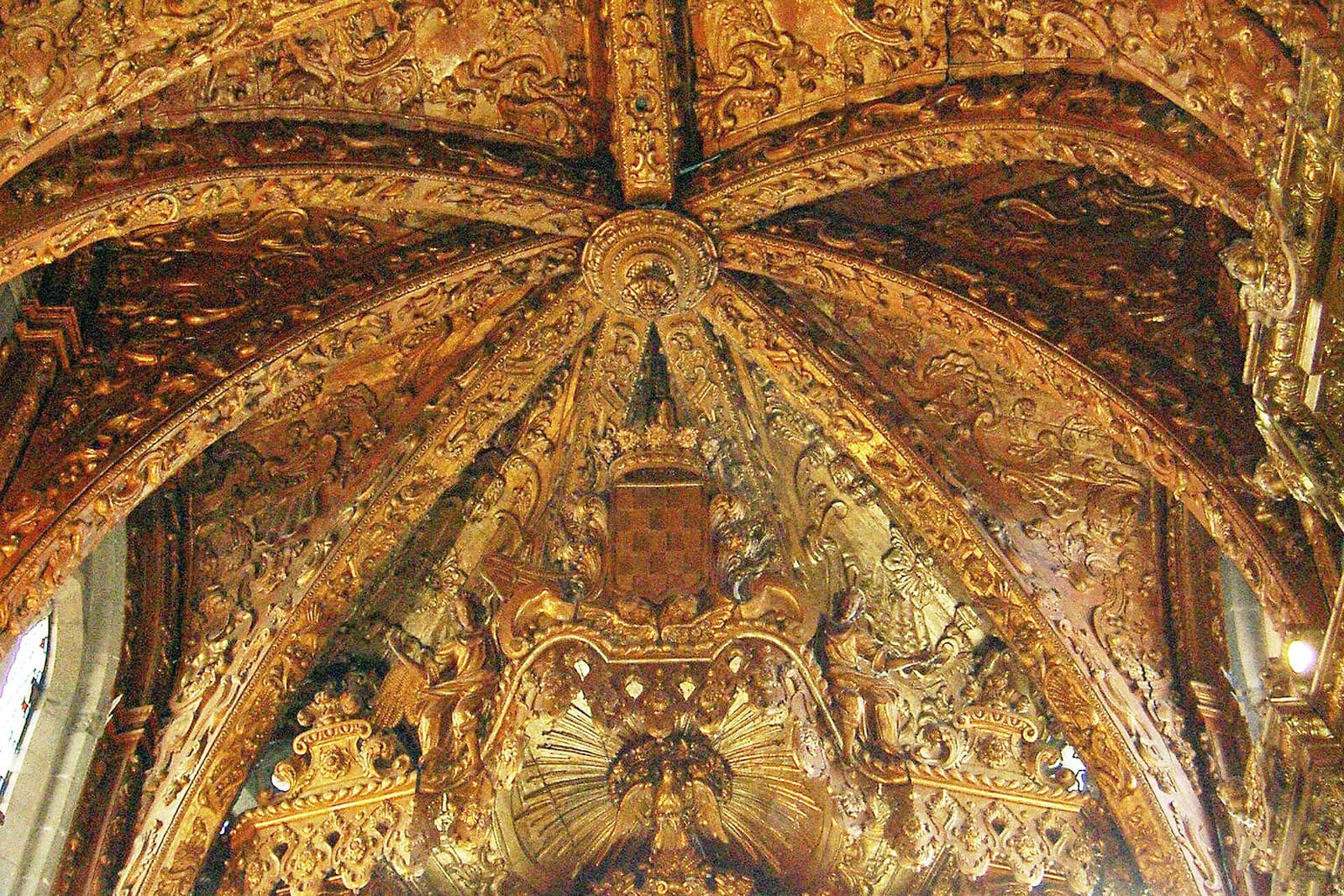
In Portugal, the Baroque is above all an art of interiors. While in other European regions the style asserted itself through the theatricality of undulating façades and the movement of stone masses, the Portuguese Baroque developed its most original language inside churches, where entire walls disappear beneath gilded woodcarving and the gleam of the altarpieces. The style spanned some two centuries, with roots in the late seventeenth century and full maturity throughout the eighteenth, and its particular chronology is explained by political and economic factors: the financial strain of the Restoration War, after sixty years of the Iberian Union, delayed the adoption of a costly decorative vocabulary.
From the sobriety of the Plain Style to exuberance
The early period inherits the restraint of the so-called Plain Style, of Mannerist and Jesuit derivation: churches with a single nave, a deep chancel, lateral chapels and unadorned façades. Upon this sober architecture, however, Baroque taste went on accumulating ornament. The great protagonist is gilded woodcarving, a technique in which sculpted wood is covered with gold leaf, applied to altarpieces, triumphal arches and tribunes until the space is wholly clad — the so-called “interior in gold”. The woodcarving of the North, in particular, took on national characteristics that would culminate in the Joanine phase.
Alongside it, the azulejo asserts itself as the second great covering. The figurative blue-and-white panels, narrative and monumental, converse with the woodcarving and complete iconographic programmes of enormous density. This combination of gold and blue became one of the most recognisable signatures of Portuguese religious heritage.
The Joanine Baroque and the cycle of Brazilian gold
The reign of King João V (1707-1750) marks the apogee of the style. The gold and diamonds of Brazil financed patronage on a grand scale and opened Portugal to the direct influence of Rome. From this period comes the Joanine Baroque, a collective name for several currents that coexisted in the country. The greatest monument is the Convent of Mafra, designed by the German-born architect João Frederico Ludovice and raised between 1717 and 1730 — at once palace, basilica and monastery, with its basilica in polychrome marbles and a carillon of European fame.
The originality of the Portuguese Baroque lies not in structural rupture, but in the capacity to transform the interior of the temple into a total space, where architecture, sculpture, woodcarving and azulejo merge into a single sensory experience.
In the North, the Italian Nicolau Nasoni introduced a more dynamic plasticity. His masterpiece, the Clérigos Church and Tower in Porto, with the church’s elliptical plan and the tallest bell tower in the country, shows how the Baroque could also conquer the city and the exterior.
From the Rococo to the twilight of the style
In the mid-eighteenth century, the Baroque evolved into a lighter and more asymmetrical register. The Rococo in Portugal, with its epicentre in Braga and in the work of André Soares, found expression in shellwork, volutes and a more graceful decoration, before neoclassical taste and Pombaline rationality imposed new references. Even so, the Baroque legacy remains structuring in the Portuguese landscape: from the parish churches of the interior to the great sanctuaries, it is the style that most densely populates the territory with woodcarving, azulejo and architecture in the service of faith and of the representation of power.
Frequently asked questions
- What sets the Portuguese Baroque apart from other European Baroques?
- Instead of the plastic exuberance of the curved Italian or German façades, the Portuguese Baroque favoured interior richness: complete coverings of gilded woodcarving and of blue-and-white azulejo over often sober architectural structures, heirs to the Mannerist Plain Style.
- What is the Joanine Baroque?
- It is the golden age of the Baroque in Portugal, associated with the reign of King João V (1707-1750) and financed by the gold and diamonds of Brazil. It is marked by monumental decorative schemes and by the influence of Roman art, visible at Mafra and in the Chapel of St John the Baptist at São Roque.
- Who were the main architects of the Portuguese Baroque?
- Outstanding among them are João Frederico Ludovice, designer of the Convent of Mafra; the Italian Nicolau Nasoni, active in Porto and author of the Clérigos Tower; and André Soares, a leading figure of the Braga Rococo.