Periods & Styles
Joanine Baroque
The Joanine Baroque, the courtly and theatrical art of the reign of King John V in Portugal, with Mafra, Nasoni and the opulent gilded carving funded by…
- Built
- 1706–1750
- Style
- Barroco
The Joanine Baroque designates the set of artistic currents that coexisted in Portugal during the long reign of King John V (1706–1750). It is not a unified style but a phase: that in which Portuguese baroque abandoned the sobriety of the so-called “national style” to embrace a courtly, theatrical and deeply cosmopolitan vocabulary, shaped by the taste of the monarch himself and by the admiration he nurtured for Rome.
Brazilian gold and royal patronage
The material condition that made this flourishing possible was the cycle of Brazilian gold and diamonds, which filled the royal treasury in the first decades of the eighteenth century. Freed from immediate financial pressures, John V converted colonial wealth into magnificence: he commissioned monumental works, imported foreign artists, had the Chapel of Saint John the Baptist built in Rome only to have it transported and reassembled in Lisbon, and made splendour a strategy of diplomatic assertion. The result was a baroque less restrained and more Roman than anything that had preceded it in Portugal.
The Joanine Baroque was not born of a reform of taste but of a circumstance: for the first time, the Portuguese crown had the means to match, in stone and gold, the scenic ambition of the great Catholic courts of Europe.
North and South: two poles, several hands
The period is distinguished by the diversity of origins of its protagonists, who gave the same era distinct regional accents. In the North, the Italian Nicolau Nasoni introduced a scenographic language, plastic and full of movement, of which the Church and Tower of the Clérigos, in Porto, is the greatest testimony; his influence extended to Braga, above all through André Soares. In the South, the German João Frederico Ludovice brought the monumentality and rigour of Central European baroque, embodied in the Convent of Mafra, inspired by the model of the Escorial and by Roman architecture.
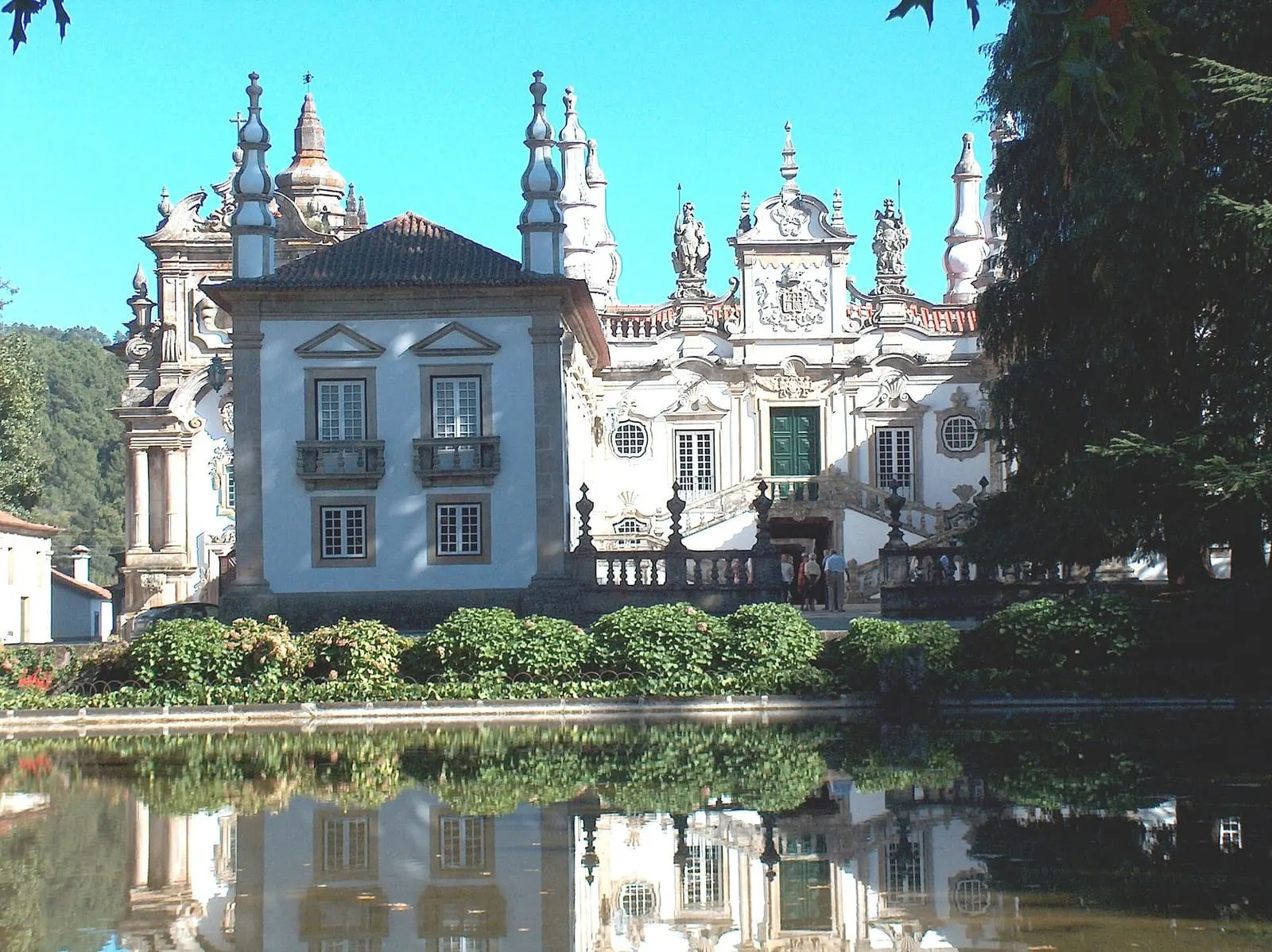
Alongside these two great undertakings, the reign left other landmark works, such as the Águas Livres Aqueduct, a feat of engineering and urban scenography that supplied Lisbon, and noble residences such as the baroque manor of Vila Real.
Gilded carving as the signature of the period
If Joanine architecture was the work of few and of great budgets, its most widespread and popular expression was gilded carving. It is in the interior of churches that the style reveals itself in all its fullness: altarpieces covering entire walls with carved wood overlaid with gold, peopled with twisted columns, cherubs, birds, atlantes and festoons. In relation to the previous period, the acanthus recedes and gives way to cartouches, arabesques, volutes and vegetal scrolls, frequently combined with azulejo, painting and sculpture in a total decorative programme.
This “Joanine” carving became the most recognisable face of Portuguese baroque and the starting point for the subsequent evolution of taste, which would lead, from the middle of the century, to the asymmetrical lightness of the rococo. The Joanine Baroque thus fixed the mental image that we still associate today with baroque in Portugal: that of the gilded interior, dense and luminous, where faith, royal power and overseas wealth meet in a single setting.
Frequently asked questions
- What is the Joanine Baroque?
- It is the name given to the artistic currents that flourished in Portugal during the reign of King John V (1706–1750), marked by a courtly, theatrical and cosmopolitan baroque, sustained by the wealth of Brazilian gold.
- Why is it called 'Joanine'?
- The name derives from King John V (João V), the monarch whose patronage and taste for Roman magnificence defined the style. 'Joanine' means, literally, relating to John.
- What is the most emblematic work of the Joanine Baroque?
- The Palace and Convent of Mafra, designed by João Frederico Ludovice, is the largest and most sumptuous achievement of the period, although the gilded carving of the churches is its most widespread expression.