Archaeology
Roman Villa of Pisões
Discover the Roman villa of Pisões near Beja: mosaics, baths and a large outdoor pool. Explore its history, location and contacts for planning your visit.
- Location
- Beja, Beja
- Built
- 1st–4th centuries AD (main Roman phase)
- Style
- Roman architecture
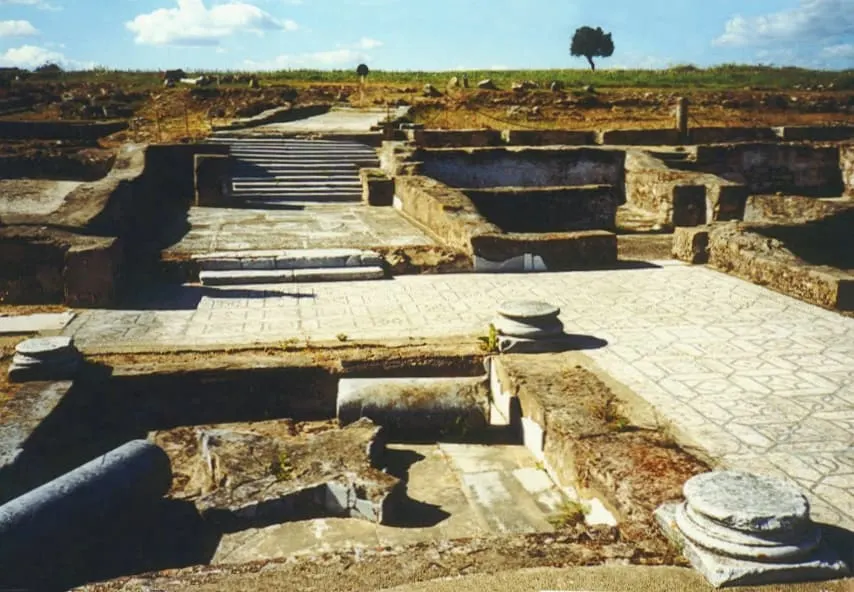
The Roman villa of Pisões, on the Herdade da Almagrassa estate about 10 km southwest of Beja, preserves evidence of housing, bathing and water management on a Roman rural property. The excavated area reveals the owners’ investment in comfort and decoration, but represents only part of a larger complex.
Pisões is in the Alentejo. The villa of Rabaçal, in Coimbra district, is a different archaeological site: the two residences invite comparison but belong to different regional landscapes.
The residence and its mosaics
The residential area, or pars urbana, is arranged around a small peristyle. The University of Évora’s archaeological itinerary identifies 48 rooms, with surviving mosaics, marble coverings and stucco. The courtyard and connections between rooms help explain movement through a house that also served to receive visitors.
Partial excavation calls for careful interpretation: the visible remains do not necessarily include every building on the estate. Compare the residential plan with productive areas discussed in the guide to Lusitanian villas.
Following the water
The baths preserve elements of a heating system that circulated hot air beneath the floors. South of the house is an outdoor swimming pool, or natatio, about 40 m long and 8.3 m wide. The dam to the north and the aqueduct formed part of the supply for baths and reservoirs.
Reading these elements together shows how central water infrastructure was to the villa. Its uses extended beyond drinking water to bathing, leisure and spaces that required a regular supply.
Discovery, chronology and protection
The site was discovered during agricultural work in 1967 and classified as a Property of Public Interest in 1970. The university itinerary places its main Roman occupation between the first and fourth centuries AD; the university also mentions material extending into the Visigothic period. These references should not be read as a single construction date for all the buildings.
Planning a visit
The University of Évora manages Pisões. Its official visitor page, checked on 2 October 2026, requests bookings at [email protected]. Confirm current times and conditions: institutional pages give different information about the lunchtime interval.
The reception centre offers interpretation resources. The university itinerary mentions mobility assistance using an electric buggy; confirm its availability and suitability for your needs beforehand. Combine the visit with Beja or, on another outing, São Cucufate in Vidigueira.
Frequently asked questions
- Where is the Roman villa of Pisões?
- It is on the Herdade da Almagrassa estate, also called Algramaça, about 10 km southwest of Beja in the Alentejo. It is separate from the villa of Rabaçal in Coimbra district.
- What can you see at Pisões?
- The partially excavated residential area preserves a peristyle, mosaics and numerous rooms. The baths and large outdoor pool are further highlights; the dam and aqueduct explain the water supply.
- How do I arrange a visit?
- The University of Évora manages the site and requests advance bookings. Confirm availability, opening times and visiting conditions at [email protected] before travelling.
- What is its heritage designation?
- The villa was classified as a Property of Public Interest under Decree 251/70, published on 3 June 1970.
Sources
Keep exploring
Heritage nearby
More places to discover from here. Approximate straight-line distances, within 50 km.