Archaeology
Roman Villa of Torre de Palma
The Roman villa of Torre de Palma in Monforte was one of the largest in Lusitania, renowned for its Muses and Horses mosaics and its Paleochristian basilica.
- Location
- Vaiamonte (Monforte), Portalegre
- Built
- Séculos I–IV d.C.
- Style
- Arquitetura romana (villa)
The Roman villa of Torre de Palma stands on the estate of the same name, a few kilometres from Monforte, in the parish of Vaiamonte, in Alto Alentejo. It was one of the largest known agricultural estates in the province of Lusitania: a vast rural domain (latifundium) with a manor residence, olive presses, granaries, and productive dependencies, continuously occupied between the 1st and 4th centuries AD, with traces extending into Late Antiquity. Classified as a National Monument since 1970, it is now an essential reference for the study of the Roman rural world in the Iberian Peninsula.
A Family and an Estate
The site is linked to the Basilii family, known from an inscription found on the premises. These landowners were responsible for the construction of a spacious and refined residence, organised around courtyards and reception areas befitting the status of a provincial elite enriched by agricultural production and, it seems, horse breeding. The scale of the complex — residential area, baths, olive press zone, and necropolis — reveals a complex community that extended far beyond the dominus’s house.
The villa is part of the dense network of rural estates in inland Alentejo, which includes other major sites such as the Roman villa of Pisões, near Beja, or the Roman villa of São Cucufate, and is closely related to the urban nucleus of the Roman city of Ammaia, at the foot of the Serra de São Mamede.
The Mosaics of the Muses and the Horses
The fame of Torre de Palma is largely due to its mosaic pavements, among the most remarkable in Portuguese territory. In the triclinium, or banquet hall, the Mosaic of the Muses was discovered, featuring figures from Greco-Roman mythology accompanied by their names — a late composition attributed to an itinerant workshop of North African tradition. In a triple-apsed reception room, the Mosaic of the Horses was found, depicting five equids identified by their names, likely evidence of horse breeding practiced on the estate.
The names inscribed next to the figures and horses make these mosaics rare documents of the culture and daily life of a Lusitanian-Roman rural elite.
Both pavements were removed during excavations and have since been part of the collection of the National Museum of Archaeology in Lisbon, where they were classified as national treasures. Their relocation preserved them but removed them from their original context, a recurring issue in the musealisation of Portuguese archaeological heritage.
From Villa to Paleochristian Basilica
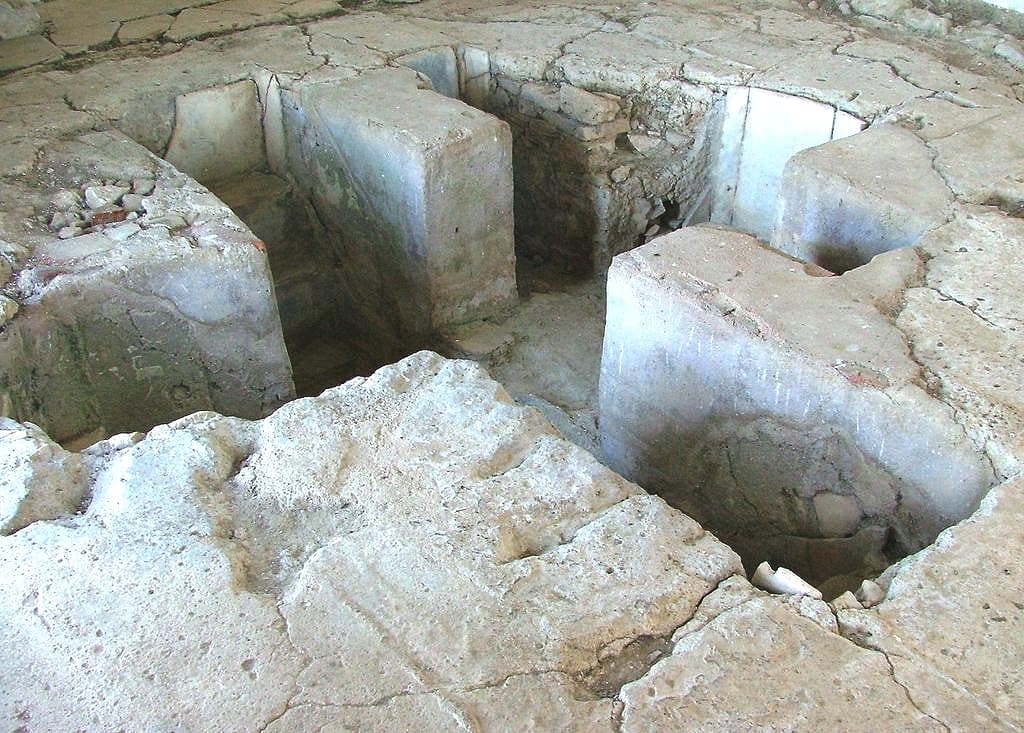
The late occupation of the site is marked by the construction of a Paleochristian basilica, probably from the 4th century, with three naves and a double and opposed apse — a rare solution, among the oldest of its kind in the Christian world. It was associated with a Lorraine cross-shaped baptistery, with opposing stair flights, considered one of the most elaborate in the Iberian Peninsula. This building documents the transition from Roman rural space to a Christian place of worship, in a process of continuity shared by many villae in Lusitania.
The ruins were identified in 1947 and systematically excavated until 1956 under the direction of archaeologist Manuel Heleno, then director of the Ethnological Museum. Later campaigns, including Luso-American projects in the last decades of the 20th century, helped clarify the layout and chronology of the complex. Framed within the long tradition of studying Roman archaeology in Portugal, Torre de Palma remains a site open to the interpretation of the ancient rural landscape of Alentejo.
Frequently asked questions
- Where is the Roman villa of Torre de Palma located?
- It is situated in the Torre de Palma estate, in the parish of Vaiamonte, municipality of Monforte, district of Portalegre, in Alto Alentejo.
- What are the most famous mosaics at Torre de Palma?
- The Mosaic of the Muses and the Mosaic of the Horses, both removed in the 20th century and now preserved at the National Museum of Archaeology in Lisbon.
- When was the villa discovered and excavated?
- The ruins were identified in 1947 and excavated until 1956 under the direction of archaeologist Manuel Heleno, with subsequent campaigns in the following decades.
Sources
Keep exploring
Heritage nearby
More places to discover from here. Approximate straight-line distances, within 50 km.