Archaeology
Roman Villa of São Cucufate
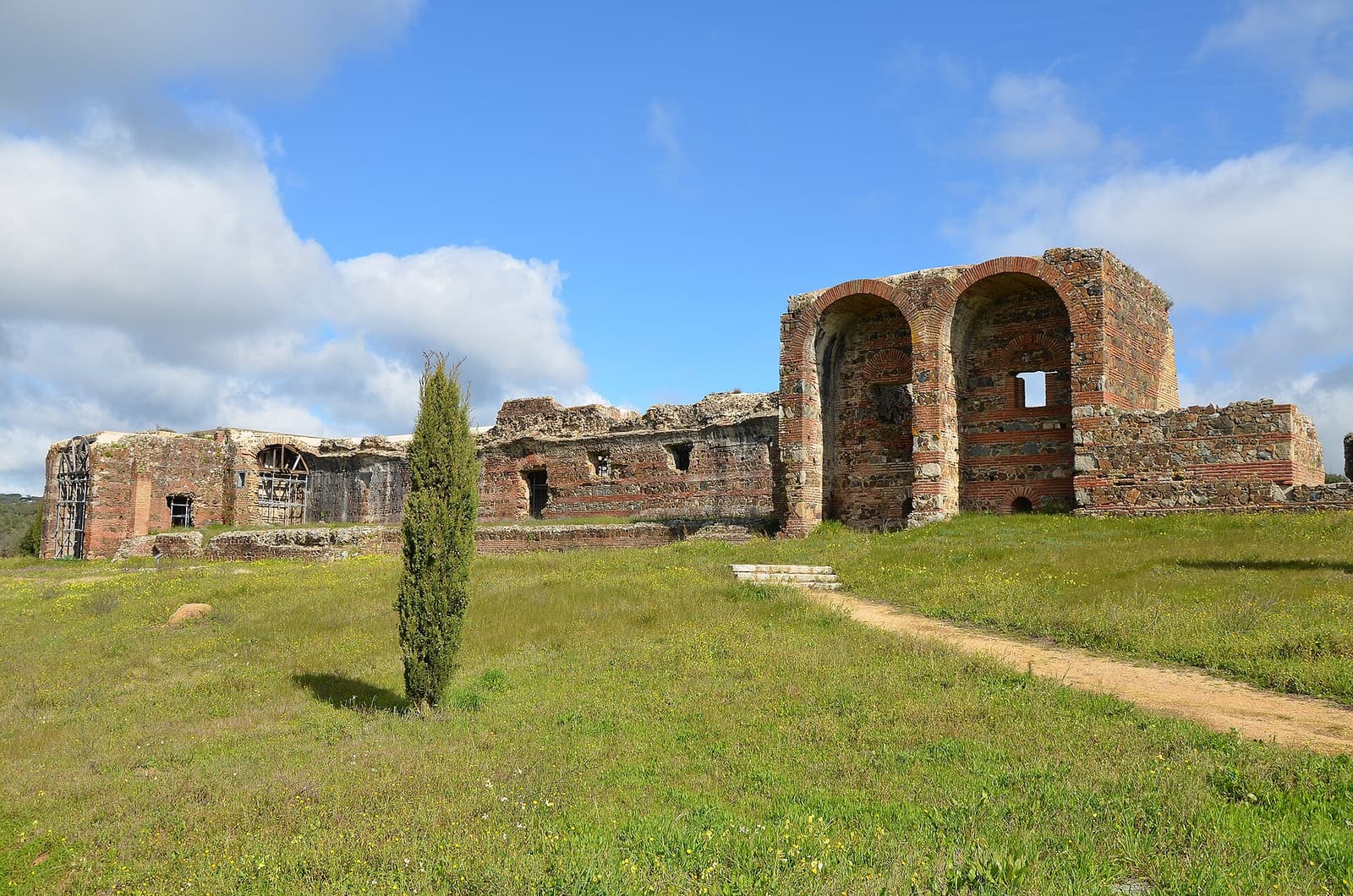
The Roman Villa of São Cucufate in Vila de Frades (Vidigueira) is the best-preserved Roman rural residence in Portugal, with two-story elevations.
- Location
- Vila de Frades, Vidigueira, Beja
- Built
- séc. I–IV d.C.
- Style
- Arquitetura romana
The Roman Villa of São Cucufate stands on a gentle elevation in Vila de Frades, in the municipality of Vidigueira, facing south towards the plain leading to Pax Iulia, present-day Beja. It is considered the best-preserved rural Roman residence in Portuguese territory: while most villae survive only at foundation level, São Cucufate preserves complete elevations of a two-story building, with arches and vaults that still allow us to reconstruct its original volumetry.
Four centuries of transformations
The occupation of the site follows the long Romanization of the Alentejo interior. In an initial phase, in the 1st century AD, a modest agricultural settlement was established here, organized around a courtyard and dedicated to wine and olive oil production. During the 2nd century, the complex was remodeled, still maintaining the traditional peristyle structure.
The great transformation occurred in the second half of the 4th century, when the old farmhouse was entirely rebuilt as a prestigious villa. Instead of the usual horizontal development around peristyles, an unusual solution was chosen for Roman domestic architecture in Hispania: a compact two-story building. The lower level, vaulted and robust, housed the pars rustica — cellars and production areas; the noble floor, the pars urbana, opened onto galleries and reception rooms for the owner.
The verticality of São Cucufate is its greatest rarity: few Roman sites in the West preserve, in elevation, the interplay between the productive and the seigniorial floors of the same house.
House, baths, and temple
The complex was not limited to the residence. It had private baths, a sophisticated water management system — with cisterns and large-capacity tanks — and a small temple, located a few dozen meters southwest of the main house. The gardens also included a water feature that functioned as an ornamental pond. This program, halfway between an agricultural estate and a palatial residence, illustrates well the lifestyle of rural elites in the Late Empire, comparable to what is observed in other large villae in the south, such as the Roman Villa of Pisões, near Beja, or the vast Roman Villa of Torre de Palma, in Upper Alentejo.
From Roman abandonment to medieval monastery
After the decline of Roman occupation, the site was not forgotten. Between the 9th and 10th centuries, a first monastic community settled here, later abandoned, and around the mid-13th century, a second cenobite was formed, active until the Modern Era. The Roman structures were reused: part of the building was converted into a convent church, still decorated with Gothic-style wall paintings. From this palimpsest of uses — villa, hermitage, convent — the toponym São Cucufate was born, evoking the Hispano-Roman martyr Cucufas.
Classified as a National Monument since 1947, the Roman Villa of São Cucufate is now a museum site and visitable, a central piece of Roman archaeology circuits in the Alentejo. Alongside urban complexes like Conímbriga, it constitutes one of the most eloquent testimonies of Roman presence in what is now Portuguese territory, with the unique particularity of returning to us, in stone and in height, the image of an ancient countryside house.
Frequently asked questions
- Where is the Roman Villa of São Cucufate located?
- It is situated in the parish of Vila de Frades, municipality of Vidigueira, Beja district, in the Alentejo region, south towards the ancient Pax Iulia (Beja).
- Why is this Roman villa so important?
- It is the best-preserved Roman rural residence in Portugal: unlike most villae, it retains the elevations of a two-story building with arches and vaults, allowing us to understand its original volumetry.
- What is the relationship between the villa and the Convent of São Cucufate?
- After the Roman abandonment, the site was reoccupied by medieval monasteries. The ruins of the Roman house were partially converted into a convent church, which preserves Gothic wall paintings, hence the name São Cucufate.
Sources
Keep exploring
Heritage nearby
More places to discover from here. Approximate straight-line distances, within 50 km.