Archaeology
Great Dolmen of Comenda da Igreja
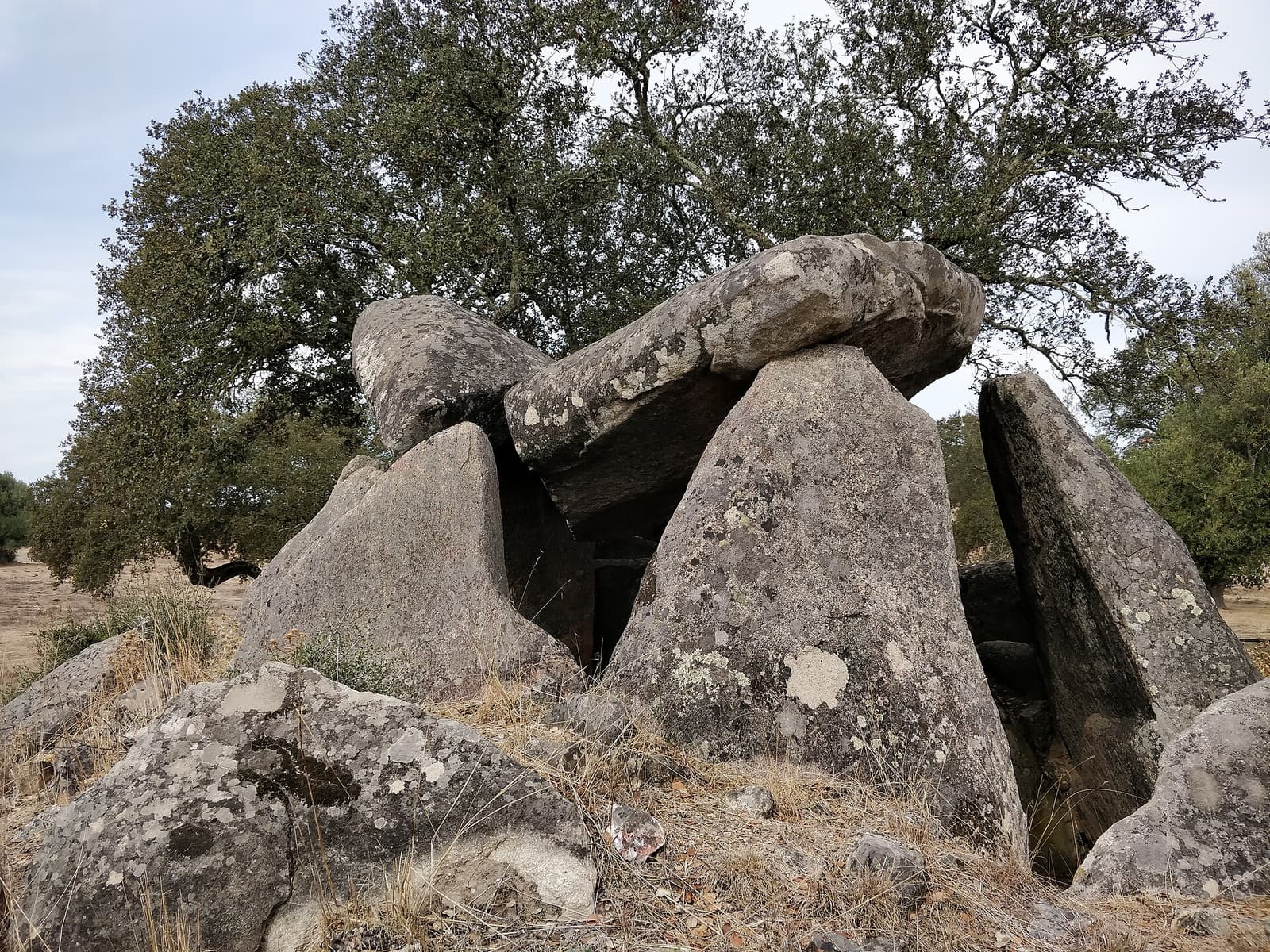
The Great Dolmen of Comenda da Igreja, in Montemor-o-Novo, is one of the most monumental passage dolmens of Alentejo megalithism, with massive orthostats.
- Location
- Montemor-o-Novo, Évora
- Built
- Finais do IV milénio a.C. – meados do III milénio a.C.
- Style
- Megalítico (anta de corredor)
The Great Dolmen of Comenda da Igreja is a megalithic passage tomb located in the parish of Nossa Senhora do Bispo, in the municipality of Montemor-o-Novo, in the heart of Central Alentejo. Raised by agro-pastoral communities between the end of the 4th millennium BC and the middle of the 3rd millennium BC, it ranks among the most monumental and best-preserved examples of the so-called Évora megalithism, the dense concentration of dolmens that dots the plains around Évora.
A passage dolmen of great dimensions
The monument belongs to the typology of dolmens with a differentiated chamber and passage, the most elaborate architectural formula of Iberian funerary megalithism. The chamber, polygonal in plan, is defined by granite orthostats of remarkable size, enclosing a space some 4 metres in diameter whose walls reach approximately 6 metres in height, counting the thickness of the great capstone. Joined to it is a passage of rectangular plan, about 10 metres long and nearly 1.80 metres high, which extends the monument to a total length of around 15 metres.
In a passage dolmen, the architecture stages a crossing: the visitor advances along a corridor that grows ever narrower and lower until it opens onto the chamber, the sacred space where the dead and their offerings lay.
The robustness of the orthostats and the integrity of the passage set this dolmen apart from many others in the region, often dismantled or reduced to fragments. Its scale brings it close to other giants of Alentejo megalithism, such as the Great Dolmen of Zambujeiro, the largest known chamber dolmen in Portugal, with which it shares the same constructive grammar.
Funerary function and votive assemblage
Like the other monuments of Alentejo megalithism, the Comenda da Igreja dolmen was a collective sepulchre, used and reused across generations by the Neolithic and Chalcolithic communities that inhabited the territory. Within it the deceased were laid alongside a set of offerings that made up the funerary furnishings.
The excavations carried out at the monument over the course of the 20th century revealed an abundant votive assemblage, in which the engraved schist votive plaques stand out — emblematic pieces of Portuguese megalithic art and a recurrent object of study for their possible symbolic and religious dimension. A significant part of these materials today forms part of the collections of the National Museum of Archaeology, in Lisbon, where they remain available for research.
Classification and context
The Great Dolmen of Comenda da Igreja has been classified as a National Monument since 1936, a recognition that attests to its value as an exceptional testimony of the first sedentary societies of the southern Iberian Peninsula. Set within a territory particularly rich in prehistoric remains — dolmens, menhirs and cromlechs scattered across the estates of Montemor-o-Novo and the neighbouring municipalities — the monument is part of a megalithic landscape of unparalleled density on a European scale, whose joint reading allows us to grasp the complexity of the communities that, some five thousand years ago, left a lasting mark on the Alentejo.
Frequently asked questions
- Where is the Great Dolmen of Comenda da Igreja located?
- It lies in the parish of Nossa Senhora do Bispo, in the municipality of Montemor-o-Novo, district of Évora, in Central Alentejo.
- When was the dolmen built?
- The megalithic monument was raised between the end of the 4th millennium BC and the middle of the 3rd millennium BC, in the Neolithic period.
- Is the dolmen classified as heritage?
- Yes, it has been classified as a National Monument since 1936.
Sources
Keep exploring
Heritage nearby
More places to discover from here. Approximate straight-line distances, within 50 km.