Archaeology
Anta Grande do Zambujeiro
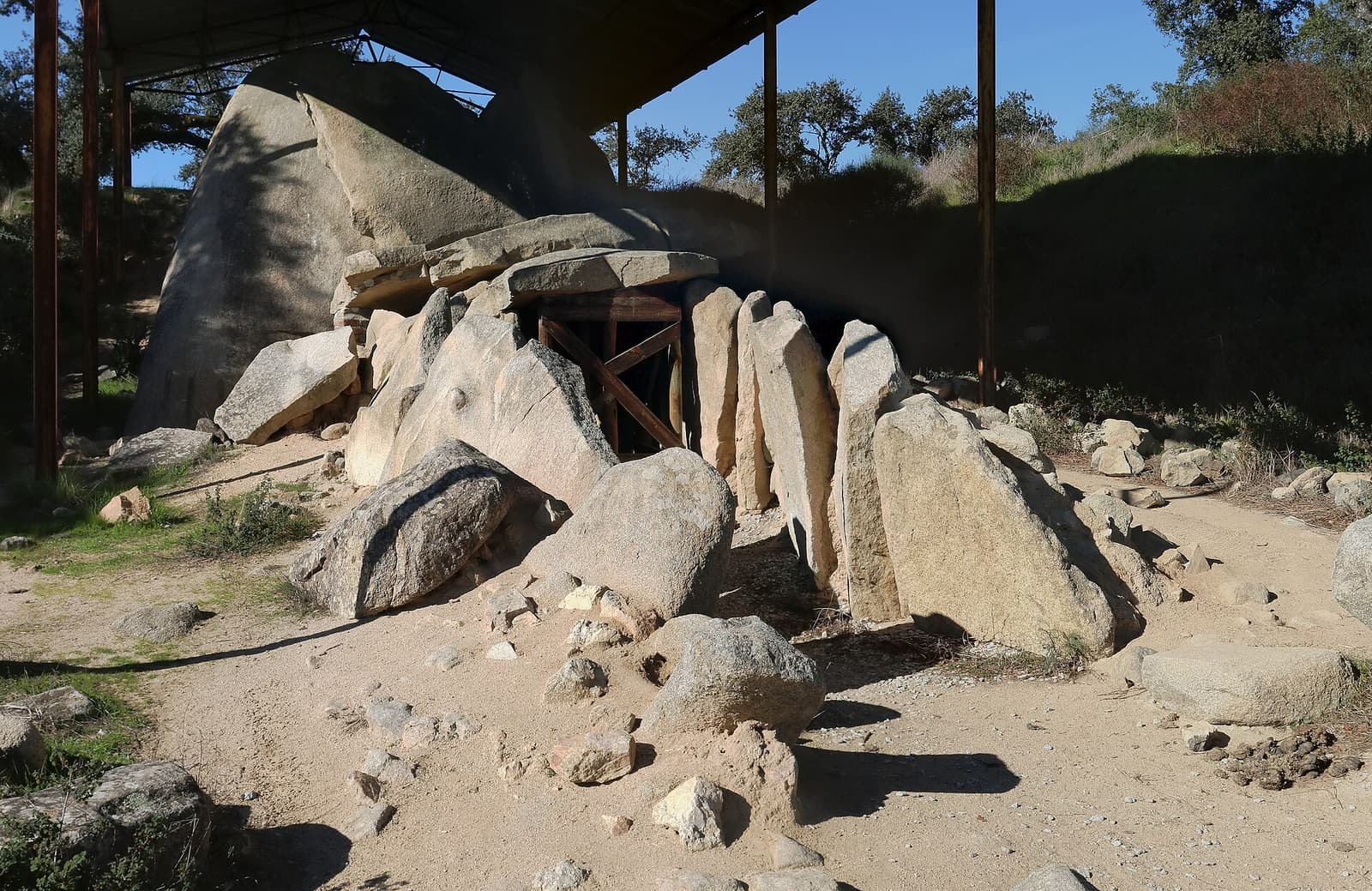
The Anta Grande do Zambujeiro, near Valverde in Évora, is the largest chamber dolmen in Portugal, with orthostats reaching about eight metres in height.
- Location
- Valverde, Évora
- Built
- c. 4000–3500 a.C.
- Style
- Megalítico (dólmen de corredor)
The Anta Grande do Zambujeiro rises in a quiet valley near Valverde, in the parish of Nossa Senhora da Tourega, a few kilometres south-west of Évora. It is the largest chamber dolmen known in Portugal and one of the most imposing in the whole Iberian Peninsula: seven granite orthostats, raised in a polygonal plan, form a chamber approaching eight metres in height. Its exceptional scale has made it a symbol of Alentejo megalithism and an essential landmark on any tour of the region’s prehistoric heritage.
A monument of the Neolithic
The dolmen was built in the Neolithic, between roughly 4000 and 3500 BC, as a collective tomb intended to receive successive burials over generations. It belongs to the passage-grave type, in which a closed chamber extends into an access corridor — here about twelve metres long, though today much ruined. Originally, the whole structure would have been covered by a great horizontal capstone and enclosed by a mamoa, the mound of earth and stone that sealed the sepulchre and marked the landscape.
To move and raise orthostats weighing several tonnes, without metal or the wheel, reveals the sophisticated social organisation of the agro-pastoral communities that occupied the plain of Évora more than five millennia ago.
The density of megalithic monuments around Évora is no accident: the region holds one of the richest collections in Europe, including the celebrated Cromeleque dos Almendres and the numerous enclosures and dolmens that document the continuity of these practices. The Anta Grande do Zambujeiro thus belongs to a tradition that runs throughout Iberian megalithism.
Excavation and finds
Systematic excavations took place in 1965, directed by Henrique Leonor Pina. The work, which involved removing the capstone and the chamber’s fill, recovered an abundant assemblage — engraved schist plaques, necklace beads, crosiers, copper objects and pottery, including carinated bowls — funerary material typical of the late Neolithic and the Alentejo Chalcolithic. Much of this collection is held today in the Museu de Évora.
The intervention, carried out with the methods of the time, exposed the structure to a fragility that still threatens it today: the orthostats, especially those of the corridor, were left visible almost to their base, and the monument requires monitoring and conservation measures to forestall the risk of collapse. A metal cover currently protects the chamber from the elements.
Listing and visiting
The Anta Grande do Zambujeiro is classified as a National Monument, a status conferred by Decree-Law no. 516/71 of 22 November. Access is by a dirt track from Valverde, crossing montado and olive grove, and the approach on foot heightens the impact of the orthostats’ scale as they appear in the valley.
The visit gains meaning when set within a broader route across the territory of Évora, which combines the prehistoric legacy with later layers of Alentejo history and forms part of the body of Portuguese megalithic art. A few kilometres away, the monuments of the Monsaraz megalithic complex complete one of the most remarkable itineraries of megalithism in Portugal.
Frequently asked questions
- Where is the Anta Grande do Zambujeiro located?
- It lies in a valley near Valverde, in the parish of Nossa Senhora da Tourega, a few kilometres south-west of the city of Évora, in the Alentejo.
- Why is it considered the largest dolmen in Portugal?
- Its polygonal chamber is formed by seven orthostats reaching about eight metres in height, dimensions that make it one of the largest chamber dolmens on the Iberian Peninsula.
- When was it built?
- It was raised in the Neolithic, between roughly 4000 and 3500 BC, as a collective tomb for the community that inhabited the region.
Sources
Keep exploring
Heritage nearby
More places to discover from here. Approximate straight-line distances, within 50 km.