Archaeology
Anta de Pavia (Chapel of São Dinis)
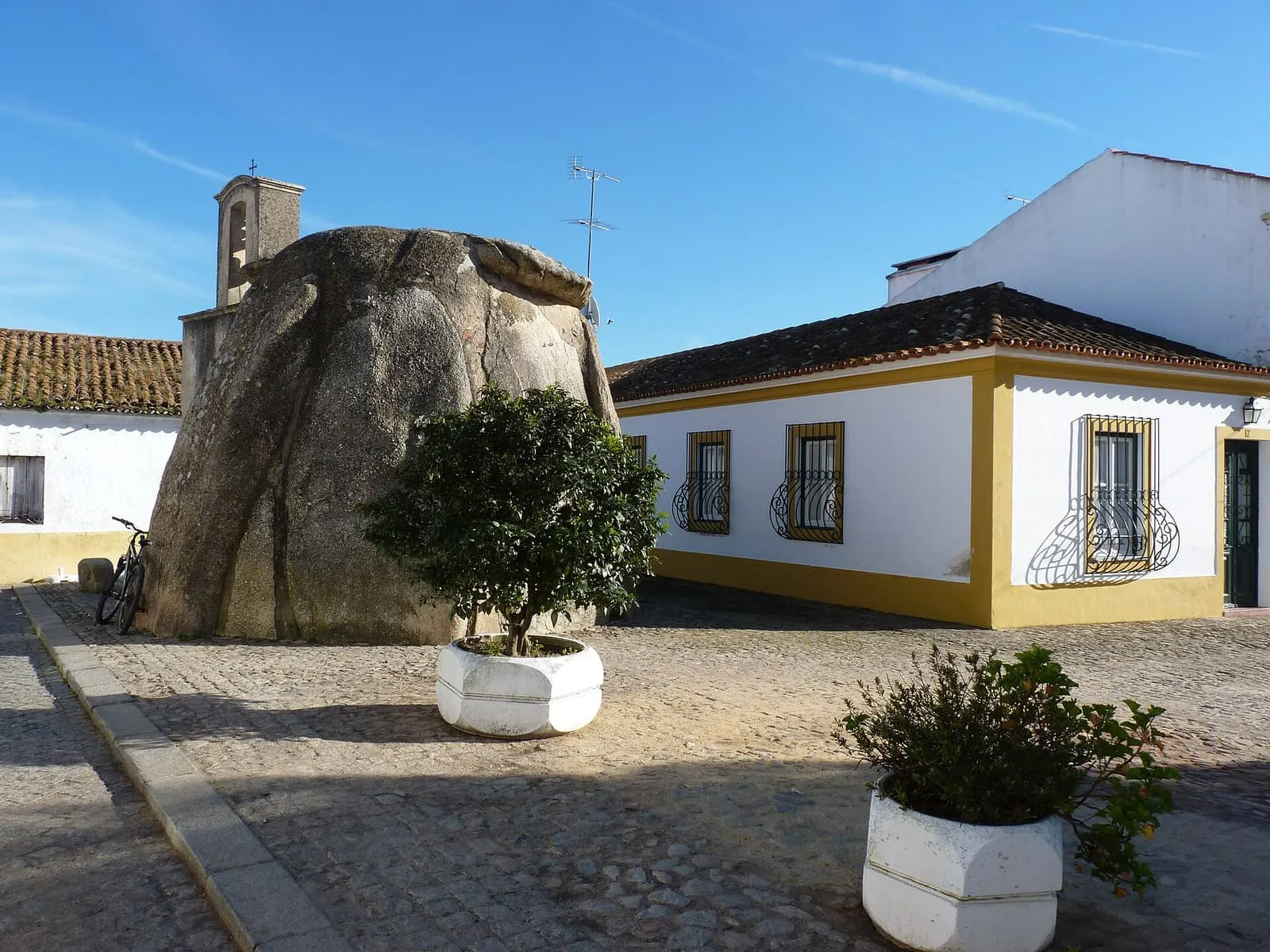
Anta de Pavia, a megalithic dolmen in Mora reused as the Chapel of São Dinis, a unique case of a prehistoric monument set in the centre of an Alentejo town.
- Location
- Pavia, Évora
- Built
- Séc. IV–III milénio a.C.
- Style
- Megalítico (dólmen de câmara)
The Anta de Pavia, also known as the Anta-Capela de São Dinis (Dolmen-Chapel of São Dinis), is a late Neolithic or Chalcolithic dolmen that rises, surprisingly, in the very heart of the town of Pavia, in the municipality of Mora, district of Évora. It is a virtually unique case in the Iberian Peninsula: a megalithic tomb some five thousand years old absorbed into the urban fabric which, instead of standing as an isolated ruin on the Alentejo heath, today shares the square with whitewashed houses and cobbled streets.
A tomb turned chamber of prayer
The monument is a large chamber dolmen, of which the polygonal chamber survives — oval in plan and with a closed outline — formed by seven granite uprights still in place and covered by a single, robust capstone roughly 3.0 by 2.6 metres. The whole reaches a maximum diameter of about 4.3 metres and a height of 3.3 metres. The access corridor that once extended the chamber has disappeared, a frequent situation in the great Alentejo dolmens such as the Anta Grande do Zambujeiro, near Évora, or the Anta da Comenda da Igreja, in Montemor-o-Novo.
In the early seventeenth century the megalithic chamber was consecrated and converted into a Christian chapel dedicated to São Dinis (or Saint Denis). For this purpose a doorway was cut between two uprights, a short nave was added in front of the chamber, and a triangular façade crowned by a bell-cote and cross was raised. Inside, the prehistoric chamber came to serve as the chancel, with an altar clad in eighteenth-century tiles of Baroque taste. The result is a rare superimposition of four millennia of religious history, from prehistory to Catholic worship, in a single building.
Few monuments express so clearly the continuity of the sacred in one and the same place: what had been a Neolithic funerary chamber became, without interruption, a space of Christian worship.
Ancient memory and archaeological study
The Anta de Pavia also has the merit of being among the first megalithic monuments mentioned in Portuguese literature. As early as the seventeenth century the scholar Manuel Severim de Faria referred to it in his Notícias de Portugal, at a time when the prehistoric nature of these constructions was far from understood. This early record makes it an important piece in the history of Portuguese megalithic archaeology itself and of the study of Iberian megalithism.
The monument has been the object of archaeological interventions, with excavations carried out in 1914–1915 and, more recently, in 2013. The materials recovered form part of reference collections, some of them held by the Museu Nacional de Arqueologia in Lisbon. Recognised for its rarity and value, the Anta de Pavia has been classified as a National Monument since 1910, in the first great group of classifications of Portuguese heritage.
Visiting
Set in the central square of Pavia, the dolmen-chapel is of immediate and free access, and may be viewed from the outside at any hour. The town forms part of the rich megalithic territory of central Alentejo, where dozens of dolmens, menhirs and cromlechs are counted, making it a natural starting point for discovering one of the densest groups of megalithic architecture in western Europe.
Frequently asked questions
- Where is the Anta de Pavia?
- It stands in the centre of the town of Pavia, in the municipality of Mora, district of Évora, in the heart of the Alentejo. It is a rare case of a dolmen set within a fully urban context.
- Why does the dolmen have a chapel?
- In the early seventeenth century the megalithic chamber was consecrated and adapted into a Christian temple dedicated to São Dinis, with a doorway opened up and a small nave added in front of the prehistoric chamber.
- How old is the monument?
- The dolmen was probably raised between the fourth and third millennia BC, in the late Neolithic or early Chalcolithic, making it one of the most remarkable Portuguese megalithic monuments.
Sources
Keep exploring
Heritage nearby
More places to discover from here. Approximate straight-line distances, within 50 km.