Periods & Styles
Iron Architecture in Portugal
Iron architecture in Portugal: nineteenth-century bridges, railway sheds, markets and lifts that wedded cast iron and glass from Lisbon to Porto.
- Built
- c. 1850–1910
- Style
- Arquitetura do ferro
Iron architecture is the most original chapter of Portuguese building in the nineteenth century. Born of the encounter between industrialisation and a newly formed engineering profession, it took shape in a series of buildings and structures — bridges, railway sheds, markets, arcades and lifts — in which cast and wrought iron ceased to be a hidden material and became the very language of the work. Unlike stone, which imposed mass and volume, iron allowed wide spans, slenderness and the generous entry of light, above all when wedded to glass.
The decisive impetus came with so-called Fontismo, the public works policy associated with Fontes Pereira de Melo, which endowed the country with railways, roads and bridges from the 1850s and 1860s onwards. The need to cross great rivers and to roof vast spaces of circulation found in iron the technical answer that masonry could not provide. Within a few decades, Portugal came to possess some of the most remarkable metal structures in the Europe of its day.
Bridges and railway sheds
In Porto, the river Douro was the stage for two masterpieces. The Maria Pia Bridge, completed in 1877 to a design by the Gustave Eiffel firm, resolved the railway crossing with a central arch of remarkable elegance; a few years later, in 1886, the Dom Luís I Bridge, by the firm of Théophile Seyrig, superimposed two decks on a single metal arch, and is today part of the historic centre of Porto classified by UNESCO. These and other achievements make the metal bridges one of the most visible legacies of the period.
Iron did not merely replace stone: it altered the very scale of the possible, allowing roofs that seemed suspended in the air.
The railway stations were another favoured territory. In Lisbon, the Rossio Station, by José Luís Monteiro, concealed behind a Neo-Manueline façade a metal-framed shed with columns crowned by Corinthian capitals. In Porto, the São Bento Station, by Marques da Silva, combined the best of the beaux-arts tradition with a broad roof of iron and glass. In these buildings, iron was often dressed in historicism, fitted into traditional shells — a new adaptability in the history of architecture.
Markets, arcades and lifts
The combination of iron and glass proved ideal for spaces that demanded light and ventilation. The nineteenth-century municipal markets adopted it with enthusiasm: the Ferreira Borges Market in Porto, designed by João Carlos Machado and completed in 1888 atop a granite base, is one of the rare Portuguese examples of iron not linked to transport, with three naves served by columns with Corinthian capitals.
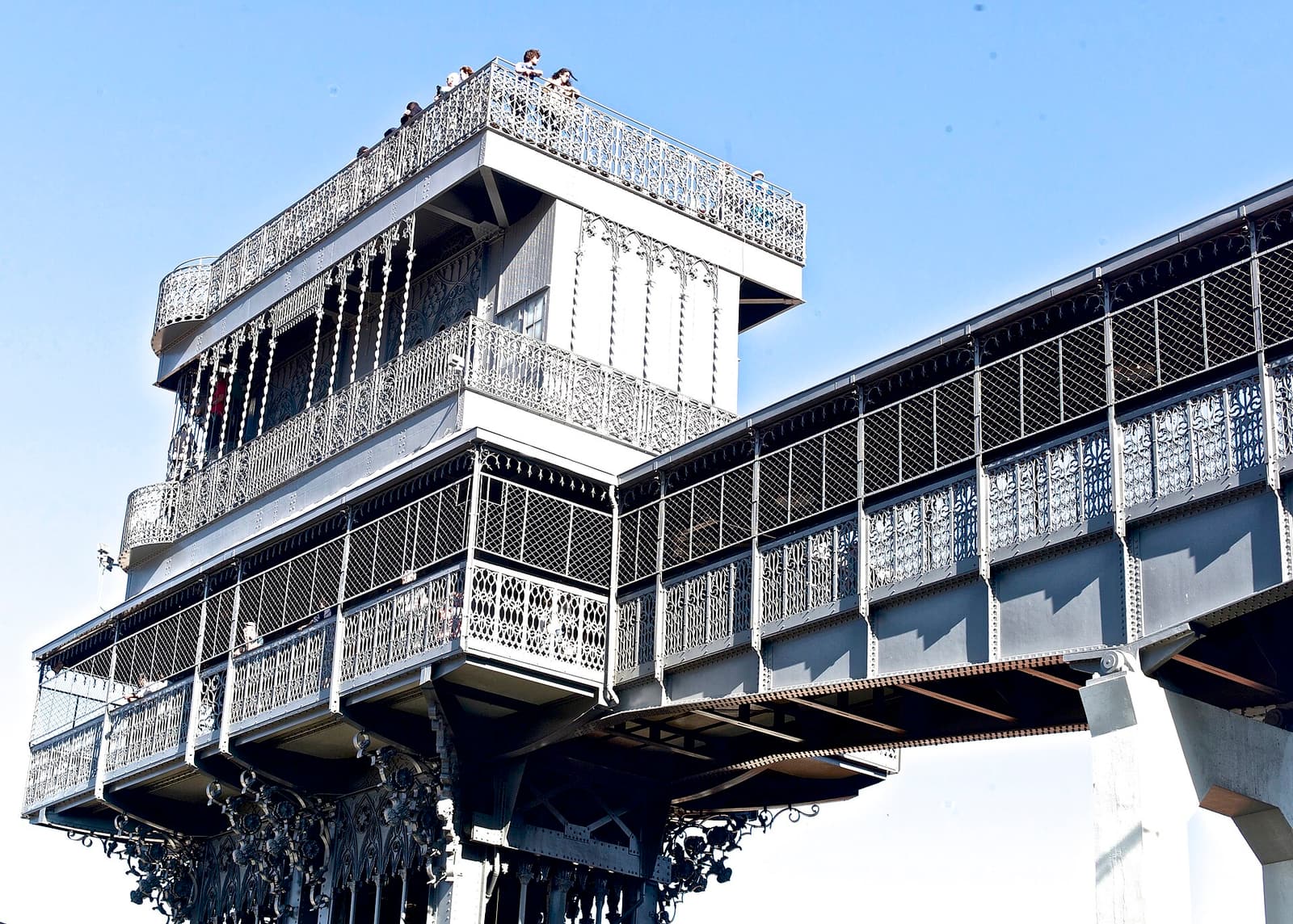
In Lisbon, the most celebrated example is the Santa Justa Lift, inaugurated in 1902 to a design by Raoul Mesnier du Ponsard. Rising as a cast-iron tower with six mock storeys, friezes and ogives, it is at once one of the chief testimonies of iron and of the Neo-Gothic in the city. It worked at first by steam, switching to electric traction only in 1907.
A legacy between engineering and art
More than a style, iron architecture was an attitude towards building, in which the engineer disputed with the architect the leading role in the work. Its achievements are inscribed today within Portuguese industrial heritage and converse with the revivals of Romanticism, which frequently lent them their decorative garb. By revealing the structural beauty of metal, these works anticipated the path that modern architecture would tread in the following century.
Frequently asked questions
- What is iron architecture?
- It is the body of nineteenth-century buildings that adopted cast and wrought iron, frequently combined with glass, as a structural and expressive element. It includes bridges, railway sheds, markets, arcades and lifts erected above all in the second half of the nineteenth century.
- What are the most important examples in Portugal?
- Notable examples include the Maria Pia Bridge and the Dom Luís I Bridge in Porto, the Ferreira Borges Market, the Rossio and São Bento stations, and the Santa Justa Lift in Lisbon.
- Who designed the Santa Justa Lift?
- The engineer Raoul Mesnier du Ponsard, author of several Portuguese lifts and funiculars. The Santa Justa Lift entered service in 1902.