Typologies
Metal and Iron Bridges
The 19th-century metal and iron bridges of Portugal: an industrial engineering typology that spanned the Douro, Lima, and Tagus rivers.
- Built
- c. 1875–1900
- Style
- Arquitetura do ferro
Metal and iron bridges represent one of the most expressive typologies of 19th-century built heritage. Born of the Industrial Revolution, they visibly embodied confidence in an era of technical progress: for the first time, conquering a major river no longer depended on stone and perfect semicircular arches but instead relied on calculations, trusses, and rivets. In Portugal, this typology emerged primarily in the last quarter of the 19th century, when railway expansion demanded crossings that traditional engineering could not provide.
A New Structural Language
The innovation of iron bridges lies not just in material but in construction philosophy. Where Roman and medieval tradition erected massive piers and successive arches over riverbeds, iron enabled wide spans, lightweight decks, and minimal supports. This shift was part of the broader iron architecture movement that transformed markets, stations, bandstands, and exhibition pavilions throughout the century.
Technically, material distinctions matter. Cast iron, resistant to compression but brittle, was soon abandoned for tension-prone structures; wrought (puddled) iron, ductile and reliable, became the material of choice for large arches and beams. By the century’s end, steel—more homogeneous and economical—gradually replaced wrought iron in major projects.
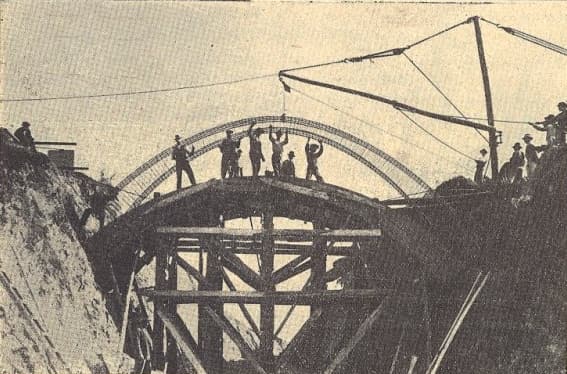
The suspended deck arch of Maria Pia Bridge was not an aesthetic choice but a necessity: only an articulated, double-hinged arch could span the Douro’s 160+ meters without intermediate supports in the river’s torrential flow.
The Great Crossings of the Douro and Lima
The foundational example is the D. Maria Pia Bridge in Porto, inaugurated on November 4, 1877. Designed by Gustave Eiffel’s firm, with Théophile Seyrig as lead engineer, it featured the world’s largest iron arch at the time and served exclusively the Northern Line railway. Its design—a parabolic arch with increasing chord supporting the deck—became an icon of European engineering.
A few years later, the D. Luís I Bridge, designed by Belgium’s Société de Willebroeck again under Seyrig, was built upstream between 1881 and 1886. With dual decks for road and pedestrian traffic, it now forms part of Porto’s UNESCO World Heritage-listed historic center.
To the north, the Eiffel Bridge over the Lima River in Viana do Castelo opened on June 30, 1878. Also from Eiffel’s firm, this mixed-use crossing (lower railway deck, upper road deck) spans 645 meters using over two million kilograms of iron. It is currently under consideration for national monument status.
Significance and Conservation
More than infrastructure, these bridges document a transforming economy. Built to serve railways—the driving force of 19th-century territorial development—they are intrinsically linked to railway stations and other industrial heritage of the era. Some, like Maria Pia, were decommissioned as newer bridges took over traffic, making their preservation a challenge: iron structures require continuous anti-corrosion maintenance and spark debates about repurposing obsolete engineering feats.
In short, this typology captures a precise moment in Portugal’s technical history—when structural calculus, steel industry, and international engineering converged to forever change how rivers were crossed.
Frequently asked questions
- What are the most important metal bridges in Portugal?
- Notable examples include the D. Maria Pia Bridge (1877) and the D. Luís I Bridge (1886) over the Douro in Porto, and the Eiffel Bridge over the Lima in Viana do Castelo (1878). All date from the peak of iron architecture in Portugal.
- Who designed the D. Maria Pia Bridge?
- It was designed by the Eiffel company, with Gustave Eiffel and engineer Théophile Seyrig, and inaugurated in 1877. Seyrig would later design the neighboring D. Luís I Bridge.
- What is the difference between cast iron and wrought iron in bridges?
- Cast iron resists compression well but is brittle under tension; wrought (puddled) iron is more ductile and suitable for beams and arches. Major 19th-century bridges primarily used wrought iron, later transitioning to steel.