Typologies
Railway Stations
Portuguese railway stations, from nineteenth-century iron and glass to grand azulejo façade tilework, as a typology of the built heritage.
- Built
- 1856–1930
- Style
- Arquitetura do ferro, ecletismo, neomanuelino, neoclássico
Railway stations constitute one of the most expressive typologies of the built heritage of the nineteenth and early twentieth centuries in Portugal. Born with the arrival of the railway — inaugurated in 1856, on the stretch between Santa Apolónia Station, in Lisbon, and Carregado —, these constructions became structuring facilities of the territory, linking the transport of passengers and goods with industrialisation and with the drawing together of the coast and the interior. More than embarkation points, they were the gateway through which towns entered modernity and, frequently, the most ambitious public building in many localities.
Iron architecture and revivalist idioms
The station as a typology emerged in association with a new engineering that combined traditional masonry with metal structures and roofs of iron and glass, in the image of the great European termini. This technical aspect falls within what is termed iron architecture, in which the exposed structure, lightness and wide spans become aesthetic values. Rossio Station, in Lisbon, inaugurated in 1890 and designed by José Luís Monteiro, is a paradigmatic example: a façade in the Neo-Manueline taste — a revival of national roots — covers a metal nave inspired by Parisian models.
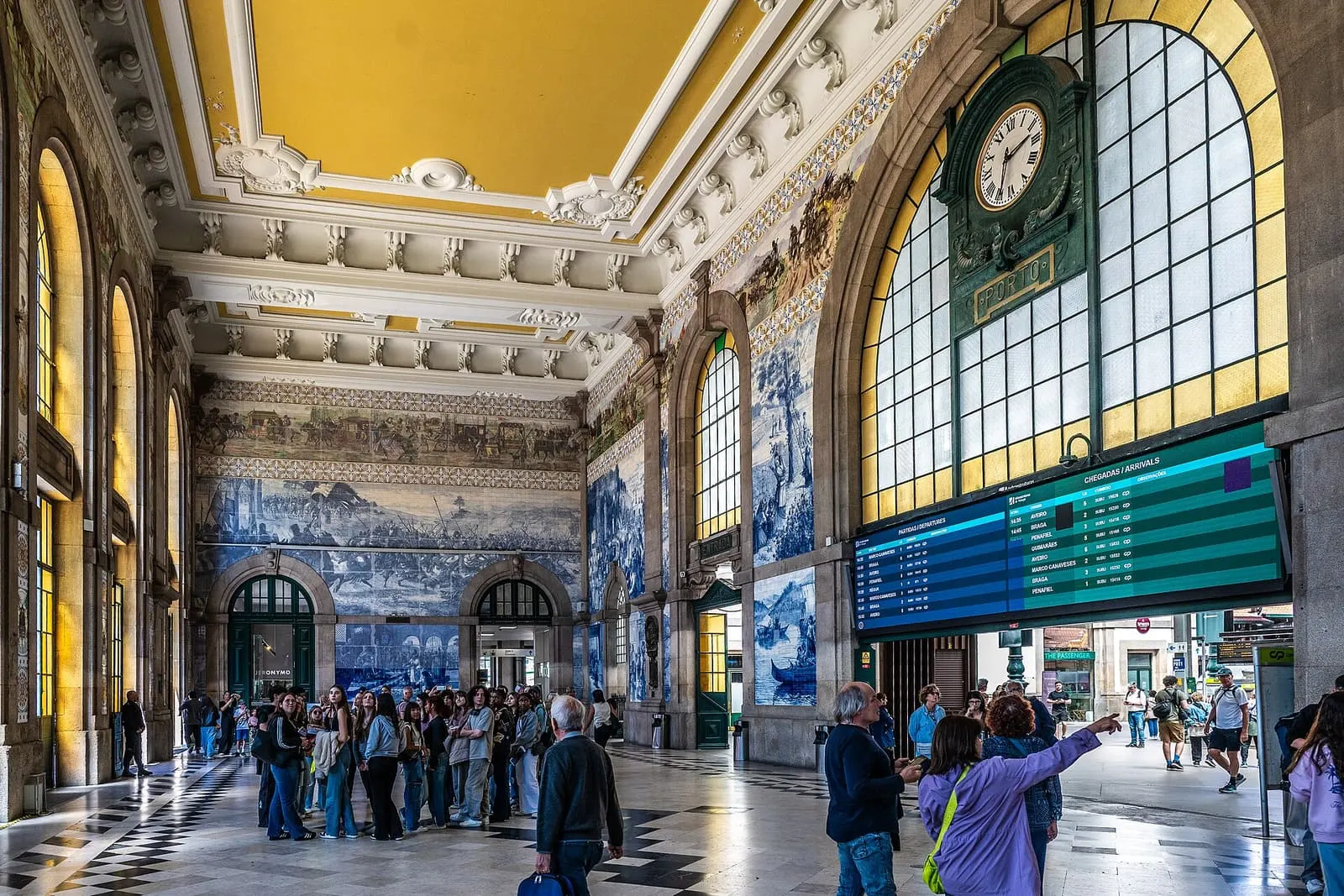
Alongside the revivalist idiom, there coexisted the sober Neoclassicism of Santa Apolónia (1865) and the French-influenced eclecticism of Porto-São Bento, the work of the architect José Marques da Silva, inaugurated in 1916 on the foundations of the former Convent of São Bento da Avé Maria. This diversity makes the stations a showcase of the architectural currents that ran through the country between late Romanticism and the beginnings of the Estado Novo.
The azulejo as façade and hall narrative
If there is one element that sets the Portuguese station apart in the European context, it is the intensive use of the azulejo. Out of some 900 stations and halts, 308 preserve ceramic facings, ranging from compositions of standard modules and toponymic panels to grand figurative façade tilework. The foremost case is the hall of São Bento, where Jorge Colaço assembled around 20,000 blue-and-white tiles, produced at the Sacavém factory, with episodes from national history — from the Battle of Valdevez to the Conquest of Ceuta. In the Douro, Pinhão Station displays panels devoted to the wine cycle, from the landscapes to the harvest.
The Portuguese railway station can be read as an open-air museum: each tiled frieze transforms a waiting room into a compendium of history and local identity.
Heritage value and recognition
As a whole, stations are today understood as a central part of Portuguese industrial heritage, combining architectural, artistic and commemorative value. Several are classified as national monuments or properties of public interest, and the conservation of their azulejo collections has been the object of specific restoration campaigns. The material and technical memory of the railway is gathered above all at the National Railway Museum, in Entroncamento, which documents the rolling stock and the evolution of this typology over more than a century and a half. To understand the stations is thus to recognise one of the densest chapters of the typologies of the built heritage in Portugal.
Frequently asked questions
- When did the railway begin in Portugal?
- The first section was inaugurated in 1856, between Lisbon (Santa Apolónia) and Carregado, covering about 36 kilometres. A rapid expansion of the network followed throughout the second half of the nineteenth century.
- Which railway station is best known for its tilework?
- Porto-São Bento Station, whose hall brings together some 20,000 tiles painted by Jorge Colaço, depicting episodes from the history of Portugal as well as scenes of transport and ways of life.
- How many Portuguese stations have azulejos?
- According to Infraestruturas de Portugal, out of some 900 stations and halts, 308 possess azulejos of various types, figurative and non-figurative, both interior and façade.