Archaeology
The megalithic complex of Monsaraz
The megalithic complex of Monsaraz, in Reguengos de Monsaraz, brings together the Xerez cromlech, menhirs and dolmens of the Alentejo Neolithic.
- Location
- Reguengos de Monsaraz, Évora
- Built
- c. 4000–3000 a.C.
Around the hill of Monsaraz and the vast plain that descends towards the Guadiana lies one of the densest concentrations of megalithic monuments in Portugal. The municipality of Reguengos de Monsaraz brings together more than one hundred and fifty prehistoric archaeological sites — cromlechs, isolated menhirs, dolmens and rock-art stations — testimony to the communities of herders and farmers who, over the course of the 5th, 4th and 3rd millennia BC, marked this territory with stone.
The Xerez cromlech
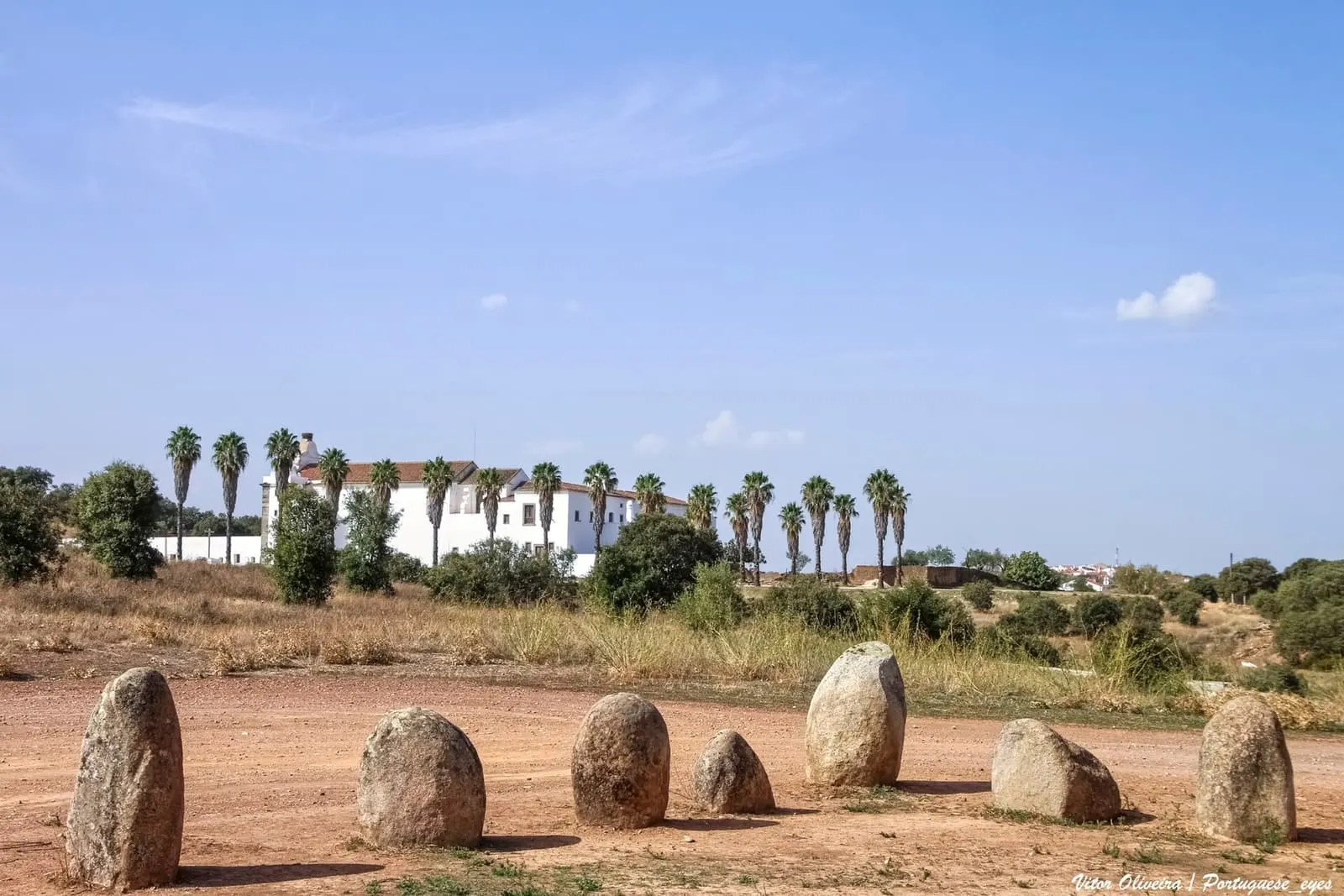
The most emblematic piece of the ensemble is the Xerez cromlech, identified in 1969. It is a megalithic enclosure of quadrangular plan, a rare case among the cromlechs of the Iberian Peninsula, which are usually circular or oval. About fifty granite menhirs, between 1.20 and 1.50 metres tall, delimit the enclosure, arranged around a great central menhir of phallic form some 4.5 metres high and weighing around seven tonnes. Several of the uprights bear engraved decoration, with cup marks and schematic motifs.
The dating points to the interval between roughly 4000 and 3000 BC, although the function of the enclosure remains under debate. The most widely held interpretation attributes to it a ceremonial and symbolic role, possibly linked to observations of the sky and agrarian cycles — the same logic that runs through the great enclosures of the Alentejo, such as the Almendres cromlech, near Évora.
The quadrangular plan of Xerez and its early chronology make it one of the rare Portuguese points of comparison for the great Atlantic megalithic enclosures.
A monument that changed place
Xerez is also singular for its recent history. The construction of the Alqueva dam, which from 2002 flooded part of the Guadiana valley, condemned the original site to submersion. To save it, the cromlech was dismantled stone by stone in November 2001 and re-erected in June 2004 next to the Orada convent, in the vicinity of Monsaraz. It was the only megalithic monument in the area to be relocated, in an exercise of rescue archaeology that still today prompts discussion about the fidelity of the reconstitution compared with the original layout.
Menhirs and dolmens across the territory
The complex does not end with Xerez. Scattered across the municipality is a remarkable ensemble of monuments. The Outeiro menhir, nearly six metres tall, is among the largest isolated menhirs of the Iberian Peninsula. The Rocha dos Namorados, a granite block standing more than two metres tall and decorated with cup marks, still retains today an associated popular ritual of throwing stones to its summit. The dolmens of Olival da Pega, collective chamber-and-corridor tombs built between around 3500 and 3000 BC, held the remains of more than a hundred individuals, revealing the funerary and communal dimension of these populations.
As a whole, these monuments belong to the broader universe of megalithism and of Portuguese megalithic art, of which the engraved menhirs are the foremost expression — a theme developed in the study of statue-menhirs and stelae. Visiting them from the fortified town of Monsaraz is to traverse, in a single day, several millennia of human occupation of central Alentejo.
Frequently asked questions
- What does the megalithic complex of Monsaraz comprise?
- It brings together the Xerez cromlech, isolated menhirs such as the Outeiro menhir and the Rocha dos Namorados, and dolmens such as those of Olival da Pega, all in the municipality of Reguengos de Monsaraz.
- Why was the Xerez cromlech relocated?
- The original site was submerged by the Alqueva reservoir. The monument was dismantled in November 2001 and rebuilt in June 2004 next to the Orada convent, near Monsaraz.
- From what period does the Xerez cromlech date?
- Researchers place it between the 5th and 3rd millennium BC, within the framework of the Neolithic and Chalcolithic of central Alentejo.
Sources
Keep exploring
Heritage nearby
More places to discover from here. Approximate straight-line distances, within 50 km.