Themes
Portuguese Azulejos
Portuguese azulejo art, from Hispano-Moorish patterns to the great Baroque blue-and-white cycle and the façade tile, across five centuries of art.
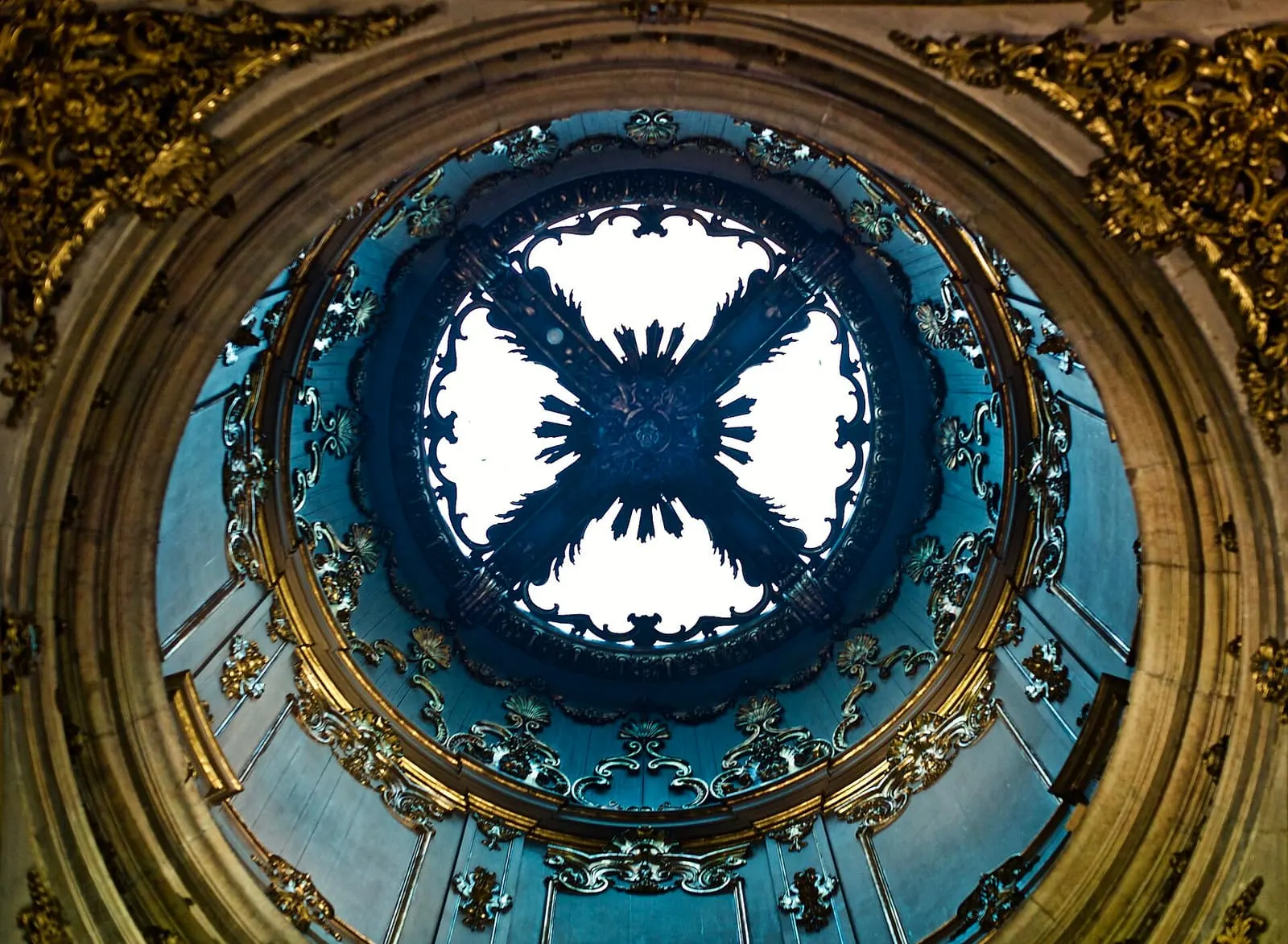
Azulejo art is perhaps the most distinctive of the Portuguese decorative arts. Over five centuries, Portugal covered the interiors and façades of churches, convents, palaces, staircases and entrance halls with glazed ceramic facings, transforming an imported technique into a plastic idiom of its own — to the point that, in the seventeenth century, the country became the largest European producer of azulejos. More than ornament, the azulejo organised architectural space, controlled light, narrated sacred and profane stories and fixed a visual memory of the cities.
From Hispano-Moorish origins to majolica
The word azulejo derives from the Arabic az-zulayj, “small polished stone”. The first examples reach Portugal in the late fifteenth century, imported from Seville and Toledo, and clad the walls of palaces and churches with geometric patterns. The Mudéjar techniques of the Hispano-Moorish tradition then dominated: corda seca, which separated the enamels with a greasy line, and aresta, which contained them in small grooves. King Manuel I, dazzled by the facings he had seen in Spain, had them applied in the Paço de Sintra, where some of the oldest ensembles in the country survive.
The decisive turning point came in the mid-sixteenth century, when the Italian majolica technique made it possible to paint directly onto the white, tin-based glaze. Freed from the geometry of the mould, the azulejo became a pictorial surface. The first local workshops appeared in Lisbon, along with figurative compositions such as the Nossa Senhora da Vida panel.
The great Baroque blue-and-white cycle
The seventeenth century consolidated the taste for the repeating pattern and opened the way to the most brilliant period. In the last quarter of the century, blue-and-white monochrome prevailed, under the influence of Chinese porcelain and Delft faience. Privileging drawing over colour, this choice allowed compositions of enormous scenographic ambition.
In the great Baroque churches, the azulejo ceased to be a facing and became painted architecture: frames, feigned columns and life-sized figures extend the real space into the wall.
This is the age of the great masters. Gabriel del Barco, a Spanish painter established in Lisbon, is a transitional figure; the Grande Panorama de Lisboa (c. 1700), a panel of more than twenty metres recording the city before the 1755 earthquake, is attributed to his workshop. He was followed by António de Oliveira Bernardes and his son Policarpo, authors of decorative programmes of extraordinary coherence, and by masters such as Bartolomeu Antunes. The azulejo stagings of many churches belong to this surge of energy, in dialogue with Portuguese Baroque painting and with gilded woodwork.
From the Pombaline pattern to the nineteenth-century façade
The 1755 earthquake and the Pombaline reconstruction of Lisbon imposed a new rhythm. For the buildings of the Baixa, the Pombaline pattern azulejo became widespread — modular, sober and mass-produced, more economical than figurative panels. The Real Fábrica de Louça do Rato came to supply the reborn city.
In the nineteenth century, semi-industrialisation and stencilling democratised the cladding of entire façades, creating the tiled urban landscape that still today distinguishes cities such as Lisbon, Porto, Aveiro and Ovar. In the twentieth century, Art Nouveau and modernism renewed the language with names such as Jorge Colaço, author of monumental panels, and later artists who brought the azulejo to the stations of the Metro. The complete history of this art, from the Mudéjar mould to the contemporary panel, is gathered at the Museu Nacional do Azulejo, housed in the former Convent of Madre de Deus, and forms part of the wider panorama of the Portuguese decorative arts.
Frequently asked questions
- When did the production of azulejos begin in Portugal?
- The first azulejos, imported from Seville, appear in the late fifteenth century; local production in Lisbon became established from the mid-sixteenth century onwards, using the majolica technique.
- Why is Baroque azulejo blue and white?
- From the last quarter of the seventeenth century, blue monochrome on a white ground prevailed, under the influence of Chinese porcelain and Delft faience, emphasising drawing and scenographic composition.
- Where can the history of the azulejo be studied?
- The Museu Nacional do Azulejo, in the former Convent of Madre de Deus in Lisbon, holds the most complete collection and recounts five centuries of this art.