Themes
Hispano-Moresque Azulejo
The Hispano-Moresque azulejo in Portugal: alicatado, cuerda seca and arista techniques imported from Seville in the sixteenth century, with the Palace of…
- Built
- século XVI
- Style
- Mudéjar / Hispano-mourisco
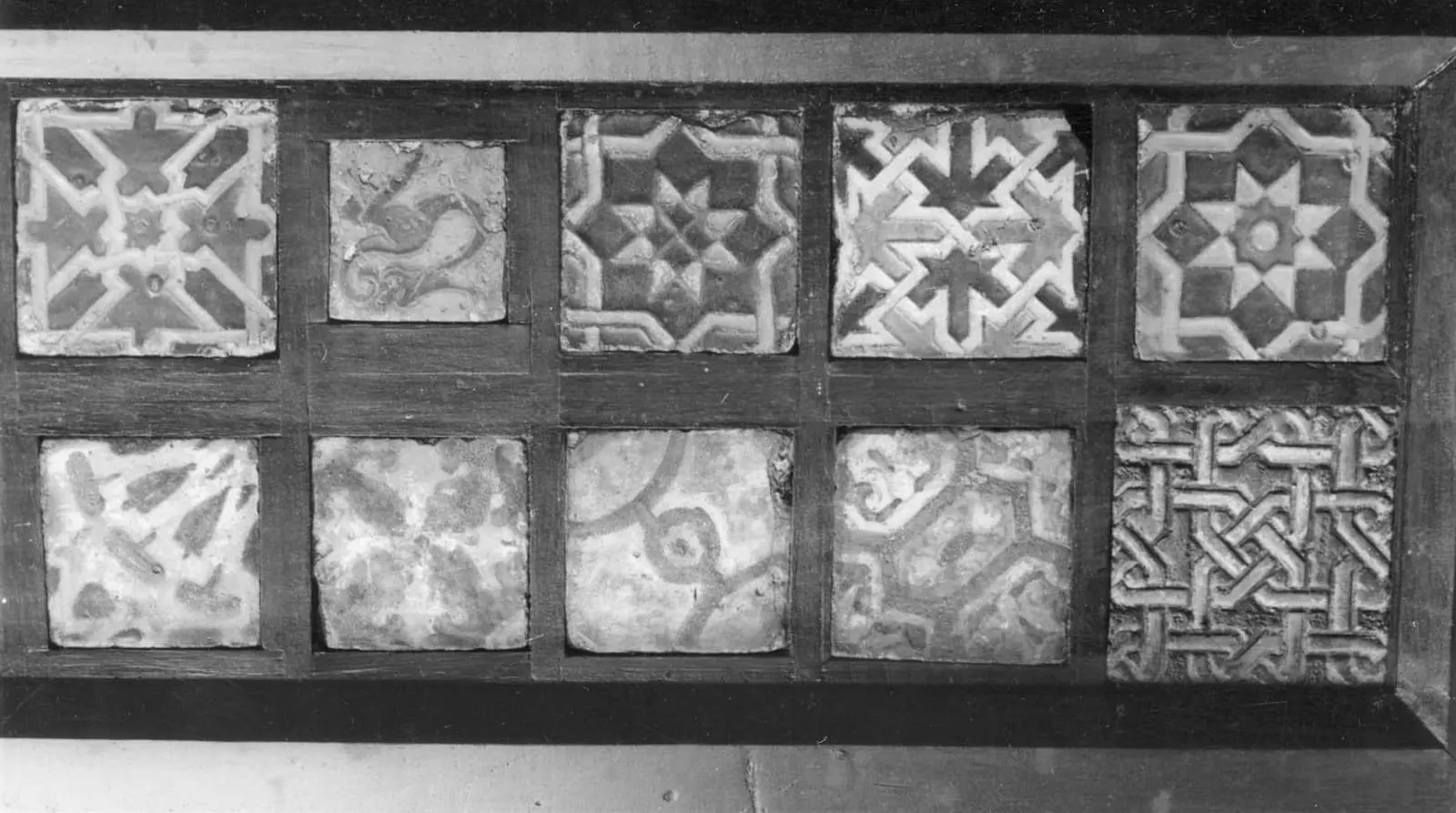
The Hispano-Moresque azulejo constitutes the first chapter in the long history of the azulejo in Portugal. It is wall ceramic of Islamic origin, produced above all in Seville and Toledo between the fifteenth and sixteenth centuries, in which the decoration is exclusively geometric and vegetal. There is no figure or scene: there is a module. The piece exists in order to repeat itself, covering the wall like a continuous carpet and dissolving the surface into a luminous weave of colour and pattern.
The three techniques
Before the square tile became widespread, alicatado prevailed, in which small monochrome pieces were cut and fitted like mosaic tesserae to form stars, interlacing and interwoven polygons. It was painstaking and costly work, proper to the great Mudéjar buildings.
To make it more accessible, the Sevillian workshops developed, over the course of the fifteenth century, two processes that simulated the effect of alicatado on a single tile. In cuerda seca, the design was outlined by a groove filled with manganese oxide mixed with a greasy substance, which prevented the glazes from mixing during firing. Around 1500, cuerda seca was gradually replaced by arista (in Spanish, arista or cuenca): the tile was pressed in a mould that left small ridges in relief, and those ridges retained each colour in its own compartment. The palette came from metallic oxides — cobalt for blue, copper for green, iron for yellow, manganese for browns and blacks.
The genius of these techniques lies in their economy: they replace the patient labour of cutting with a mechanical gesture of moulding, without losing the sharpness of the geometric design. It is the industrialisation possible before industry.
Seville in Sintra
The arrival of these tiles in Portugal is owed in large measure to King Manuel I, who on journeys to neighbouring Castile was dazzled by walls clad in ceramic. He ordered them in quantity from the workshops of Triana, in Seville, having them applied to the royal palaces. The most spectacular result is the National Palace of Sintra, which preserves the most important Hispano-Moresque ensemble in situ in all of Europe — thousands of tiles gathering, in a single building, alicatado, cuerda seca, arista and relief.
In the Sala dos Árabes, a bronze fountain is framed by revetments where the three techniques coexist; in other rooms, the same patterns cover walls and floors, extending the logic of the oriental carpet to the ground and the skirting. It is an abstract decoration, without narrative, faithful to the Islamic prohibition of the image — and, nonetheless, fully integrated into a Christian palace in the very age of the Discoveries.
From pattern to figure
The Hispano-Moresque azulejo represents a moment of transition. It still belongs to the world of the repeatable ornament and of geometry, but it prepares the ground for the revolution that would follow. With the arrival of the maiolica technique, over the course of the sixteenth century, the azulejo would cease to depend on grooves and ridges: it became possible to paint freely over the white tin glaze, opening itself to perspective and, finally, to the great figurative composition that would culminate in the seventeenth-century blue-and-white panel.
Set within the Portuguese decorative arts, the azulejo of Seville is thus the root of a tradition that Portugal would come to make its own like no other European country. What began as an import ended up becoming a national language — but its first grammar, geometric and modular, remained inscribed forever on the walls of the Palace of Sintra.
Frequently asked questions
- What distinguishes the Hispano-Moresque azulejo from later tilework?
- It is characterised by geometric and vegetal patterns of Islamic tradition, modular and repeatable, without figuration. The colours were kept separate by physical means — grooves or ridges — and not by free painting, as would later happen with maiolica.
- Where are the finest examples found in Portugal?
- The National Palace of Sintra preserves the most important in situ ensemble in Europe, with alicatado, cuerda seca and arista revetments commissioned by King Manuel I from Sevillian workshops.
- What were the main techniques?
- Alicatado, which cut monochrome pieces to compose mosaics; cuerda seca, which separated the glazes with a groove filled with manganese oxide; and arista, which raised small ridges in relief to contain the colours.