Themes
Maiolica Tile (Renaissance Faience)
Maiolica tilework in Portugal: the Italian technique of tin glaze and the polychrome figurative tile art of sixteenth- and seventeenth-century Lisbon.
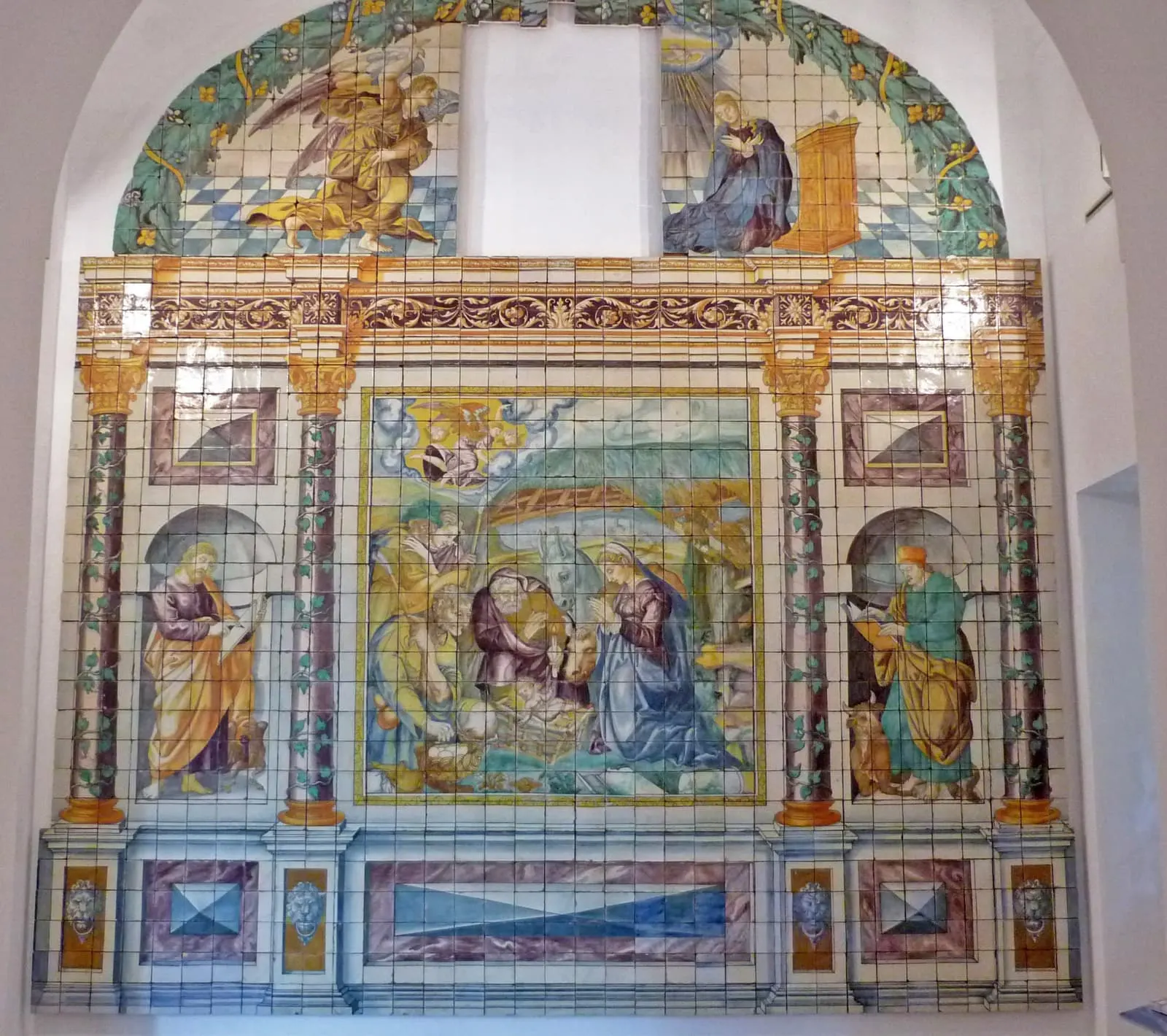
- Built
- séculos XVI–XVII
- Style
- Renascimento / Maneirismo
Maiolica represents a technical and aesthetic break in the history of Portuguese tilework. By maiolica (or faience) is meant the earthenware and tile of ceramic body coated with an opaque white glaze, obtained by adding tin oxide to the lead varnish. This opaque, luminous ground, fired in a second kiln, served as a canvas onto which the painter could apply his motifs directly, with brush and metallic-oxide pigments. It was this freedom that transformed the tile from a repetitive geometric element into a narrative and figurative surface.
The Italian technique and its diffusion
Maiolica was born in Renaissance Italy, where it reached extraordinary sophistication in the centres of Faenza, Urbino and Deruta. Its introduction into the Iberian Peninsula is largely owed to the Italian ceramist Francisco Niculoso, active in Seville from the late fifteenth century, who broke with the medieval techniques of cuerda seca and arista — inherited from the Hispano-Moorish tradition — to paint freely over the flat glaze.
In Portugal, the initial imports came chiefly from Seville and the Low Countries, but from the mid-sixteenth century workshops emerged in Lisbon capable of autonomous production. Decisive in this was the settlement in the capital of Flemish potters, bearers of northern technical knowledge. Maiolica tilework relied on a characteristic palette of five colours stable at high temperature: cobalt blue, bronze green, manganese purple or brown, antimony yellow and, with greater difficulty, iron red.
The great demand of maiolica lies in its irreversibility: the pigment is absorbed by the glaze while still in powder form, with no possibility of correction, so that each brushstroke had to be definitive — a painting without hesitation.
The major works of the Renaissance and Mannerism
Sixteenth-century Portuguese maiolica production left ensembles of remarkable ambition. The paradigmatic example is the Altarpiece of Our Lady of Life, dated 1580 and attributed to the painter Marçal de Matos, originating from the vanished Church of Santo André in Lisbon and today a centrepiece of the Museu Nacional do Azulejo. Composed of some 1,498 tiles, it simulates in trompe-l’œil an architectural altarpiece of columns and niches, with an Adoration of the Shepherds at the centre and an Annunciation inspired by an engraving by Caraglio after Titian — direct testimony to the circulation of Italian models.
From the same generation are the panels of the Chapel of São Roque, in the Church of São Roque, Lisbon, signed and dated by Francisco de Matos in 1584. There, instead of religious scenes, unfolds a repertoire of Mannerist taste — grotesques, acanthus leaves, putti, amphorae, obelisks and medallions — that demonstrates command of ornamental decoration according to the antique-style vocabulary spread throughout Europe. Other ensembles, such as the mythological panels of the Quinta da Bacalhoa (1565), confirm the profane and erudite taste the technique made possible.
From polychrome figuration to the blue-and-white pattern
Despite the virtuosity of these unique pieces, maiolica also proved the ideal support for serial production. At the turn of the sixteenth into the seventeenth century, Lisbon workshops developed the first seventeenth-century pattern tiles, polychrome modules that, combined in geometric grids, clad entire walls of churches and palaces at a more accessible cost. Technical evolution accompanied this mass production, with the progressive shift from lead-rich glazes to lead-alkali glazes.
Maiolica is thus the common trunk of all modern Portuguese tilework: from it derive both the great figurative painting of the Baroque and, later, the chromatic refinement of blue and white. As a branch of the arts of ceramics and faience in Portugal, it remains the founding moment in which the tile ceased to be a wall covering and asserted itself as an autonomous pictorial language.
Frequently asked questions
- What distinguishes maiolica tiles from earlier techniques?
- Maiolica uses an opaque white tin-based glaze that allows painting directly onto the tile, freeing the decoration from the compartmentalisation of mosaic work and the cuerda seca and arista techniques used in Hispano-Moorish tilework.
- When did the maiolica technique reach Portugal?
- The technique spread across the Iberian Peninsula from the late fifteenth century, with domestic production in Lisbon workshops from the mid-sixteenth century onwards, owing above all to Flemish potters who settled there.
- What are the masterpieces of sixteenth-century Portuguese maiolica?
- The most notable are the Altarpiece of Our Lady of Life (1580), attributed to Marçal de Matos, and the grotesque panels of the Chapel of São Roque, signed and dated by Francisco de Matos in 1584.