Places
Barcelos
Barcelos, the comital town of the Minho on the banks of the Cávado: the counts' palace, a medieval bridge, a weekly fair and the tradition of pottery and the…
- Location
- Barcelos, Braga
On the right bank of the River Cávado, in the heart of the Minho, Barcelos is one of the historic towns most laden with memory in the Portuguese northwest. Seat of the first county of the kingdom and, for centuries, the residence of one of the highest lineages of the national nobility, the town preserves a compact monumental core where medieval granite, Baroque devotion and a vivid tradition of popular craftsmanship come together. It belongs to the district of Braga and to the Norte region, and its name circulates around the world today above all through a figure of clay: the rooster.
From town to county
Barcelos received its charter from King Afonso Henriques in 1140, when it was no more than a modest settlement above the Cávado. The decisive leap came in 1298, when King Dinis established the county of Barcelos — the first Portuguese county — whose first holder was D. João Afonso Telo de Menezes. The title would eventually settle in the House of Bragança, and it was one of its members, D. Afonso, eighth Count of Barcelos and first Duke of Bragança, the illegitimate son of King João I, who in the early fifteenth century had the Paço dos Condes (Palace of the Counts) built.
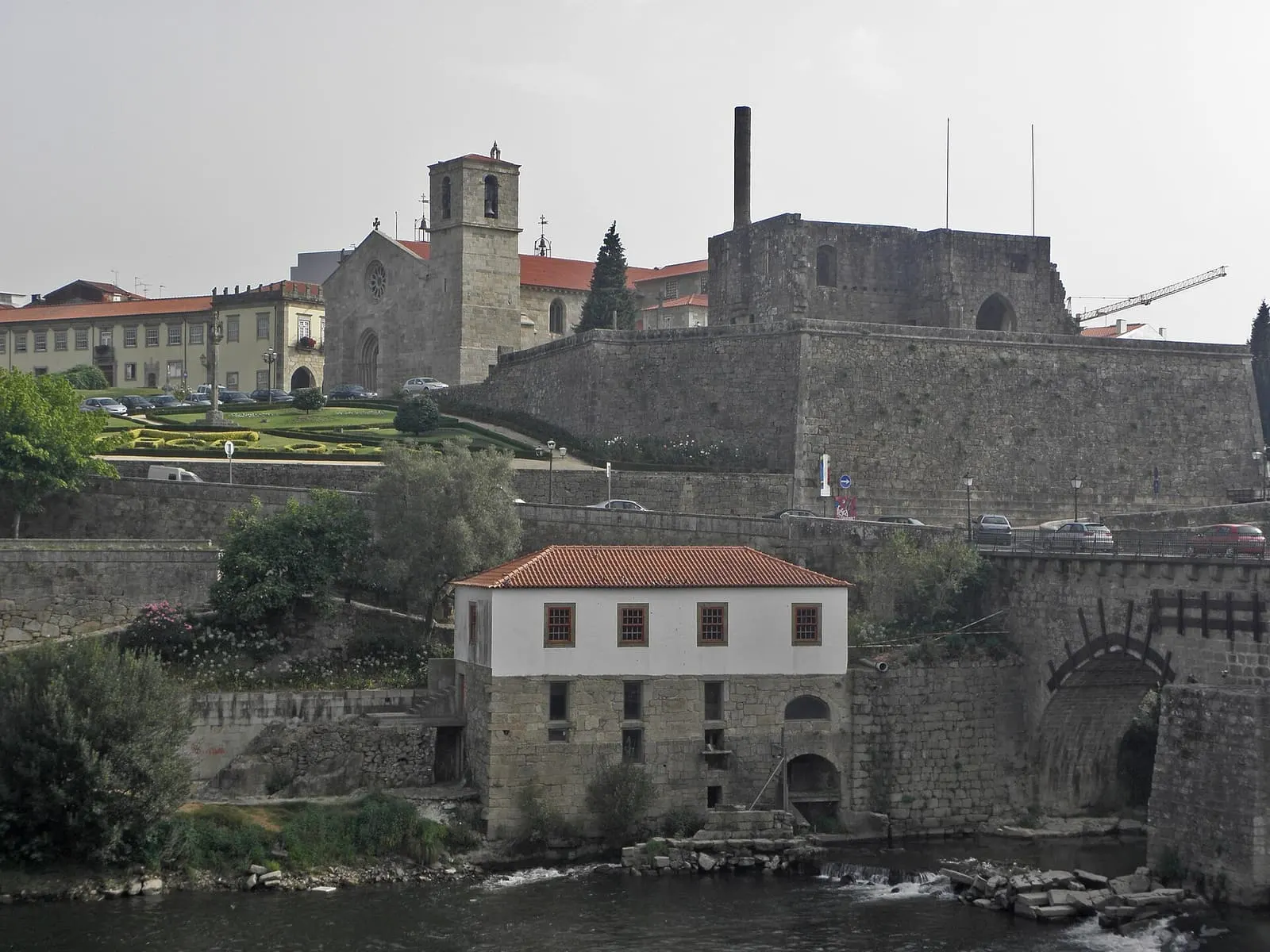
That Gothic palace, with its characteristic tubular chimneys, translated the growing power of its lords into stone. Inhabited until the seventeenth century, it then fell into ruin, a process accelerated by the earthquake of 1755. Today its open-air walls house the Archaeological Museum, and the ensemble has been classified as a National Monument since 1910.
Bridge, churches and the monumental square
A few steps from the palace, the medieval bridge crosses the Cávado and connects Barcelos to Barcelinhos. Built between 1325 and 1330, in the time of D. Pedro Afonso, third Count of Barcelos and bastard son of King Dinis, it rests on five slightly pointed and uneven arches, taking advantage of the granite profile of the banks. It is one of the most remarkable crossings of the medieval period in Portugal and fits naturally into the itinerary of Portuguese medieval bridges.
The axis formed by the bridge, the palace in ruins and the mother church draws, within a few dozen metres, a rare synthesis of Portuguese history: from the Dionysian county to the ducal grandeur of the Bragança.
Around it is gathered a dense monumental ensemble: the Mother Church of Santa Maria, Romanesque in origin with Gothic remodellings; the Temple of Senhor Bom Jesus da Cruz, a Baroque church of centralised plan raised in the eighteenth century; and the Torre da Porta Nova, a vestige of the medieval wall. Barcelos is also a point of passage on the Central Portuguese Way of Saint James, which crosses the city on its way to Compostela and over the centuries nourished its religious and commercial life.
Fair, pottery and the rooster
If there is one tradition that defines Barcelos, it is that of clay. The city is often pointed to as the capital of Portuguese craftsmanship, and its pottery — with figurative pieces of vivid colour and ingenuous forms — has achieved international recognition. It is from this world that the Rooster of Barcelos emerges, born of a legend of a pilgrim saved by a roasted rooster and today turned into one of the national emblems.
The great stage of this material culture is the Barcelos Fair, held on Thursdays in the Campo da República. One of the largest and oldest fairs in the country, it brings together crockery, ceramics and country produce, keeping alive a sociability that goes back to the comital town. Between the stone of its monuments and the colour of its stalls, Barcelos continues to be, at once, an archive of Portuguese medieval history and a thriving centre of the popular art of the Minho.
Frequently asked questions
- Why is Barcelos called a comital town?
- In 1298 King Dinis created the county of Barcelos, the first in Portugal, and the town became the seat of that seigneurial house. The title would later pass to the House of Bragança, linking Barcelos to the most powerful noble lineage in the kingdom.
- What is the origin of the Rooster of Barcelos?
- It springs from a local legend about a pilgrim unjustly condemned and saved by a roasted rooster that crowed. The figure became the symbol of Barcelos craftsmanship and, by extension, one of the most recognised emblems of Portugal.
- When is the Barcelos fair held?
- The Barcelos Fair takes place weekly on Thursdays in the Campo da República, and is one of the largest and oldest fairs in the country, with a strong presence of crockery and regional crafts.
Sources
Keep exploring
Heritage nearby
More places to discover from here. Approximate straight-line distances, within 50 km.