Archaeology
Castro de Romariz
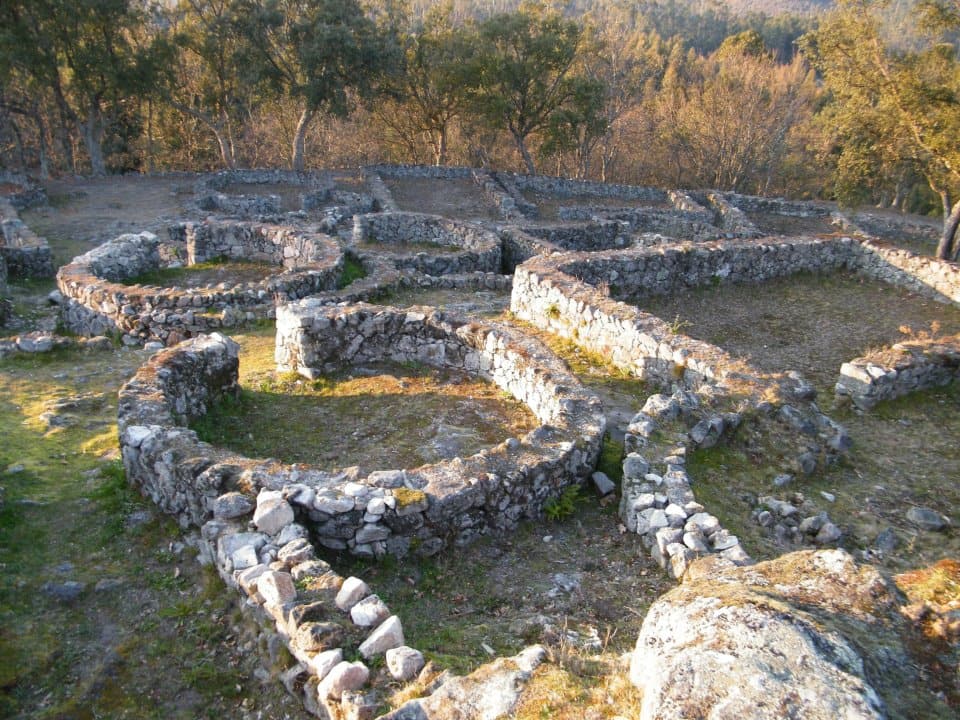
Castro de Romariz, a fortified settlement at Santa Maria da Feira occupied from the Iron Age to the Roman period, famous for its coin hoard.
- Location
- Romariz, Santa Maria da Feira, Aveiro
- Built
- Século V a.C.
The Castro de Romariz is a fortified settlement set on a spur in the parish of Romariz, in the municipality of Santa Maria da Feira (district of Aveiro). Because of its long occupation — spanning the Iron Age and the phase of Romanisation — it is today regarded as one of the most significant archaeological sites in the Entre Douro e Vouga region, a borderland between the great rivers that give it its name.
Chronology and occupation
Archaeological investigations place the founding of the settlement in the fifth century BC, with occupation continuing until the first century AD, by then well into the Roman period. It is thus a site open to a dual reading: on the one hand, it belongs to the Castro culture of the north-west of the Iberian Peninsula, characterised by hilltop settlements defended by walls; on the other, it documents the transformation of those communities during the Iron Age and their later integration into the Roman world.
The choice of location was not accidental. The elevated position ensured visual command over the routes of movement and the surrounding farmland, while also making the settlement defensible — a recurrent logic in the hillforts of the north-west.
The wall and the defensive structure
The defensive system of the Castro de Romariz is organised in two concentric lines of wall, reinforced on the southern side — the most vulnerable — by a ditch. This fortified apparatus enclosed the residential space, where excavations have brought to light platforms and structures that document the evolution of the housing over the centuries of occupation.
The reading of the walls and the dwellings reveals a settlement that did not remain static: over more than half a millennium it adapted to new building techniques and to the influences that arrived through the circuits of exchange.
Finds and trade
The material culture gathered at Romariz stands out for its diversity and its geographical reach. Alongside indigenous materials are Punic, Greek and Roman ceramics, together with glass, metals, coins and inscriptions. This assemblage attests to the settlement’s inclusion in regional and long-distance exchange networks, at a time when the north-western coast was opening up to the Mediterranean.
The most famous find is the Romariz hoard, a coin assemblage identified in the mid-nineteenth century that brought the site into the archaeological literature long before it was scientifically studied. The presence of coinage and the circulation of imported goods help to understand the place of Romariz within the context of the archaeology of Roman Portugal.
Research and classification
After the nineteenth-century discovery, the hillfort underwent a long period of scientific neglect. It was only in 1980 that systematic archaeological work began, allowing the sequence of occupation and the layout of the defences to be clarified. The site has been classified as a Property of Public Interest since 1945 (Decree-Law no. 34 452 of 20 March).
Open to visitors by appointment, the Castro de Romariz forms part of a group of fortified settlements of the north-west that are best read as a network — among them the neighbouring Castro de São Lourenço — and stands as a privileged witness to the most ancient history of the lands of Feira.
Frequently asked questions
- Where is the Castro de Romariz?
- It lies in the parish of Romariz, in the municipality of Santa Maria da Feira, district of Aveiro, on a spur overlooking the valley, in the Entre Douro e Vouga region.
- What protection status does the Castro de Romariz have?
- It has been classified as a Property of Public Interest since 1945, by Decree-Law no. 34 452 of 20 March.
- What is the Romariz hoard?
- It is a set of coins discovered at the site in the mid-nineteenth century, evidence of the trade that linked the settlement to regional and long-distance circuits.
Sources
Keep exploring
Heritage nearby
More places to discover from here. Approximate straight-line distances, within 50 km.