Intangible Heritage
Cavaquinho
The cavaquinho, a small four-stringed chordophone from the Minho, ancestor of the ukulele and a central instrument in the popular music of north-western Portugal.
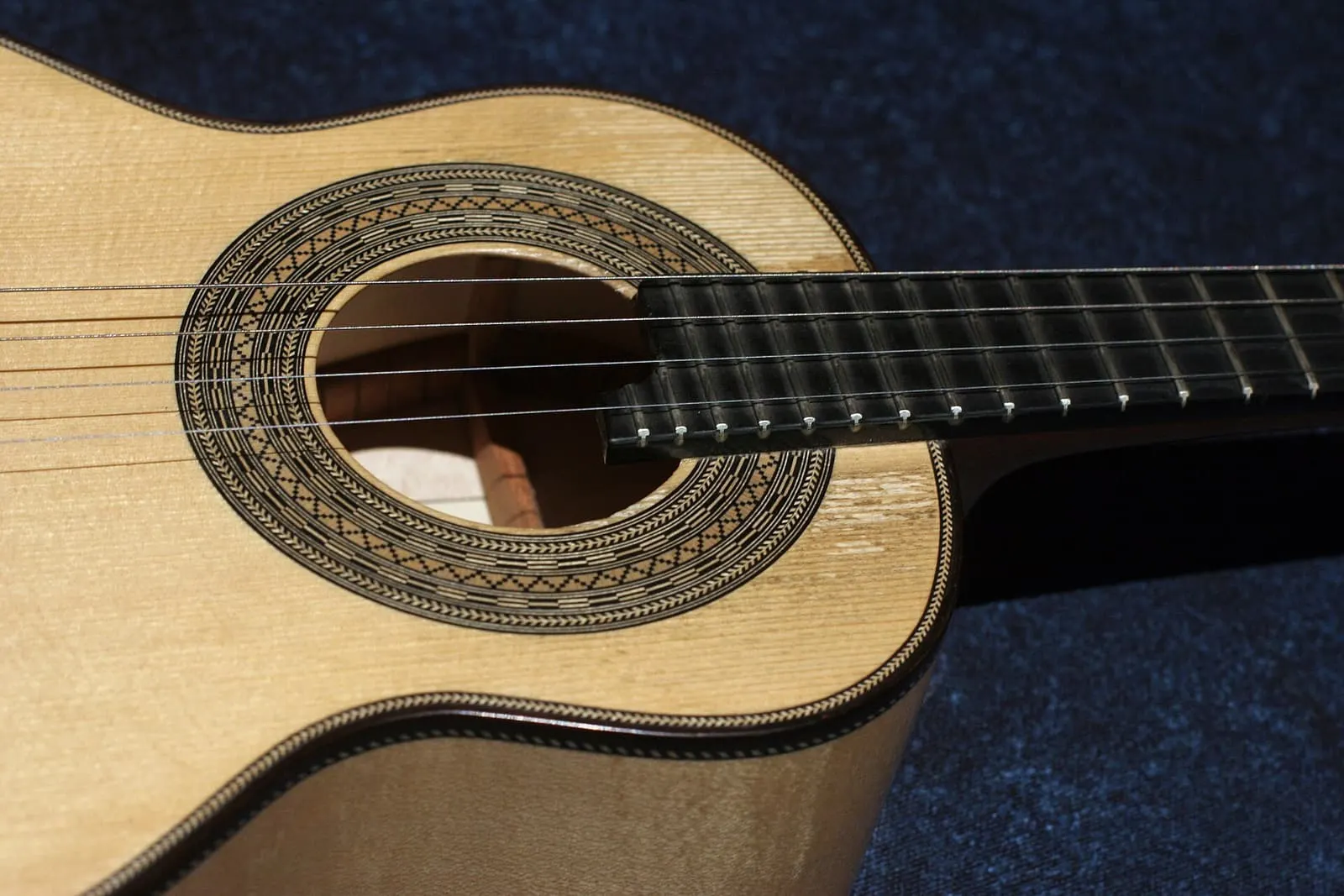
The cavaquinho is a small Portuguese chordophone of the viola family, shaped like a miniature guitar and, in its most common version, strung with four metal strings. With a narrow body and a bright, crystalline tone, it is at once an instrument of rhythmic accompaniment and of melody, able to mark the beat of the dances and to improvise nimble flourishes. In Portugal the strings are usually tuned C-G-A-D, although the instrument is known by countless regional tunings. Despite its modest size, the cavaquinho is probably the most widely diffused Portuguese musical instrument in the world.
A Minho cradle
Its origin lies in the Minho, in north-western Portugal, where it became the instrument par excellence of the rusgas — the festive groups that parade through the streets during pilgrimages and village fairs. The earliest references to the making of the cavaquinho are linked to the workshops of Braga and Guimarães, and it was from here that the instrument spread throughout the country. Two great constructive families can be distinguished: the Minho cavaquinho, with its neck level with the soundboard and metal strings, suited to the strummed, percussive playing of popular festivities, and the Lisbon type, with a raised neck, closer to the technique of the urban violas.
In the context of the traditional music of northern Portugal, the cavaquinho converses with the concertina, the bass drum and the triangle, sustaining the lively pace of the vira, the malhão and the chula. Its learning still takes place today chiefly through oral transmission, within communities and brass bands, in a knowledge that belongs fully to Portuguese intangible cultural heritage.
A chordophone that conquered the world
Accompanying Portuguese navigators and emigrants, the cavaquinho travelled far beyond its frontiers of origin. In Brazil, where it was taken in the nineteenth century, it became one of the pillars of samba and choro, acquiring a slightly larger body and the popular name of cavaco. In Cape Verde it established itself as the rhythmic base of the morna and the coladeira, and it is likewise present in the music of Mozambique and other former geographies of the Portuguese expansion.
Few objects of Portuguese popular culture have had so vast a lineage: from Rio’s samba to the Hawaiian ukulele, the cavaquinho sowed entire families of instruments across the four corners of the world.
The most surprising chapter of this dispersal was written in Madeira. The cavaquinho that arrived there in the mid-nineteenth century gave rise to local variants — the braguinha (literally, the “little one from Braga”) or machete — as well as the larger rajão. In 1879, Madeiran emigrants who landed in Hawaii took these instruments with them; adapted to the precious koa wood and to local taste, they were transformed into the ukulele, today the sonic symbol of the Pacific archipelago.
Identity and continuity
More than an ethnographic curiosity, the cavaquinho remains a living instrument. It continues to be built by artisans of the Minho and played in folk groups, tunas and ensembles of popular music, maintaining its role in the celebration of the calendar’s festivities. It belongs to the great family of traditional Portuguese chordophones, alongside instruments such as the Portuguese guitar and the various regional violas, and it intertwines with the popular music animated by concertinas in the festive repertoire of the north-west.
Its history — from a small street chordophone of Braga to the ancestor of instruments played on every continent — makes it one of the most remarkable ambassadors of Portuguese musical culture, and a testimony to how intangible heritage travels, transforms and reinvents itself without losing the memory of its roots.
Frequently asked questions
- What is the cavaquinho?
- It is a small Portuguese chordophone of the viola family, shaped like a miniature guitar and generally fitted with four strings. With its bright, treble sound, it is used above all to mark the rhythm and to weave rapid melodies in the popular music of the Minho.
- Where does the cavaquinho come from?
- The cavaquinho has its roots in the province of Minho, in north-western Portugal, where it became the instrument of choice for the rusgas and popular festivities. The earliest references to its making are linked chiefly to the cities of Braga and Guimarães.
- What is the relationship between the cavaquinho and the ukulele?
- The cavaquinho reached Madeira in the mid-nineteenth century, where it gave rise to the braguinha, or machete. Madeiran emigrants took this instrument to Hawaii in 1879, where, adapted to the local koa wood, it evolved into the ukulele.