Themes
Caldas da Rainha Ceramics
The ceramics of Caldas da Rainha: naturalistic and satirical faience from Manuel Mafra to Rafael Bordalo Pinheiro, in western Portugal, district of Leiria.
- Location
- Caldas da Rainha, Leiria
- Built
- 1853–1884 (faiança artística)
- Style
- Naturalismo cerâmico
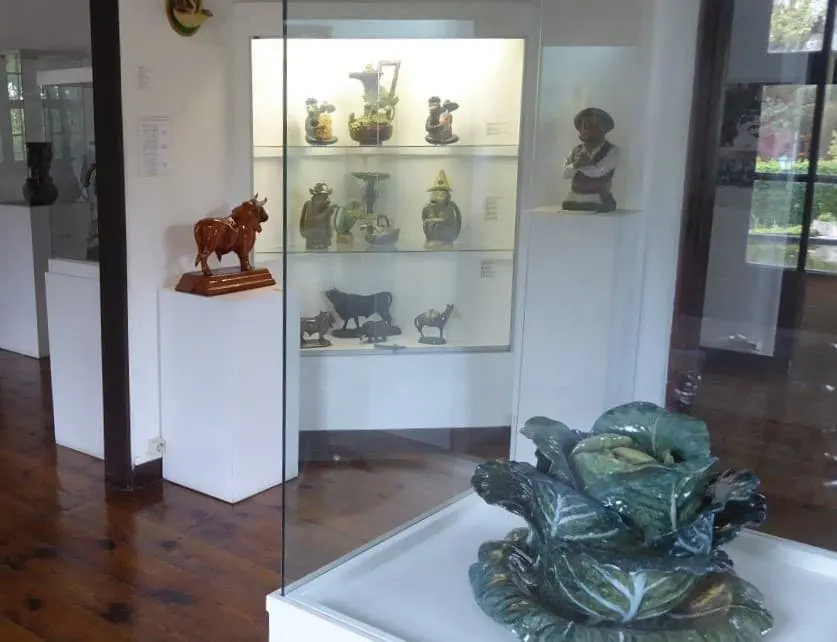
The ceramics of Caldas da Rainha are one of the most original pottery traditions in Portugal. Born in the West, in the district of Leiria, they are distinguished by naturalistic modelling in relief — cabbage leaves, fruit, fish, shells, frogs and lizards — and by a satirical irreverence that few European ceramic centres managed to cultivate. More than tableware, it is a way of commenting on the world, halfway between popular pottery and sculpture.
From popular potteries to artistic faience
Caldas had known pottery production since at least the seventeenth century, linked to the thermal springs that made the town famous. But the turning point came at the start of the nineteenth century with Maria dos Cacos (b. 1797), a potter and market trader whose workshop, active between 1820 and 1853, is regarded as the original engine of the Caldas ceramic centre. Her utilitarian ware, glazed in copper green or manganese brown and of popular taste, paved the way for the next phase.
That phase was that of artistic ceramics, founded by Manuel Cipriano Gomes Mafra (1831–1905), who took over the workshop inherited from Maria dos Cacos and directed it between 1853 and 1905. Mafra established in Caldas the naturalistic style of Palissian inspiration — a reference to the sixteenth-century French ceramist Bernard Palissy — covering plates, jugs and fountains with reptiles, amphibians and vegetation modelled with extraordinary realism. Awarded at the universal exhibitions of Vienna (1873), Philadelphia (1876) and Paris (1878), and a supplier to the Royal Household from 1870, Mafra’s faience projected the name of Caldas internationally.
Caldas ceramics were born humble, in the hands of the market potters, and became art without ever losing the taste for clay, for relief and for colour — a faience that one touches with the eyes.
Rafael Bordalo Pinheiro and satire in clay
The genius who made the ceramics of Caldas universal was Rafael Bordalo Pinheiro (1846–1905), a caricaturist and ceramist who in 1884 founded the Fábrica de Faianças das Caldas da Rainha, with the support of his brother Feliciano and the writer Ramalho Ortigão. Bordalo took the naturalistic tradition to a new level and added an unprecedented dimension to it: social satire. From his hands came pieces depicting the Portuguese society of his time, including the celebrated Zé Povinho, the symbolic figure of the common people, and a gallery of comic types modelled in relief.
The factory’s output was vast — utilitarian and decorative ware, sculpture, building materials and tiles — and Ramalho Ortigão called it “an iconographic narrative” of Portuguese popular history. Despite the financial crises, which led to bankruptcy in 1907 and to the creation, by his son Manuel Gustavo, of the Fábrica de San Rafael in 1908, the legacy endured. The faience of Caldas thus belongs to the wider panorama of Portuguese ceramics and faience and Portuguese decorative arts, alongside traditions such as the black pottery of Bisalhães or the fine porcelain of Vista Alegre.
A living tradition
Caldas ceramics never died out. The Fábrica de Faianças Bordallo Pinheiro remains in operation in the town of Caldas da Rainha, reissuing the historic models and, since 2018, forming part of the Vista Alegre group. The Ceramics Museum and the Bordalo Pinheiro Museum preserve and study this heritage, while countless local workshops perpetuate the craft. The cabbage green, the fountain frog and the relief plate remain, for the Portuguese, an immediate synonym for Caldas — proof of a material culture that managed to be, at once, popular, artistic and profoundly national.
Frequently asked questions
- Who was the principal creator of the artistic ceramics of Caldas da Rainha?
- Manuel Cipriano Gomes Mafra (1831–1905) gave rise to the artistic ceramics of Caldas from 1853 onwards, establishing the Palissian and naturalistic style. Rafael Bordalo Pinheiro later raised it to a satirical and national dimension with the Fábrica de Faianças, founded in 1884.
- What distinguishes the faience of Caldas?
- It is distinguished by its naturalistic relief — leaves, fruit, animals, reptiles and shells modelled by hand and glazed in vivid colours — and by the satirical strand created by Bordalo Pinheiro, who portrayed Portuguese society and figures such as Zé Povinho.
- Is the tradition still alive today?
- Yes. The Fábrica de Faianças Bordallo Pinheiro remains in operation in Caldas da Rainha and, since 2018, has been part of the Vista Alegre group, which reissues the historic models.