Resources
National Railway Museum
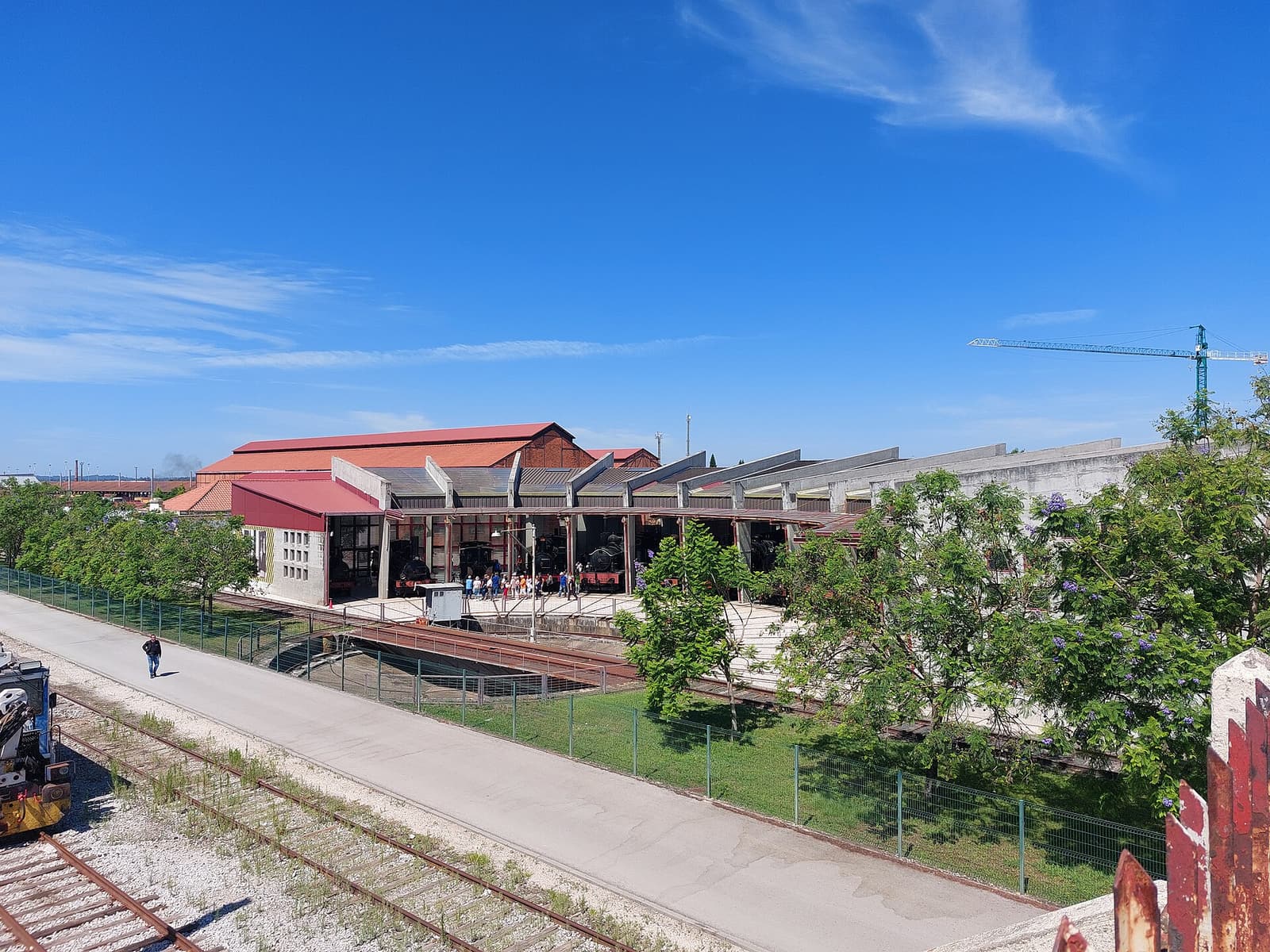
The National Railway Museum in Entroncamento (Santarém district) preserves Portugal's railway heritage within a historic 4.5-hectare complex.
- Location
- Entroncamento, Santarém
- Built
- 2005–2015
In Entroncamento — a city born from a railway junction that even owes its name to the railroad — stands the museum preserving Portugal’s railway memory. The National Railway Museum occupies a historic 4.5-hectare complex by the station, featuring nineteen tracks and workshop buildings that themselves formed the heart of national railway operations for over a century. This is no conventional gallery space, but a working landscape transformed into heritage.
From foundation to opening
The institution originates from the Armando Ginestal Machado National Railway Museum Foundation, established by Decree-Law No. 38/2005 on 17 February, with the mission to collect, conserve and showcase artefacts accumulated by former railway companies and CP over roughly 160 years — dating from the inauguration of Portugal’s first railway section between Lisbon and Carregado in 1856.
Entroncamento’s selection was no accident. The city grew around central workshops and the junction of Northern and Eastern railway lines, remaining for generations a settlement entirely shaped by trains. The museum repurposed iconic site buildings like the 1939 Cottinelli Telmo-designed Provisions Warehouse and the Locomotive Roundhouse. After lengthy preparations, the museum opened on 18 May 2015, International Museum Day.
A life-sized collection
The collection comprises approximately 36,000 objects. Its most spectacular element is rolling stock: steam, diesel and electric locomotives, railcars and carriages tracing the complete technical evolution of railway traction. Among its most symbolically valuable pieces are the Royal Train, used by the monarchy, and the Presidential Train, which served Republic heads of state between 1940-1970 and remains operational for commemorative runs.
Alongside rolling stock, the collection includes workshop equipment, signalling apparatus, station furniture and instruments, uniforms, and significant documentary and photographic archives supporting transport history research. This technical and documentary preservation aligns the museum with other institutions in the Portuguese Museum Network, within the broader context of heritage institution history.
A nationwide network
The National Railway Museum extends beyond Entroncamento. Satellite museum units occupy decommissioned stations and facilities nationwide — including Arco de Baúlhe, Bragança, Chaves, Lagos, Macinhata do Vouga, Valença and Santarém — preserving local track sections, buildings and materials linked to network expansion. This geographical dispersion mirrors railways’ inherent nature: a linear heritage scattered across the country that only makes sense when understood as a system. Through its scale and scope, the museum holds a unique position among Portugal’s national museums as guardian of an industrial heritage frequently threatened by dismantlement.
Frequently asked questions
- When was the National Railway Museum established?
- The National Railway Museum Foundation was created by Decree-Law No. 38/2005 on 17 February. The museum, housed in the Entroncamento railway complex, opened to the public on 18 May 2015, International Museum Day.
- Where is the National Railway Museum located?
- It occupies a 4.5-hectare complex adjacent to Entroncamento station in Santarém district, intrinsically linked to the city's history as the country's primary railway hub.
- What can visitors see at the museum?
- The collection includes approximately 36,000 objects: steam, diesel and electric locomotives, the Royal Train and Presidential Train, carriages, workshop equipment, signalling devices, and extensive documentary archives.
Sources
Keep exploring
Heritage nearby
More places to discover from here. Approximate straight-line distances, within 50 km.
Resources for research
Find the sources. Follow the story.
Guides to researching buildings, exploring museum collections and understanding heritage protection.
SIPA
Get to know the architectural inventory, building records and documentary archive.
Read the guideMuseum collectionsMatrizNet
Explore the museum catalogue and records of works, materials, authorship and provenance.
Read the guideHeritage protectionHeritage classification
Understand cultural property categories and the levels of national, public and municipal interest.
Read the guide