Themes
Façade Azulejo
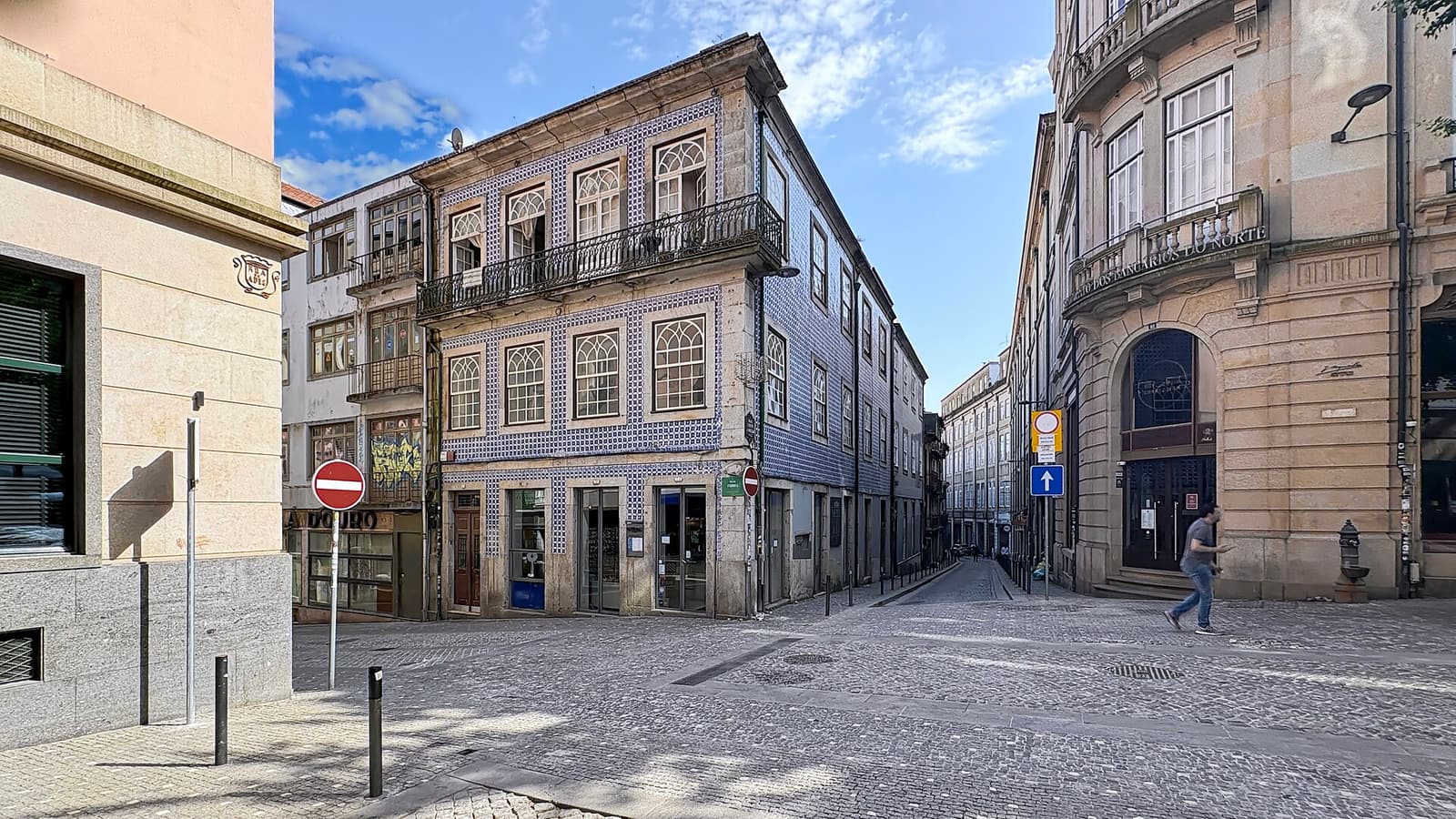
Façade azulejos clad thousands of Portuguese urban buildings in the nineteenth century, from Porto to Lisbon, in a dialogue between Portugal and Brazil.
- Built
- c. 1830–1920
- Style
- Romantismo e Arte Nova
The façade azulejo is one of the most recognisable features of the Portuguese urban landscape: thousands of buildings in Porto, Lisbon, Aveiro, Ovar or Viana do Castelo are entirely clad in glazed ceramic, with repeated patterns that play with light, colour and reflection. It is an essentially nineteenth-century phenomenon, which took the azulejo out of the interior of churches and palaces — where it had reigned since the sixteenth century — and transferred it to the exterior of the ordinary house, in the service of a new city, bourgeois and industrial.
Origin and the question of the “brasileiros”
The spread of tiled façades can be placed somewhere between the 1830s and 1840s, gaining enormous scale in the second half of the century. The traditional explanation points to the so-called “brasileiros” — Portuguese emigrants who had grown wealthy in Brazil and who, after the independence of the former colony in 1822, returned and are said to have imported a building habit more common on the other side of the Atlantic, where ceramic already protected exterior walls against damp.
More recent research nuances this account. The taste for exterior cladding established itself above all as an urban and cosmopolitan phenomenon, with strong expression in both Porto and Lisbon, and not always dependent on the individual return of emigrants. What is certain is the reversal of an artistic traffic: for centuries Portugal had exported azulejo to Brazil; in the nineteenth century the fashion for clad façades crossed both shores of the Atlantic in constant dialogue.
The façade azulejo was not merely decoration: it was the first mass response to a concrete problem — to protect and dignify, at low cost, the façade of the bourgeois house in a rapidly growing city.
Industrial production
The success of the façade azulejo owes itself to the industrialisation of ceramics. The use of semi-industrial techniques, above all stencilling and mechanical pressing with imported metal moulds, made it possible to mass-produce the low-cost pattern azulejo, capable of covering entire walls with borders framing doors and windows.
In Porto and Vila Nova de Gaia, factories such as Massarelos, Miragaia, Carvalhinho and Santo António do Vale da Piedade flourished. Among them all, the Fábrica de Cerâmica das Devesas stood out, founded in the mid-1860s in Gaia, which became the largest national producer of ceramic applied to architecture and dominated the sector until around 1915. In Lisbon and its surroundings, Viúva Lamego, the Fábrica da Roseira, the Constância and the great Fábrica de Sacavém produced for façades. This dense network of factories explains why the North and the capital became the two great poles of exterior azulejo cladding.
Styles, decline and protection
The earliest cladding drew on geometric and floral patterns of romantic origin, close to the tradition of the blue-and-white azulejo, but quickly diversified with reliefs, bevels and intense polychromy. At the turn of the century, the taste of Art Nouveau renewed the repertoire, with figurative panels and plant-inspired compositions that still punctuate entire streets today.
Throughout the twentieth century, many façades decayed or were destroyed, and the sale of antique azulejos fed a trade that gutted entire buildings. Heritage awareness, driven by movements such as SOS Azulejo, culminated in Law no. 79/2017, which made the removal of façade azulejos subject to licensing. Today, this heritage is studied and disseminated by institutions such as the Museu Nacional do Azulejo, and its value is recognised at the scale of the city — as in the historic centre of Porto, where façade azulejos are an inseparable part of the visual identity classified by UNESCO.
Frequently asked questions
- What sets the façade azulejo apart from the traditional azulejo?
- Unlike the interior azulejo, conceived for churches and palaces, the façade azulejo covers the exterior of buildings. Mass-produced in repeated patterns, it was intended for the ordinary architecture of the nineteenth-century bourgeois city.
- Did emigrants returning from Brazil bring the façade azulejo?
- Tradition attributes the custom to the "brasileiros", emigrants who returned after Brazil's independence in 1822. Recent research nuances this idea: the taste was above all urban and Portuguese, with strong expression in both Lisbon and Porto.
- Is the façade azulejo protected by law in Portugal?
- Yes. Law no. 79/2017 of 18 August makes works involving the removal of façade azulejos subject to municipal licensing, halting decades of destruction of this heritage.