Periods & Styles
Neo-Manueline Style
The Neo-Manueline style: the Romantic revival of the Manueline as a national idiom in Portugal, from the Pena Palace to Rossio Station.
- Built
- 1839–1910
- Style
- Neomanuelino
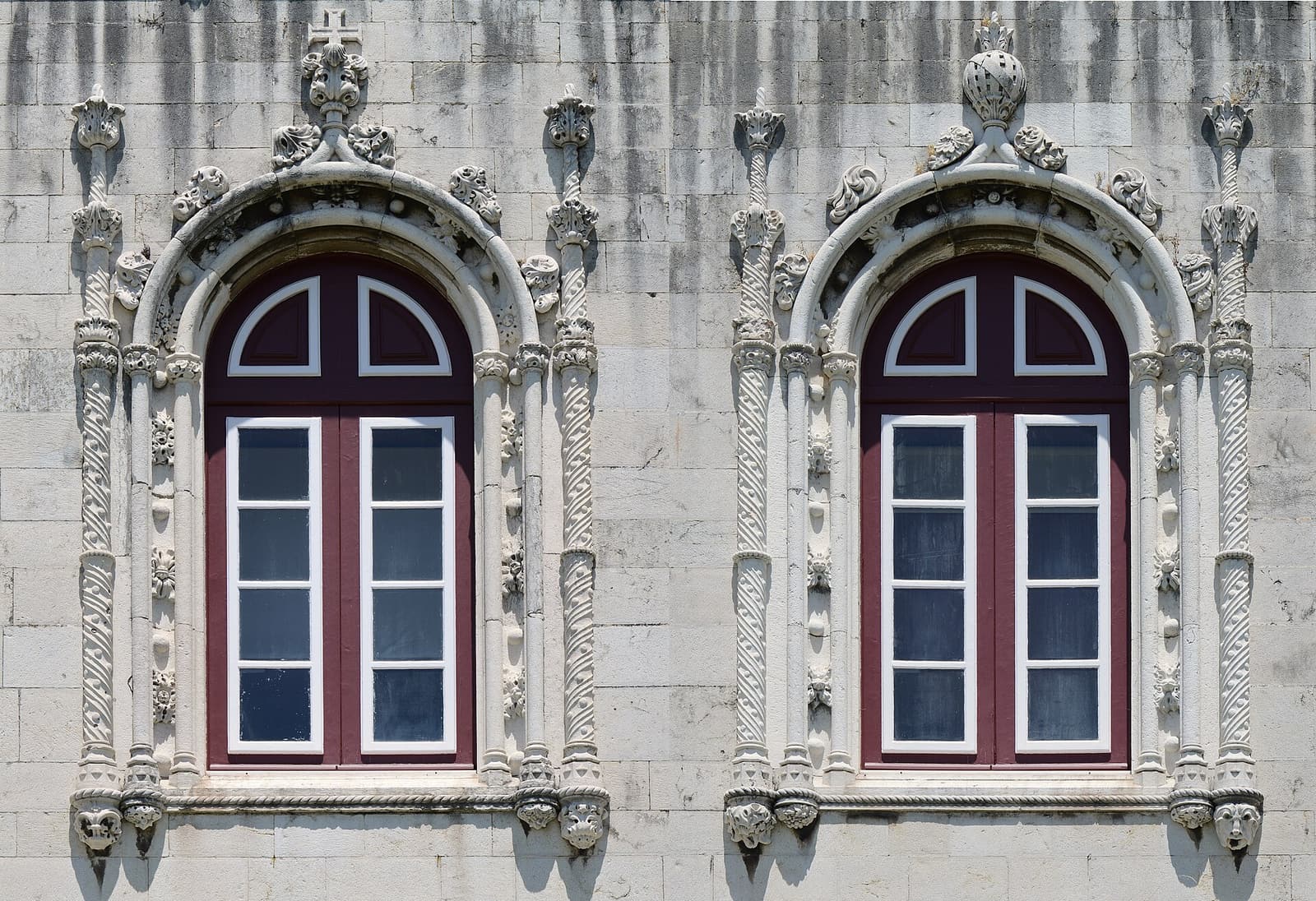
The Neo-Manueline style is the most characteristic form of the architecture of Portuguese Romanticism. Between the mid-nineteenth century and the first decades of the twentieth, architects and patrons revived the ornamental vocabulary of the sixteenth-century Manueline — ropework, armillary spheres, crosses of the Order of Christ, and vegetal and maritime motifs — not as a mere archaeological quotation, but as a living idiom in the service of an idea of nation. It is to nineteenth-century Portuguese architecture what Neo-Gothic is to the rest of Europe.
A revival with a national bent
The name itself results from joining the Greek prefix neo (“new”) with “Manueline”, a term coined in 1842 by the historian Francisco Adolfo de Varnhagen to designate the artistic production of the reign of Manuel I (1495–1521). The coincidence between that flowering and the Age of Discovery made the original style especially apt to be reappropriated: at a moment of identity-building, to evoke the Manueline was to evoke the maritime and imperial apogee of Portugal. Part of the broader wave of Romanticism and the revivals, the Neo-Manueline distinguished itself by choosing a genuinely national historical reference rather than importing foreign models.
Where the rest of Europe looked to its Gothic cathedrals in search of roots, Portugal found its own in the decorative exuberance of Belém and Batalha.
From the Pena to the Rossio
The trend was inaugurated in the years 1839 to 1849, with the remodelling works of the Pena National Palace in Sintra, promoted by Ferdinand II and directed by the Baron of Eschwege. There the Neo-Manueline coexists with the Neo-Gothic, the Neo-Islamic and the Neo-Renaissance, in a deliberate eclecticism that reflects the Romantic fascination with the exotic and with mixture.
The public consecration of the style would come later, with Rossio Railway Station in Lisbon, designed by José Luís Monteiro from 1886 onwards. Its façade, with the two interlaced horseshoe portals, pilasters, buttresses, pinnacles and the clock tower, constitutes a scenographic recreation of the Manueline applied to a modern programme — a railway station. Other examples followed, such as the Bussaco Palace Hotel, designed by Luigi Manini (1888–1907), who would also design the Quinta da Regaleira in Sintra from 1904. Between 1878 and 1895, Domingos Parente da Silva completed, in a Neo-Manueline register, the central body of the Jerónimos Monastery.
Persistence and decline
The Neo-Manueline was not confined to great public buildings: it spread to small palaces, country houses, furniture and the decorative arts, also extending to Brazil and the former Lusophone world. It is distinguished from other contemporary currents, such as the Neo-Gothic, precisely by the national symbolic charge associated with it. From the 1910s onwards, the exhaustion of the repertoire and the emergence of new idioms — from Modernism to the so-called “Português Suave” — gradually relegated the style to the background, but its mark remains visible in the Portuguese urban landscape, especially in Lisbon and Sintra. For the context of the currents that preceded and followed it, see the overview of the periods and styles of Portuguese architecture.
Frequently asked questions
- What is the Neo-Manueline style?
- It is the revivalist current that, between the mid-nineteenth and the early twentieth century, recovered the decorative vocabulary of the sixteenth-century Manueline as the expression of a national Romantic architecture in Portugal.
- Which is the most emblematic Neo-Manueline building?
- Rossio Station in Lisbon, designed by José Luís Monteiro from 1886 onwards, is the most celebrated public example, although the Pena National Palace set the trend in motion.
- Why did the Neo-Manueline emerge?
- It arose from the nineteenth-century Romantic taste for historical styles and from the desire to assert a Portuguese identity, choosing the Manueline — associated with the Age of Discovery — as the national equivalent of European Neo-Gothic.