Periods & Styles
Neo-Gothic Style in Portugal
The Neo-Gothic style in Portugal: the nineteenth-century Gothic revival in palaces, churches and tombs, from restored ruins to the romantic fantasy of Sintra.
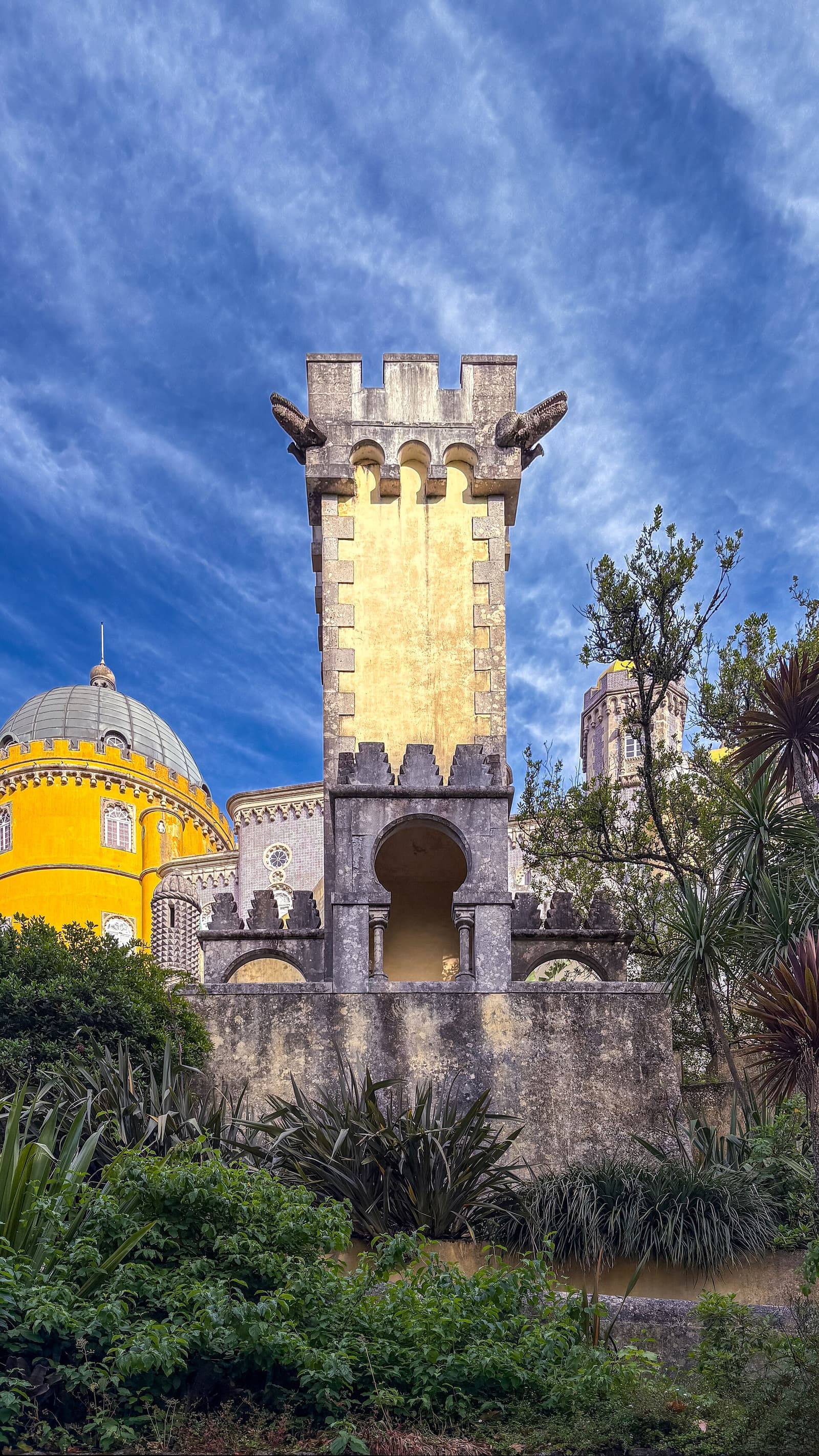
The Neo-Gothic style designates the revivalist current that, throughout the nineteenth century, took up again the forms of medieval Gothic architecture — the pointed arch, the ribbed vault, the pinnacle, the battlement and the gable — after more than two centuries in which the classical vocabulary had dominated Europe. Born in England in the mid-eighteenth century, first as a picturesque caprice and later as a doctrinal language, the Gothic revival reached Portugal at a moment of profound reassessment of the medieval past, inseparable from the Romantic sensibility and the cultural nationalism that ran through the age.
An imported taste, a national reading
In Portugal, the Neo-Gothic rarely appeared in its “pure” English or Germanic form. The Portuguese peculiarity was the almost immediate fusion of the revived Gothic with the memory of the Manueline, the late and exuberant Gothic of the age of the Navigations. From this contamination was born the Neo-Manueline style, the national variant that stands to nineteenth-century Portuguese architecture as the Neo-Gothic does to the rest of Europe: where others looked back to the medieval cathedral, the Portuguese looked back to the Torre de Belém and the Mosteiro dos Jerónimos, symbols of a golden age that they sought to resurrect.
Portuguese Neo-Gothic was less a style than a way of imagining the nation: in choosing the pointed arch, one also chose a version of the national history.
Restoration, fantasy and the romantic cemetery
The nineteenth century was, above all, the age of restoration. Several medieval monuments — the Torre de Belém, the Mosteiro da Batalha, the Jerónimos from 1867 onwards — were consolidated and, frequently, recreated in a more or less fanciful manner, in a Neo-Gothic or Neo-Manueline key. This impulse confused archaeological restitution with invention, returning to the buildings not so much what they had been as what nineteenth-century taste believed they ought to have been.
Alongside restoration, entirely new works arose. The Palácio Nacional da Pena, rebuilt from 1838 upon the ruins of a Hieronymite monastery wrecked by the earthquake of 1755, is the inaugural and most celebrated work: commissioned by King Ferdinand II and designed with the engineer Wilhelm von Eschwege, it deliberately combines Neo-Gothic battlements and pointed arches with Neo-Manueline ropework, Neo-Islamic horseshoe arches and Neo-Renaissance schemes. Nearby, the Palácio de Monserrate and, already in the early twentieth century, the scenographic Quinta da Regaleira, built by the collector Carvalho Monteiro with the Italian set designer Luigi Manini, prolonged this universe of revivalist fantasy in the Sintra hills.
The Neo-Gothic also left its mark on funerary architecture: the nineteenth-century cemeteries, such as that of Prazeres in Lisbon, filled with chapel-tombs of pinnacles and gables, in which Gothic verticality served religious aspiration and the status of bourgeois families. In a civil and industrial register, iron structures were ornamented with Gothic motifs, in a characteristic late-century marriage of new technique and medieval imagery.
The place of the Neo-Gothic among the revivalisms
The Neo-Gothic did not act in isolation. It was inscribed in the vast movement of Romanticism and the revivalisms, sharing the stage with the Neo-Arabic, the Neo-Romanesque and, above all, with the vigorous Neo-Manueline. This eclectic coexistence distinguishes the Portuguese case: while in other countries the revived Gothic aspired to a unified national style, in Portugal it coexisted — and at times dissolved — in the search for a language of its own, more tied to the maritime epic than to the medieval cathedral. It was also a reaction against the academicism of the Neoclassicism that had preceded it, opposing to the serene classical order the picturesque, asymmetry and the evocation of an idealised past.
Today, Portugal’s Neo-Gothic buildings read less as faithful restitutions of the Middle Ages than as living documents of the nineteenth-century imagination — testimonies to how a nation, in the very century of progress, chose to look backwards in order to project itself into the future.
Frequently asked questions
- What is the Neo-Gothic style?
- It is a revivalist current that emerged in England in the mid-eighteenth century and spread across Europe in the nineteenth, reviving the forms of medieval Gothic architecture — pointed arches, pinnacles, battlements and gables — in opposition to the prevailing classicism.
- What is the difference between Neo-Gothic and Neo-Manueline in Portugal?
- The Neo-Gothic draws on medieval European Gothic in general, whereas the Neo-Manueline specifically revives the Manueline, the late Portuguese Gothic of the Age of Discovery, with its maritime decoration and twisted ropework.
- What is the most famous example of the Neo-Gothic in Portugal?
- The Palácio Nacional da Pena, in Sintra, rebuilt between 1838 and 1854 for King Ferdinand II, is the founding work of Portuguese revivalist architecture, combining Neo-Gothic, Neo-Manueline, Neo-Islamic and Neo-Renaissance elements.