Periods & Styles
The Manueline Style
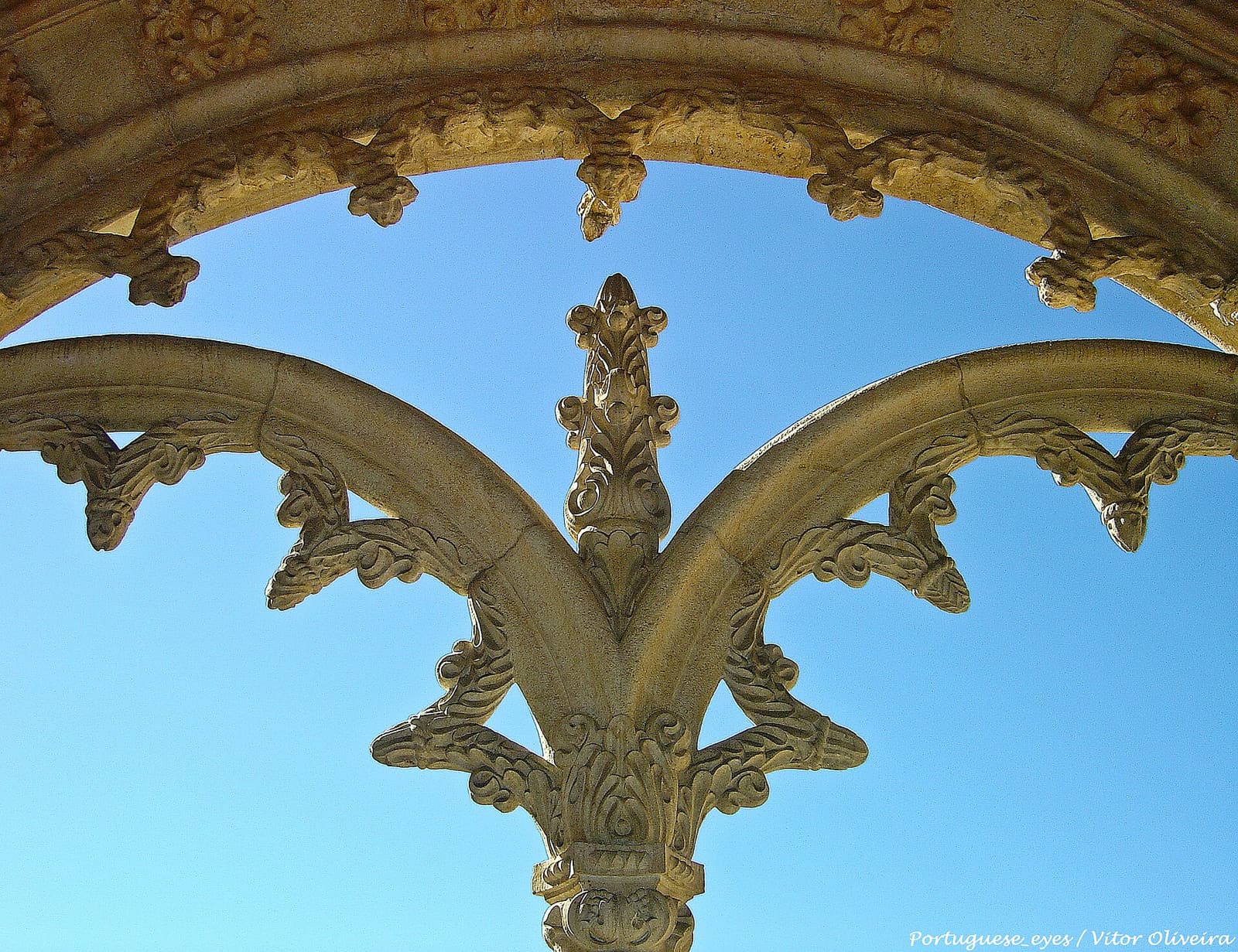
The Manueline style, Portuguese Late Gothic of the reign of King Manuel I (1495-1521), marked by the nautical, naturalistic and heraldic ornamentation of the…
- Built
- c. 1490-1540
- Style
- Manuelino
The Manueline style is the artistic expression of Portuguese Late Gothic developed above all during the reign of King Manuel I, “the Fortunate” (1495-1521), extending for some decades after his death. More than a new architecture, it is an essentially decorative and sculptural language, applied to structures of Gothic roots which, in a period of prosperity fuelled by the Age of Discovery, are clothed in a dense, exuberant and profoundly symbolic ornamentation.
Origin of the term
The designation is not contemporary: it was proposed only in 1842 by the Luso-Brazilian historian Francisco Adolfo Varnhagen, in his Notícia Histórica e Descriptiva do Mosteiro de Belém, who associated the style with the monarch under whose reign it reached its apogee. Though convenient, the label tends to suggest a unity the phenomenon does not possess: the Manueline is not an architectural order with rules of its own, but rather an ornamental repertoire superimposed on structural solutions inherited from Gothic architecture and, occasionally, already open to the early Renaissance.
Decorative vocabulary
The originality of the Manueline lies in its iconographic programme. Onto a base of Flamboyant Gothic are grafted Plateresque elements and Mudéjar and Oriental influences, giving rise to a profusion of motifs that simultaneously celebrate faith, the monarchy and maritime adventure.
For the first time in European art, the sea ceases to be a backdrop and becomes decorative matter: ropes, knots, anchors, shells, corals and seaweed invade portals and vaults as though the stone had been fished from the ocean.
To the nautical motifs are added naturalistic elements — artichokes, pine cones, foliage, exotic fauna — and the great emblems of royal power, foremost among them the armillary sphere, the personal device of King Manuel, and the cross of the Order of Christ. Twisted columns, polylobed arches and vegetal mouldings complete a system that privileges plastic effect and the richness of the surface over the clarity of the structure.
The great monuments
The Manueline asserts itself in exceptional works, owed to a remarkable group of masters. The Jerónimos Monastery in Belém, begun by Diogo Boitaca and continued by João de Castilho, offers in its south portal and cloister the most complete synthesis of the style. Nearby, the Belém Tower, designed by Francisco de Arruda, combines the military tradition with loggias and decorative merlons of Moroccan inspiration.
In Tomar, the celebrated Chapter Window of the Convent of Christ, attributed to Diogo de Arruda, raises the motif of the rope and the armillary sphere to the very limit of sculptural virtuosity. At the Batalha Monastery, Mateus Fernandes signed the portal of the Unfinished Chapels, where the stone lacework attains an almost obsessive density. To these are added interventions in churches, portals and cloisters throughout the kingdom, from the Algarve to Trás-os-Montes.
Legacy
Around 1540, the advance of the classical Renaissance, more sober and rational, rendered the Manueline obsolete. The style remained, however, in the national memory as the artistic expression of the golden age of the Discoveries. In the nineteenth century, the Romantic movement revived its vocabulary in the Neo-Manueline style, which adorned stations, palaces and pavilions with quotations from the sixteenth-century grammar. Today, the Manueline is recognised as one of Portugal’s most original contributions to the history of European art.
Frequently asked questions
- Who coined the term "Manueline"?
- The term was coined by the Luso-Brazilian historian Francisco Adolfo Varnhagen in 1842, in his work on the Jerónimos Monastery, in honour of King Manuel I, under whose reign the style flourished.
- What are the main decorative motifs of the Manueline?
- Nautical and naturalistic motifs predominate — ropes, knots, anchors, shells, corals, seaweed and exotic fauna — alongside royal symbols such as the armillary sphere and the cross of the Order of Christ.
- Which are the most emblematic Manueline monuments?
- The Jerónimos Monastery and the Belém Tower in Lisbon, the Chapter Window of the Convent of Christ in Tomar, and the Unfinished Chapels of the Batalha Monastery.