Typologies
Lighthouses
The lighthouses of Portugal: a history of maritime signalling, the Lighthouse Directorate and the built heritage strung along the mainland coast, the Azores…
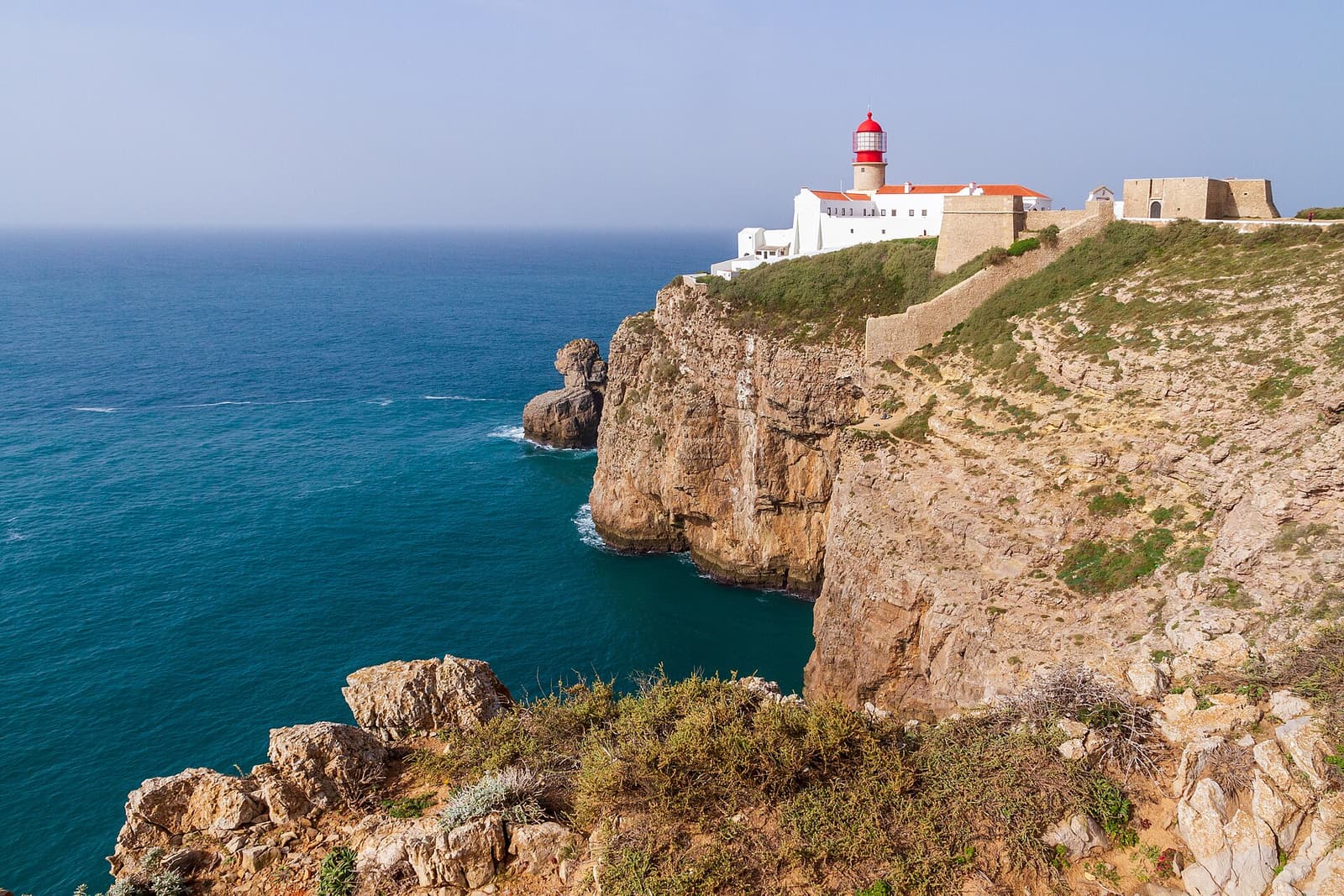
Lighthouses constitute one of the most singular typologies of Portuguese built heritage: functional structures, raised to ensure the safety of navigation, which over five centuries became defining landmarks of the coastal landscape. Inseparable from the country’s Atlantic vocation, they accompanied the Age of Discovery and, later, the intense commercial route that rounds Cape St Vincent, one of the busiest maritime junctions on the planet.
From bonfires to the Pombaline network
Before any organised service existed, the marking of the coast was rudimentary and scattered. Confraternities, convents and private individuals lit bonfires on high ground to guide ships — not always with good intentions, for there were those who deliberately caused shipwrecks in order to plunder them. The first regular light appeared in 1520, in the tower of the convent of São Vicente, at the south-western tip of the Algarve, beside what is today the fortress of Sagres.
It took the pragmatism of the Enlightenment to transform scattered bonfires into a deliberate network in the service of the State and of commerce.
The decisive turning point came under the Marquis of Pombal. The decree of 1758 ordered six lighthouses to be raised along the mainland coast, entrusting their administration to the Board of Trade. Among them was the Bugio light, installed atop the fort of São Lourenço da Cabeça Seca, at the mouth of the Tagus, which entered service in 1775 and remains in operation — a remarkable example of a military fortification reconverted into an aid to navigation.
Form, function and materials
The architecture of lighthouses is rigorously subordinate to function: to raise a light source high enough for its range to overcome the curvature of the horizon. Hence the predominance of slender towers, frequently of stone masonry, with cylindrical, octagonal or quadrangular plans. The painting in contrasting bands — white and red, white and blue — is not ornament but a daytime code that allows each lighthouse to be distinguished in daylight, complementing the rhythm proper to each light at night.
The nineteenth century brought technical advances that bring lighthouses closer to another typology of modernity, iron architecture, with metal structures, glazed lanterns and, above all, the Fresnel dioptric optic, which multiplied the range of the lights. The lighthouse at Cape St Vincent, ordered to be built by Queen Maria II in 1846 and heightened in 1908, received a hyper-radiant optic with a focal length of 1330 mm, the largest in the country and one of the few in the world, with a range exceeding 30 nautical miles.
A network among fortresses and archipelagos
The link between lighthouses and defensive architecture is recurrent in the Portuguese case. Many lights were installed on points and capes already occupied by military structures, in dialogue with the typology of the coastal forts and the towers and watchtowers that watched over the coast. Bugio, Santa Marta in Cascais or Cape St Vincent illustrate well this overlapping of surveillance, defence and orientation functions.
Since 1892 the network has been the responsibility of the Navy, with technical management ensured by the Lighthouse Directorate, created in 1924 and today integrated into the Directorate-General of the Maritime Authority. The ensemble comprises around 50 lighthouses — roughly thirty on the mainland, sixteen in the Azores and seven in Madeira —, to which are added hundreds of minor lights, buoys and fog signals. The widespread automation of the twentieth century dispensed with resident keepers, but conferred on these buildings a new heritage status: several are today listed and some, like that of Santa Marta, have opened to the public as museums dedicated to five centuries of the history of the illumination of the Portuguese coast, within the broader framework of the typologies of built heritage.
Frequently asked questions
- Which is the oldest lighthouse in Portugal?
- The first regular official light appeared in the tower of the convent of São Vicente, at Cape St Vincent, in 1520. Among the lighthouses still in service, the Bugio light, at the mouth of the Tagus, is one of the oldest, entering service in 1775 following the Pombaline decree of 1758.
- Who manages the Portuguese lighthouses?
- Since 1892 the lighthouse network has been the responsibility of the Portuguese Navy. Technical management falls to the Lighthouse Directorate, created in 1924 and integrated into the Directorate-General of the Maritime Authority.
- How many lighthouses are there in Portugal?
- The Lighthouse Directorate operates around 50 lighthouses: roughly 30 on the mainland coast, 16 in the Azores archipelago and 7 in Madeira, in addition to hundreds of minor lights, buoys and other navigation marks.