Monuments
Fortress of Sagres
The Fortress of Sagres, a fortified complex on the promontory of Vila do Bispo, in the Algarve, linked to the Infante Dom Henrique and the enigmatic Compass Rose.
- Location
- Sagres, Faro
- Built
- século XV
- Style
- Abaluartado
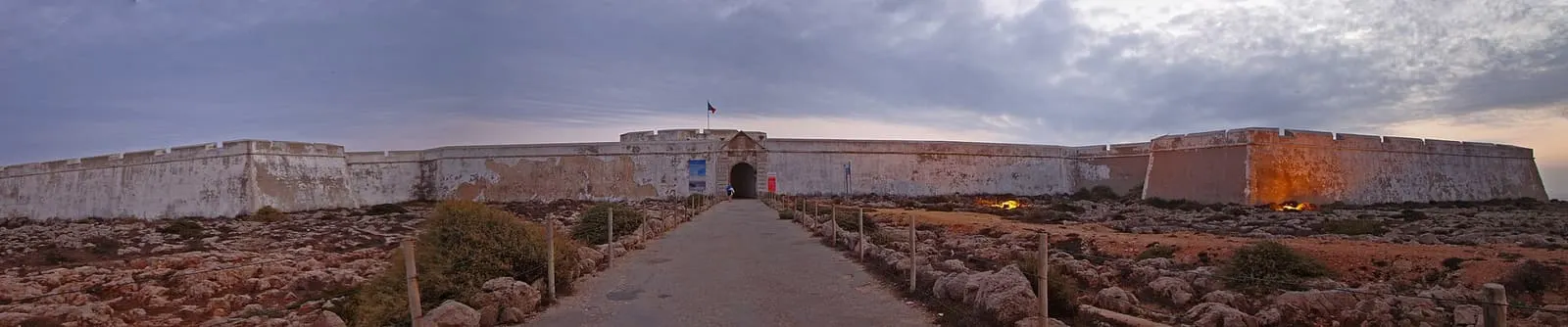
The Fortress of Sagres occupies the tip of the promontory of Sagres, in the parish of the same name in the municipality of Vila do Bispo, at the south-western extremity of the Algarve. Raised on a rocky platform battered by the Atlantic, near Cape St Vincent, it is one of the places of greatest symbolic density in Portuguese memory, inseparable from the figure of the Infante Dom Henrique and the age of the Discoveries.
From the Vila do Infante to the fortress
The occupation of the promontory goes back to the 15th century. In 1443, the Infante Dom Henrique obtained from the regent Dom Pedro authorisation to raise a settlement on the site, which he called in his letters “my vila do Infante” — also referred to as Terçanabal or Terçanaval. This nucleus, composed of buildings protected by walls, served as a residential and administrative centre linked to the Henrican maritime enterprise, on an isolated and exposed point that only slowly attracted settlers over the course of the 1450s. The Infante died in 1460, and the tradition that made of Sagres a “nautical school” or an astronomical observatory is today considered, in its mythified form, a later construction, even though the promontory was indeed a hub of Atlantic expansion.
The image of Sagres as a “school of navigators” owes more to Romantic historiography than to fifteenth-century sources: what existed here was above all a vila do Infante, a support base and seasonal residence, and not a formal academy.
The fortification seen today
Little remains of the Henrican configuration. The fortress was severely shaken by the earthquake of 1755, which ruined a large part of the walls, and the reconstruction begun in 1793, under the direction of the engineer José de Sande Vasconcelos, profoundly altered the complex. The present layout, with its long bastioned wall closing off the entrance to the promontory, reflects above all that eighteenth-century intervention and the remodellings of the 20th and 21st centuries. Within the enclosure survives the small Church of Nossa Senhora da Graça, with a single nave and a barrel vault, built in the Henrican period and preserving funerary slabs.
The enigmatic Compass Rose
The most famous element of the complex is the so-called Compass Rose, a vast paved circular structure with dozens of radial lines, uncovered on the promontory. Its function remains unclear: it has been interpreted as a compass rose, as a gigantic sundial, or as a vestige associated with an old hermitage. The absence of secure dating keeps the discussion alive and feeds the fascination that the place exerts on visitors.
A coastal defensive system
The Fortress of Sagres was not an isolated element: it was part of a system for the defence of the Algarve coast that included the nearby Fortress of Belixe and the Fort of São Vicente, beside the cape. This network watched over one of the busiest maritime routes of Atlantic Europe and responded to the threat of piracy and corsairs. Within the context of Portuguese military heritage, Sagres converses with the country’s other fortifications and with the world of medieval castles, although its bastioned idiom brings it closer to modern military architecture. A few kilometres away, the Castle of Silves bears witness to the region’s Islamic legacy, while the town of Lagos and the wider Algarve complete the historical itinerary of the south-west of the Peninsula.
Classified as a National Monument in 1910, the Fortress of Sagres is today a site open to visitors, where the grandiose landscape of the promontory — cliffs, ocean and horizon — surpasses, in evocative power, the very structures that survive there.
Frequently asked questions
- Was the Fortress of Sagres built by the Infante Dom Henrique?
- The original core dates from the 15th century and is associated with the Infante Dom Henrique, who established his Vila do Infante here after 1443. The fortification seen today, however, is the result of successive later works, above all the reconstruction begun in 1793 after the earthquake of 1755.
- What is the Compass Rose of Sagres?
- It is a large paved circular structure, about 43 metres in diameter and with radial lines, uncovered on the promontory. Its function remains debated: it has been interpreted as a sundial, a compass rose, or the mark of an old hermitage, with no definitive theory.
- Is the Fortress of Sagres a National Monument?
- Yes. The Tower and Walls of Sagres were classified as a National Monument in 1910, and today form part of the heritage complex managed as a site open to visitors on the promontory of Sagres.
Sources
Keep exploring
Heritage nearby
More places to discover from here. Approximate straight-line distances, within 50 km.