Typologies
Convents and Friaries
The convents of the mendicant and religious orders in Portugal: architecture, cloister, conventual church, history, and the impact of the 1834 dissolution.
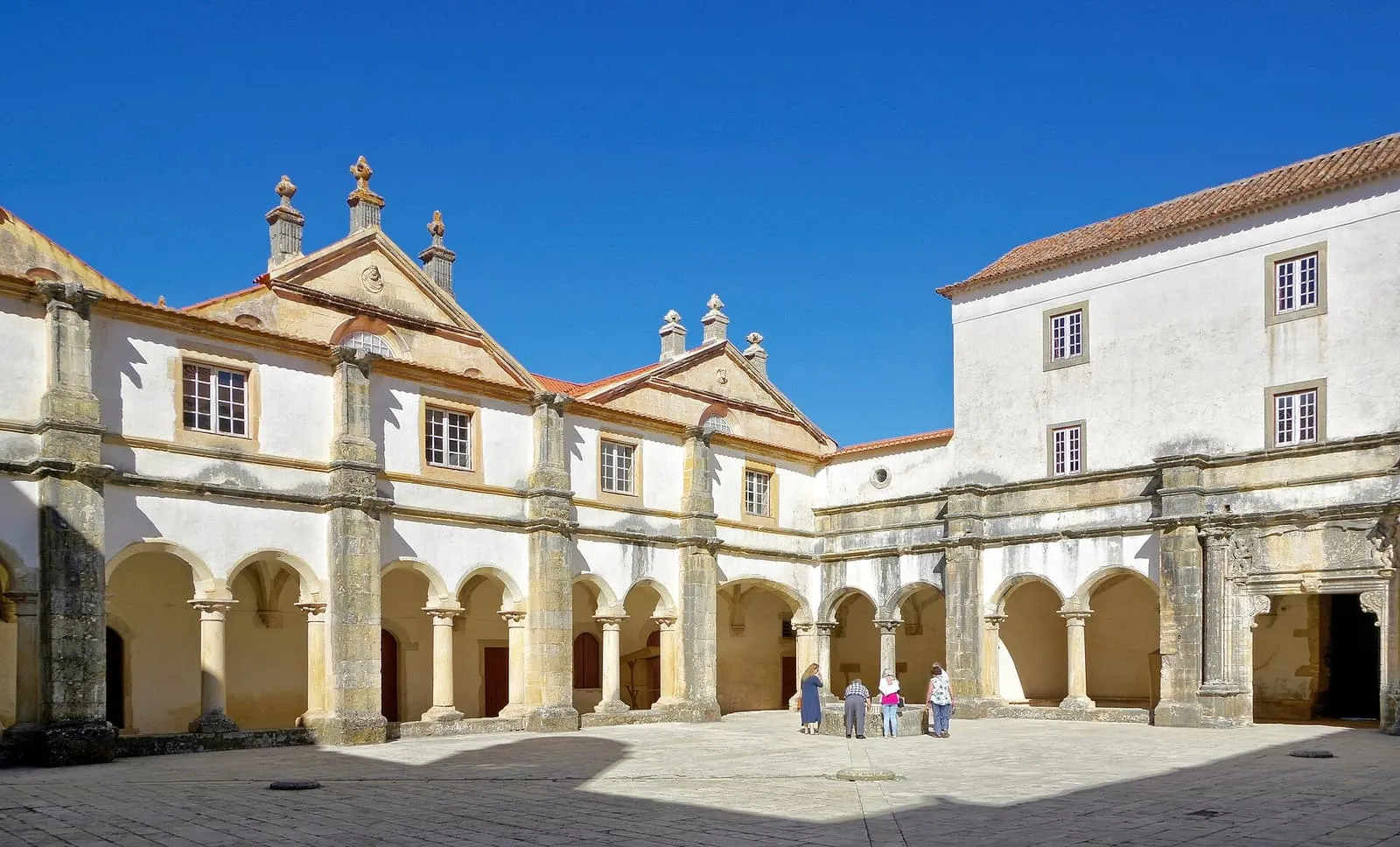
The convent is one of the most widespread typologies of Portuguese built heritage. As the home of a religious community devoted to prayer, work, and frequently to urban apostolate, it is distinguished from the monastery above all by its location: whereas the latter traditionally rose in the countryside and was associated with the monastic orders, the convent arose within or beside the city walls, in the service of the mendicant orders. The expansion of towns blurred this boundary, but any reading of the building must always take into account the context of its foundation.
Arrival of the mendicant orders
The mendicant orders — Franciscans, Dominicans, Augustinians, Carmelites and, later, Capuchins and Poor Clares — established themselves in Portugal as early as the beginning of the thirteenth century. The Franciscans arrived around 1217 and the Dominicans shortly afterwards, finding in the reign of King Dinis (1279–1325) a decisive period of expansion. Unlike monks, who withdrew into a self-sufficient contemplative life, the mendicants took a vow of poverty and settled among the people, preaching, teaching, and tending to the sick and the poor. For this reason their convents appear in the outskirts and squares of cities, in constant dialogue with civic life.
The Franciscan house did not isolate itself from the city: it shaped it. Fairs, streets, and devotions were organised around the convent, and its church became a stage for preaching and for the burials of the urban elites.
The architectural form
The conventual plan was organised around one or more cloisters, porticoed spaces that articulated the community’s principal buildings: the conventual church, with a raised choir for the religious; the chapter house, where the community gathered; the refectory; the library; and, on the upper floor, the dormitories or individual cells. The whole complex was bounded by an enclosure wall, a walled precinct that included vegetable gardens, orchards, and spaces for retreat, ensuring the separation between the religious world and the outside.
The architecture of the first mendicant convents translated the ideal of poverty into a pared-down Gothic, of clear volumes and restrained ornamentation, very different from the exuberance of the cathedrals of northern Europe. This austerity marked churches with a single nave and large chancels pierced by narrow windows. Over the centuries, however, the convents were enriched with successive decorative programmes — gilded woodwork, azulejo, and Baroque altarpieces — layering one phase upon another, so that each building becomes an archive of successive artistic sensibilities.
Grandeur, dissolution, and fate
Some convents reached monumental scale and exceptional status. The Convent of Christ in Tomar, seat of the Order of Christ and today a World Heritage Site, and the vast Convent of Mafra, raised by King João V, count among the greatest works of Portuguese architecture. Alongside these, hundreds of more modest houses spread across the territory, shaping the fabric of many cities.
The turning point came in 1834. The liberal victory in the civil war led to the dissolution of the male religious orders and the incorporation of their property into the National Treasury. The convents were inventoried, closed, and dispersed: many were sold to private owners, others converted into barracks, hospitals, courts, or public offices, and numerous churches became parish churches. This process caused irreparable losses to the heritage, but it also saved from ruin ensembles now classified as national monuments. To understand the convent is thus to read simultaneously the history of the religious orders and that of the religious heritage which for centuries structured the Portuguese urban landscape.
Convent of Christ, Tomar
Seat of the Order of Christ and a World Heritage Site, from the Templar rotunda to the cloister of João III.
CONVENTConvent of Mafra
A colossal Baroque and Johannine complex commissioned by King João V.
CONVENTCarmo Convent, Lisbon
The Gothic ruins that the earthquake of 1755 immortalised in the heart of the city.
TYPOLOGYMonasteries
The great houses of the monastic orders, the rural counterpoint to the urban convents.
TYPOLOGYParish Churches
Many conventual churches survived, converted into parish churches.
THEMEReligious Heritage
The panorama of buildings of worship that structures the Portuguese landscape.
Frequently asked questions
- What is the difference between a convent and a monastery?
- Traditionally, the convent was established in an urban setting, within or beside the city walls, and was associated with the mendicant orders; the monastery stood in the countryside and was linked to the monastic orders, such as the Benedictines or the Cistercians. The growth of cities blurred this distinction, so classification should take into account the original context of foundation.
- Why are so many Portuguese convents today vacant or put to other uses?
- The dissolution of the male religious orders, decreed in 1834 after the liberal civil war, transferred conventual buildings and property to the State. Many were sold, adapted into barracks, hospitals, schools, or town halls, and their churches converted into parish churches.