Intangible Heritage
Festas do Povo of Campo Maior
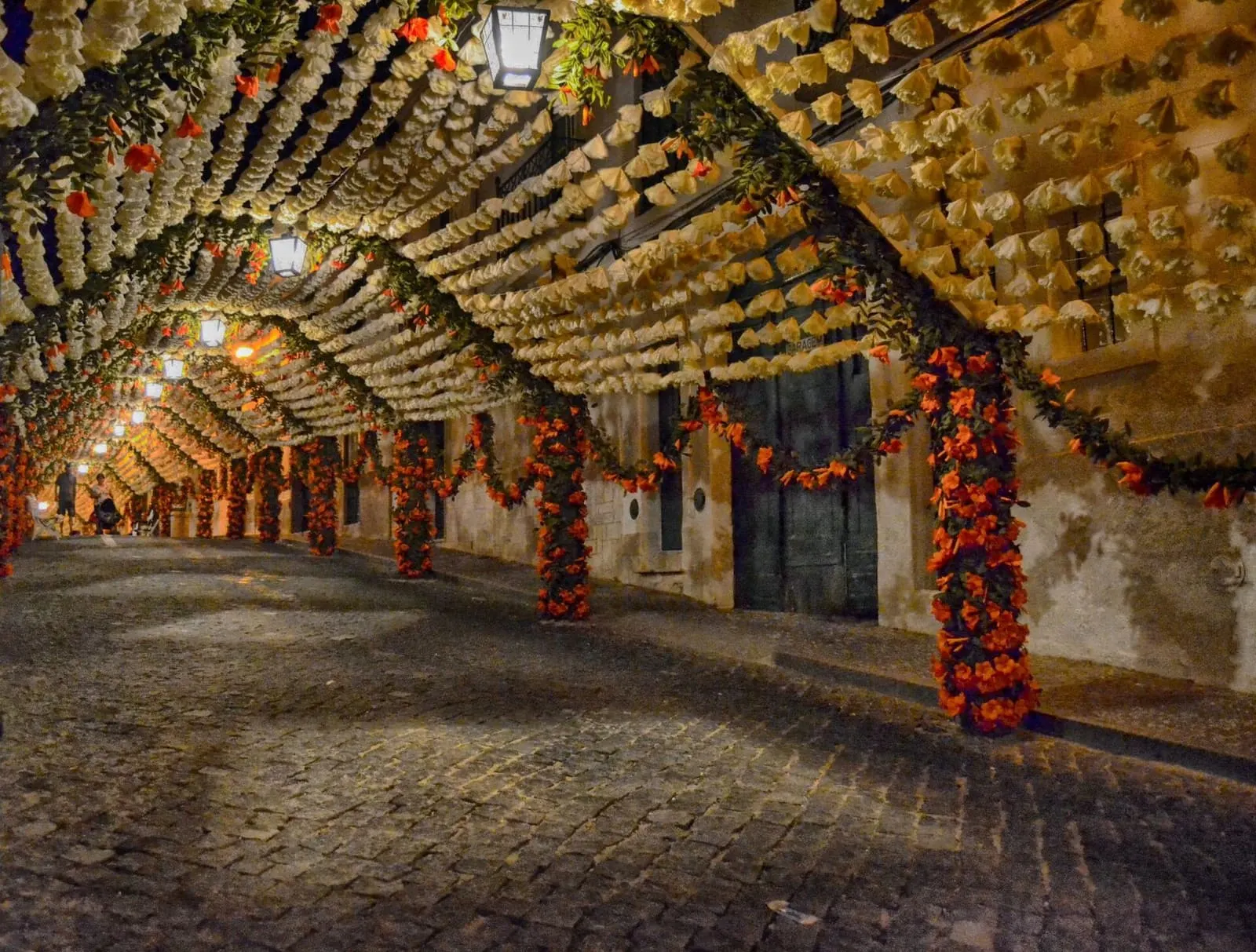
The Festas do Povo of Campo Maior, in the Alentejo, where the streets are covered in paper flowers. Intangible Cultural Heritage of Humanity since 2021.
- Location
- Campo Maior, Portalegre
- Built
- desde 1897
- UNESCO
- Intangible Heritage
At the Festas do Povo of Campo Maior, a town in the district of Portalegre, in the Alentejo, the streets disappear beneath millions of paper flowers. Also known as the Festas das Flores (Festival of Flowers) or Festas dos Artistas (Festival of the Artists), they are one of the most singular expressions of Portuguese popular culture and have been inscribed on UNESCO’s Representative List of the Intangible Cultural Heritage of Humanity since 15 December 2021.
A festival that the people decide
The most remarkable feature of these festivities is that they have no fixed periodicity. They follow no calendar, no anniversary and no municipal decision: they take place when the people, spontaneously, decide to hold them. For this reason many years may pass between editions, which gives each one an unrepeatable character and makes it deeply anticipated. The organisation arises from the bottom up, through street committees that decide to take part, set the date and conceive, in secret, the theme, the colours and the decorative motifs of their stretch.
For about nine months, neighbours of all ages gather in homes and garages to cut, fold and glue flowers, festoons and structures of paper and card. Secrecy is an essential part of the ritual: each street keeps its project hidden until the eve, assembling everything all at once, during the night. When the town wakes, it is unrecognisable — and a healthy rivalry sets in between streets to determine which has the most original and luminous decoration.
The extraordinary thing about the Festas do Povo lies not only in the visual result, but in the fact that an entire community agrees to work for months, in secret, for a transformation that lasts only a few days and that no one imposes.
Roots and meaning
The tradition of adorning the streets dates back to 1897, though its roots are sunk in the cult of Saint John the Baptist, patron of Campo Maior since the sixteenth century. The celebrations began linked to the religious festivities in honour of the saint, a dimension that gradually lost its formal character over the twentieth century, as the prominence passed entirely to popular initiative and to the collective ingenuity of its anonymous artists.
More than a spectacle, the festivities are a mechanism of social cohesion: they reinforce the sense of belonging, transmit manual know-how from generation to generation and mobilise emigrants and dispersed relatives, who return to the town to take part. This communal vitality brings them close to other living expressions of Portugal’s Intangible Cultural Heritage, from Cante Alentejano, likewise from the Alentejo, to the Winter Festivals and Caretos of Podence, in Trás-os-Montes.
International recognition
The UNESCO inscription, under reference number 01604, placed Campo Maior within the select group of Portuguese traditions distinguished as World Heritage in their intangible dimension. The recognition honours not a monument, but a know-how and a social practice — the capacity of a small community to reinvent itself collectively, at its own pace, and to make of the street an ephemeral, shared work of art.
Frequently asked questions
- When do the Festas do Povo of Campo Maior take place?
- They have no fixed calendar. They are held only when the people of the town decide to organise them, and many years may pass between editions. They are traditionally celebrated around the feast of Saint John the Baptist, in summer.
- Why do the streets fill with paper flowers?
- Each street, organised into a committee, spends about nine months preparing thousands of flowers and adornments of paper and card, kept secret until they are assembled all at once, transforming the town overnight.
- Since when are they UNESCO Heritage?
- The Festas do Povo of Campo Maior were inscribed on UNESCO's Representative List of the Intangible Cultural Heritage of Humanity on 15 December 2021, under reference number 01604.