Intangible Heritage
Mirandese Bagpipe
The Mirandese bagpipe, a handcrafted aerophone from the Mirandese Plateau that accompanies the lhaços of the pauliteiros and the ritual dances of Trás-os-Montes.
- Location
- Miranda do Douro, Bragança
The Mirandese bagpipe is the emblematic aerophone of the Mirandese Plateau, the far north-east of Trás-os-Montes where Portugal borders the lands of Sanabria, Aliste and Sayago on the Spanish side. An entirely handcrafted instrument, it shares with the bagpipes of those borderland districts a common morphological and sonic family: a powerful voice, shaped for the open air of festivals, religious gatherings and dances. It is, moreover, one of the most archaic examples of this type of instrument surviving in Europe, which makes it a living document of the musical history of the peninsular interior.
Anatomy of a borderland instrument
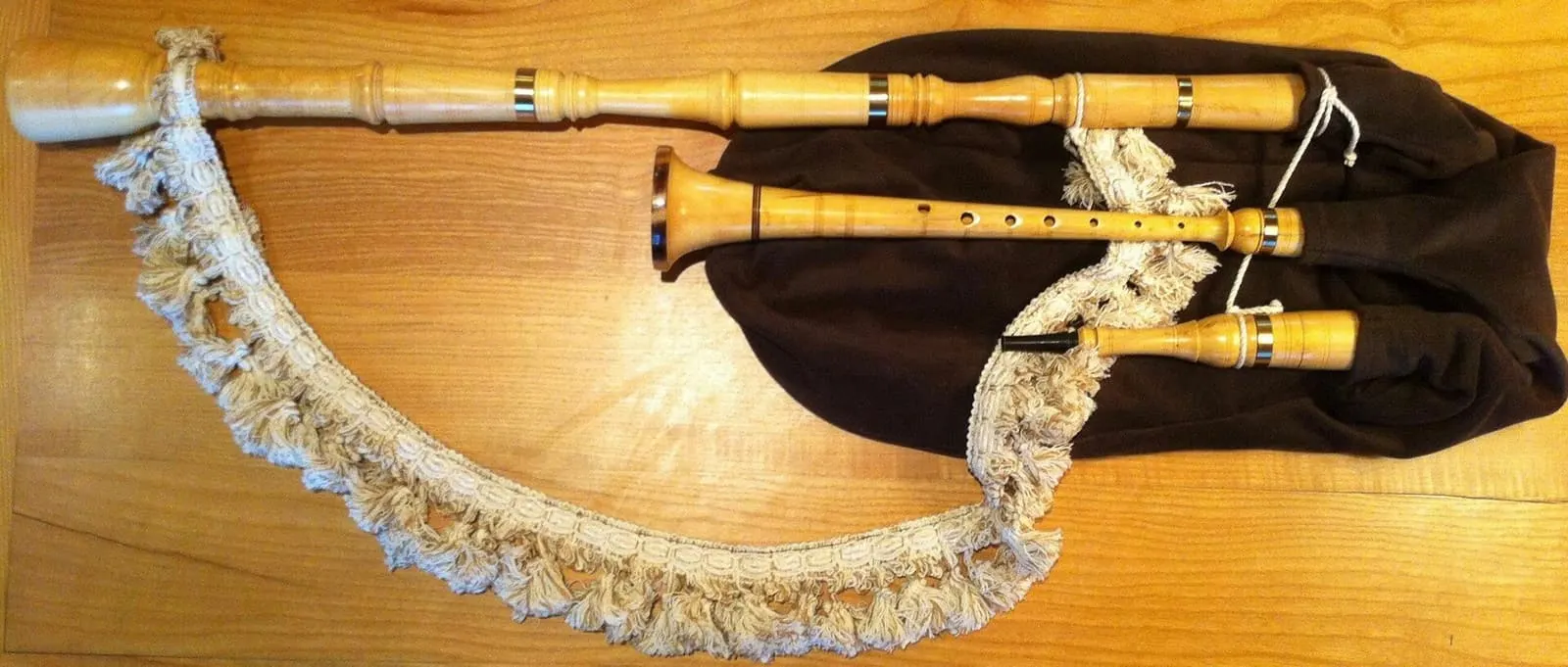
The bagpipe rests on a bag made from the whole hide of a kid-goat’s skin, which acts as an air reservoir and ensures the continuity of the sound. Three pipes are fitted into this bag. The chanter, conical and equipped with a double reed, is where the piper fingers the melody; its wide bore and robust reed account for the instrument’s characteristic volume. The drone, of large dimensions, sounds continuously about two octaves below the chanter, creating the typical deep carpet of sound of the peninsular bagpipes. Finally, the blowpipe is the tube through which the player blows in the air. The traditional woods — chiefly boxwood — and the colourful fabric adornments of the bag give each instrument its own identity, the fruit of the craftsman’s hand.
The tuning does not follow a fixed standard: depending on the maker, the bagpipe may be pitched in B, B flat or A. The scale frequently unfolds in a Dorian mode, with a minor third and a major sixth, a modal structure that brings its sound close to early music and to the song and pastoral flute (the fraita, in Mirandese) of the same region.
The voice that accompanies the pauliteiros
More than an object, the bagpipe is inseparable from a figure — the gaiteiro (piper) — and from a context. Its greatest role is to accompany the dances of the pauliteiros de Miranda, playing the lhaços, the ritual melodies over which the dancers strike their sticks in choreographies of warrior origin. Together with the snare drum and the bass drum, the bagpipe also structures the close-held baltes, jotas, mourisqueiras and carvalhesas that enlivened the festivals of the rural calendar.
The Mirandese bagpipe is not played to be heard in silence: it was born to move bodies, to mark the step of the dancers and to cover the noise of open-air festivities. It is functional music, not concert music — and it is in that function that it survives.
This collective dimension inscribes the bagpipe in the same cultural universe that distinguishes the Mirandese Plateau, a territory where the Mirandese language — Portugal’s second official language — is spoken, and where unique rituals endure. The bagpipe thus belongs to a coherent set of local expressions, as singular as the landscape of Miranda do Douro that safeguards them.
From the brink of extinction to revival
During the twentieth century, the tradition almost died out. Emigration — to Brazil and France —, the depopulation of the villages and competition from instruments such as the concertina drastically reduced the number of pipers. It fell to ethnographers and anthropologists, notably Ernesto Veiga de Oliveira from the 1960s onwards, to document the repertoire and the last makers before the knowledge disappeared.
The turning point came in 2007, with the First International Congress of the Mirandese Bagpipe, held in Miranda do Douro, which established the instrument’s correct designation and launched the slogan “not one more festival without the bagpipe”. Since then, the number of practitioners has grown remarkably, sustained by schools, instrument-making workshops and young groups. The bagpipe thus joins other families of traditional Portuguese sound — from the traditional chordophones to the ritual music of the interior — in an intangible cultural heritage in which memory continues to live in the practice of communities, and not in archives.
Frequently asked questions
- What is the Mirandese bagpipe?
- It is a double-reed aerophone, supplied with air by a bag made from a kid-goat's skin, characteristic of the Mirandese Plateau in Trás-os-Montes. It consists of a conical chanter on which the melody is played, a low drone that sounds continuously, and a blowpipe through which the player blows in the air, making it one of the most archaic examples of this type of instrument in Europe.
- Where is the Mirandese bagpipe played?
- Mainly on the Mirandese Plateau, in the municipalities of Miranda do Douro, Vimioso and Mogadouro, in the district of Bragança, the territory where the Mirandese language is spoken. It traditionally accompanies the pauliteiros, the religious festivals and the ritual celebrations of the region.
- What is its connection to the pauliteiros de Miranda?
- The gaiteiro (piper) is, par excellence, the musician who accompanies the dances of the pauliteiros, playing the lhaços — the ritual melodies over which the dancers strike their sticks. Together with the snare drum and the bass drum, the bagpipe provides the sonic foundation of these warrior dances.