Places
Horta
Horta, the main town of Faial Island in the Azores: sixteenth-century forts, baroque churches, the navigators' marina and the whaling memory of the Pico channel.
- Location
- Horta, Açores
- Built
- século XV (povoamento c. 1467)
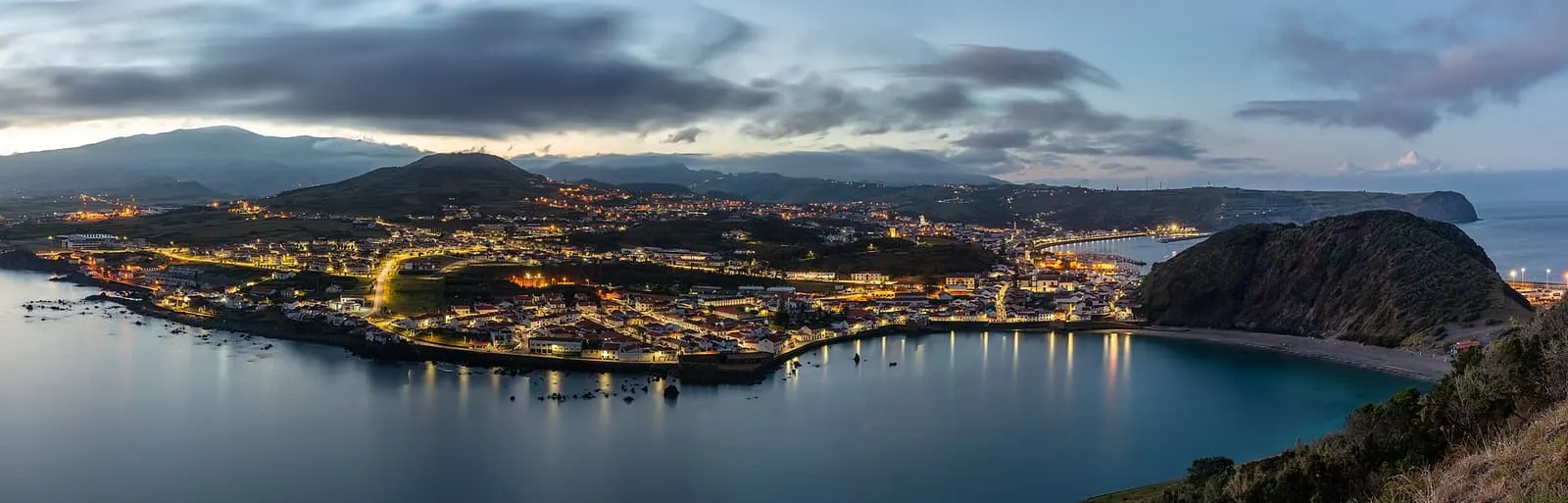
Horta is the main town of Faial Island and one of the most distinctive urban centres of the Azores archipelago. Overlooking a wide sheltered bay and facing the volcanic cone of the neighbouring island of Pico, it grew up as a town of the sea: for centuries it was an obligatory port of call on the Atlantic routes, and that maritime vocation shaped its architecture, its economy and its memory.
From Flemish origins to the Liberal town
The settlement of Faial began around 1467, under the direction of the Flemish nobleman Josse van Huerter — the origin of the strong presence of colonists from Flanders that marked the island. The place name “Horta” derives, according to tradition, from the Portuguese-adapted surname of this first captain appointed by the lord proprietor. Raised to the status of a town in 1498, in the reign of King Manuel I, Horta prospered with the woad trade and, later, with its strategic position in the Atlantic.
The town was ringed with fortifications to withstand attacks by corsairs and foreign ambitions. Of the sixteenth- and seventeenth-century defensive network there survive the Fort of Santa Cruz, whose construction began in 1567 beside the harbour, and the Fort of São Sebastião, to the north of the bay. It was in 1833, during the Liberal Wars, that Horta was elevated to a city, receiving the epithet of “Most Loyal Town of Horta”.
An urban ensemble of churches and manor houses
Horta is a town that has always looked outward — towards the channel, towards the ocean, towards the ships that made it a meeting point between Europe and America.
The houses are arranged on gentle terraces above the bay, in an ensemble of great coherence in which several churches stand out. The Mother Church of the Most Holy Saviour, the former church of the Jesuit college, rises with its two-towered façade and became a parish after the expulsion of the Society of Jesus. The Church of São Francisco, rebuilt in the late seventeenth century and opened for worship around 1700, preserves an interior of three naves with gilded woodwork and azulejo tilework. Popular devotion also centres on the Church of Nossa Senhora das Angústias, in an ensemble that reflects the baroque richness of the Azores and converses with traditional Azorean architecture, made of dark volcanic stone framing whitewashed openings.
As on the other islands, the religious and community calendar is punctuated by the feasts of the Holy Spirit, with their impérios and coronations, a living expression of a cultural identity shared throughout the archipelago.
The town of the sea: whaling, cables and sailing boats
The modern history of Horta is inseparable from the ocean. Between the nineteenth and twentieth centuries, Faial Island and the Pico channel were one of the great centres of whaling in the Azores, an activity that left museums, factories and a deep heritage memory in the coastal communities. From 1893, the town also became a hub of intercontinental telecommunications, with the arrival of the first submarine telegraph cables linking Europe to America — a position that attracted foreign companies and technicians of various nationalities.
Today, that cosmopolitan legacy continues in the Horta Marina, inaugurated in 1986 and one of the most visited in the world. It is an almost ritual stopover for the sailing boats that cross the North Atlantic, renowned for the colourful panels that crews paint on its quays — a tradition that, they say, brings good luck on the crossing — and for the legendary Peter Café Sport, a meeting place for sailors.
The legislative capital of the Azores and seat of the Regional Legislative Assembly, Horta forms, together with Angra do Heroísmo, one of the most expressive examples of historic Azorean urbanism, where the built heritage and the centuries-old relationship with the sea continue to define the face of the town.
Frequently asked questions
- Where is Horta?
- Horta is the main town of Faial Island, in the central group of the Azores archipelago, facing the channel that separates it from the island of Pico.
- When was Horta raised to the status of a town?
- Horta was granted town status in 1833, in the context of the Liberal Wars, being distinguished with the title of 'Most Loyal Town'.
- Why is Horta's marina famous?
- The marina is one of the main stopping points in the North Atlantic for sailing boats on ocean crossings, renowned for the murals that crews paint on its quays by tradition and superstition.
Sources
Keep exploring
Heritage nearby
More places to discover from here. Approximate straight-line distances, within 50 km.