World Heritage
Vineyard Culture Landscape of Pico Island
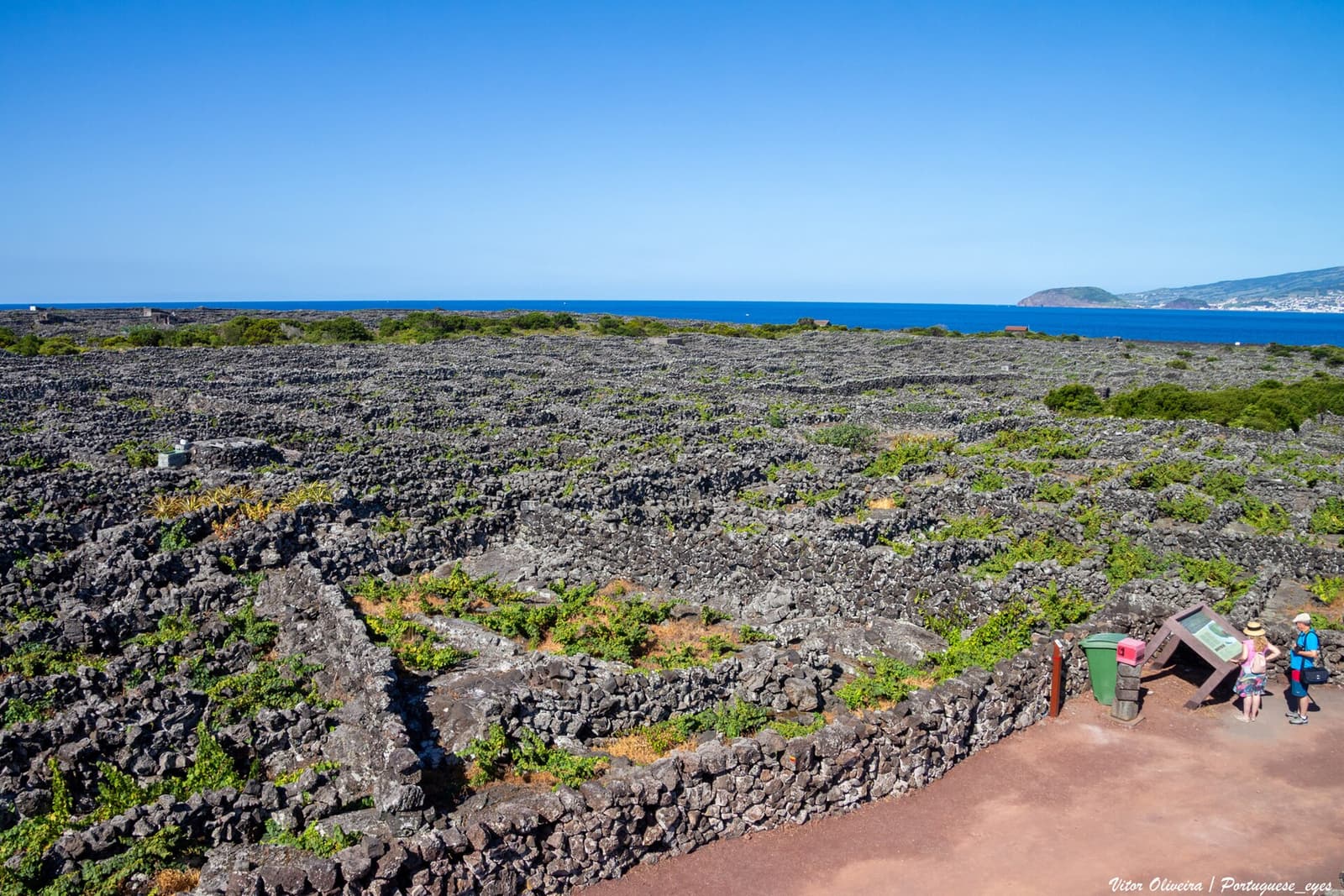
Vineyard Culture Landscape of Pico Island in the Azores: vineyards within black lava stone enclosures, a UNESCO World Heritage site since 2004 in Madalena.
- Location
- Madalena, Açores
- Built
- século XV–XX
- UNESCO
- World Heritage · since 2004
On Pico Island, the second largest in the Azores archipelago, vines do not grow on fertile soil but directly on lava rock. Over centuries, generations of farmers transformed an apparently hostile terrain — black basalt fields battered by Atlantic winds and sea spray — into one of the world’s most unique vineyard landscapes. This landscape, known as the Vineyard Culture Landscape of Pico Island, was inscribed on the UNESCO World Heritage List in 2004, under reference 1117 and cultural criteria (iii) and (v).
A Chessboard of Walls on Lava
The designated area covers about 987 hectares, protected by a buffer zone of nearly 1,924 hectares, primarily in the municipality of Madalena and, to a lesser extent, in São Roque do Pico. The defining feature of this landscape is an extraordinary pattern of dry-stone walls, arranged in lines parallel and perpendicular to the rocky coastline. These walls enclose thousands of small rectangular plots — the currais or curraletas — where vines are planted in the crevices of the lava itself.
The walls serve a dual practical and ingenious purpose: they shelter the plants from maritime winds and sea spray while maintaining the sun exposure needed for grape ripening. The dark stone absorbs daytime heat and releases it to the vines at night, creating a microclimate that compensates for the lack of soil. The result is a geometric grid stretching to the sea’s edge, inseparable from the imposing backdrop of Mount Pico, Portugal’s highest peak.
The Pico landscape is a rare example of how a community turned geological limitation into an agricultural method, making volcanic rock not an obstacle but the very instrument of cultivation.
Centuries of Island Viticulture
Vines likely arrived on Pico in the 15th century with the island’s settlement, their expansion linked to the presence of religious orders and later to the trade of the famed Verdelho wine, exported to various European courts. The emblematic sites of Lajido da Criação Velha and Lajido de Santa Luzia preserve not only vineyards but also an entire associated heritage ensemble: wine cellars, distilleries, tidal wells, barrel rollers, chapels, embarkation ports, and 19th-century manor houses. It is a complete testimony to a way of life organized around wine production.
Beyond the built heritage, vineyard culture has generated a rich intangible heritage, expressed in gastronomy, songs, and dances linked to the harvest period. This deep connection between agricultural labor, food, and festivity aligns Pico’s tradition with other practices recognized as Intangible Cultural Heritage, where cultivation, landscape, and sociability intertwine.
Outstanding Universal Value
The inscription on the World Heritage List is based on the exceptional nature of this landscape, considered a unique testimony to a cultural tradition (criterion iii) and a remarkable example of human adaptation to a vulnerable environment (criterion v). Like the Historic Centre of Angra do Heroísmo, designated in 1983 on Terceira Island, Pico places the Azores among the select group of Portuguese properties recognized by UNESCO.
Today, part of the landscape is classified as a Protected Landscape, and Criação Velha features an Interpretation Centre. Safeguarding the walls and reviving traditional vineyards remain challenges, balancing the preservation of ancestral know-how with maintaining a living agriculture.
Frequently asked questions
- When was it designated as a World Heritage site?
- The Vineyard Culture Landscape of Pico Island was inscribed on the UNESCO World Heritage List in 2004, with reference number 1117, under cultural criteria (iii) and (v).
- Where is the designated area located?
- It extends along the western, northwestern, and southwestern coasts of Pico Island in the Azores, primarily in the municipality of Madalena and, to a lesser extent, in São Roque do Pico. The emblematic sites are Lajido da Criação Velha and Lajido de Santa Luzia.
- What are the 'currais' or 'curraletas'?
- They are small rectangular enclosures bounded by dry-stone walls of black lava rock, which protect the vines from wind and sea spray while allowing the sunlight necessary for grape maturation.
Sources
Keep exploring
Heritage nearby
More places to discover from here. Approximate straight-line distances, within 50 km.