Resources
José de Figueiredo Laboratory
The José de Figueiredo Laboratory in Lisbon: the national reference laboratory for the conservation and restoration of cultural property, with origins in the MNAA.
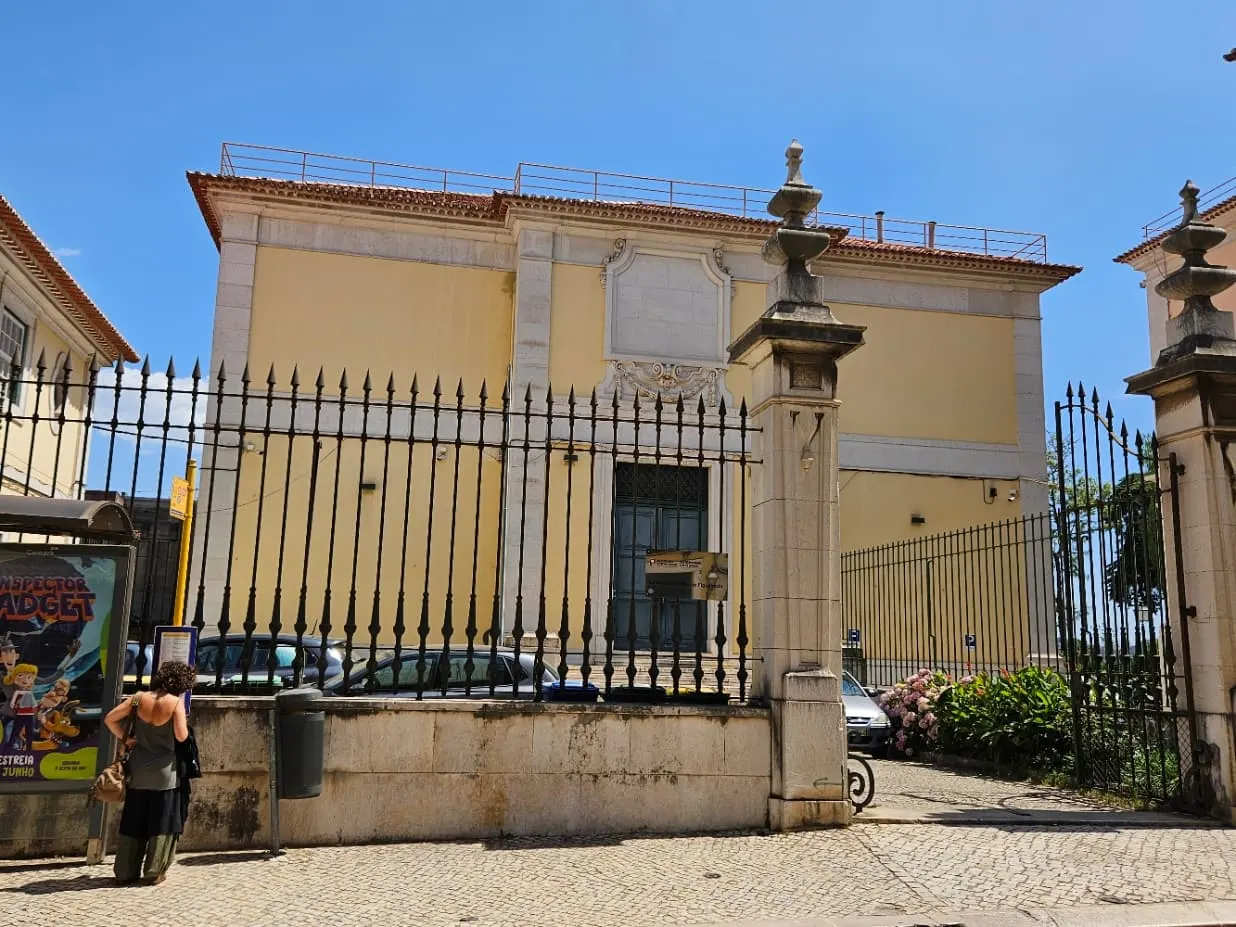
- Location
- Lisboa, Lisboa
- Built
- 1938–1940
The José de Figueiredo Laboratory is the national reference laboratory for the conservation and restoration of movable cultural property in Portugal. Based in Lisbon, on Rua das Janelas Verdes, in a purpose-built building adjoining the Museu Nacional de Arte Antiga, it brings together intervention studios and scientific laboratories where, for more than a century, paintings, sculptures, textiles, furniture and other testimonies of the national artistic heritage have been studied and treated.
From the museum’s workshops to an autonomous institute
The history of this institution is inseparable from that of the material study of art in Portugal itself. In 1911, José de Figueiredo (1872–1937), art historian and first director of the Museu Nacional de Arte Antiga, set up a restoration workshop at the museum and invited the painter Luciano Freire to take charge of conserving the works in the collection. It was a pioneering gesture: for the first time, restoration ceased to be an occasional task and became a permanent activity tied to the museum institution itself.
In the following decades, under the management of the physicist Manuel Valadares, the workshop acquired laboratory equipment — including an X-ray tube — and came to be known as the “Laboratory for the Examination of Works of Art”. The introduction of scientific methods of analysis marked a qualitative leap: radiography, photography and physico-chemical examinations made it possible to read layers invisible to the naked eye, to distinguish earlier interventions and to ground treatment decisions on solid evidence.
Restoration ceased to be a craft of the hands and became also a discipline of the laboratory, in which diagnosis precedes and justifies the intervention.
A building for restoration
It fell to the director João Couto to grasp that the growth of the activity required dedicated spaces. The building, designed by the architect Guilherme Rebelo de Andrade from concepts developed by Figueiredo, Valadares, Couto and Fernando Mardel, was built between 1938 and 1940. According to Couto, it was an “Institute of Restoration in its own home, in a building specially built for that purpose, a unique case in the world” — a claim that reflects the ambition to make conservation an autonomous field, with workshops, laboratories and training capacity.
Institutional autonomy came in 1965 when, at the initiative of the conservator and painter Abel de Moura, the workshops and the photographic, physics and chemistry laboratories emancipated themselves from the museum’s authority and gave rise to the José de Figueiredo Institute (Decree-Law no. 46,758 of 18 December 1965). For decades, the institute was an international reference in the treatment of delicate works, from panel painting to centuries-old tapestries.
Continuity and heritage
In 2000, the José de Figueiredo Institute was abolished and its functions passed to the newly created Portuguese Institute for Conservation and Restoration. Successive reorganisations of the heritage administration then integrated this remit into the central structures of the State, culminating in its current oversight by the Directorate-General for Cultural Heritage and Património Cultural, I.P. The laboratory has kept the name that honours José de Figueiredo, perpetuating the link between historical-artistic study and technical practice.
More than an administrative structure, the José de Figueiredo Laboratory is a landmark of conservation and restoration in Portugal: within it, generations of technicians were trained and the profession of conservator-restorer was consolidated, founded on the principle that each intervention must be reversible, documented and underpinned by scientific examination. Its workshops continue to host campaigns to study and treat major works of the national heritage, ensuring that central pieces of Portuguese art reach future generations in a condition to be understood and admired.
Frequently asked questions
- What is the José de Figueiredo Laboratory?
- It is the national reference laboratory for the conservation and restoration of movable cultural property, based in Lisbon, next to the Museu Nacional de Arte Antiga. It originated in the restoration workshops set up at the museum in 1911 and today forms part of the structure of Património Cultural, I.P.
- Why does it have this name?
- It honours José de Figueiredo (1872–1937), art historian and first director of the Museu Nacional de Arte Antiga, who in 1911 established the restoration workshop from which the institution descends.
- Where is the laboratory located?
- On Rua das Janelas Verdes in Lisbon, in a purpose-built building constructed between 1938 and 1940, adjoining the Museu Nacional de Arte Antiga.
Sources
Resources for research
Find the sources. Follow the story.
Guides to researching buildings, exploring museum collections and understanding heritage protection.
SIPA
Get to know the architectural inventory, building records and documentary archive.
Read the guideMuseum collectionsMatrizNet
Explore the museum catalogue and records of works, materials, authorship and provenance.
Read the guideHeritage protectionHeritage classification
Understand cultural property categories and the levels of national, public and municipal interest.
Read the guide