Memory of the World
The 1922 South Atlantic flight: UNESCO-registered reports
Explore the reports of the 1922 South Atlantic flight, written in January 1923, registered in 2011 and held at the Portuguese Navy Historical Archive.
- Document dates
- January 1923 (reports)
- UNESCO
- Memory of the World · since 2011
The first flight across the South Atlantic, made by Sacadura Cabral and Gago Coutinho in 1922, produced documentary testimony entered on the Memory of the World Register in 2011. The registration concerns the two aviators’ reports, held at the Portuguese Navy Central Library — Historical Archive in Lisbon. Related aircraft, instruments and monuments belong to the event’s history, but are not this registered documentary object.
The flight and its later account
The Lisbon–Rio de Janeiro journey began on 30 March and ended on 17 June 1922, with stops and the use of three floatplanes. Sacadura Cabral piloted; Gago Coutinho navigated. The artificial-horizon sextant enabled astronomical observations adapted to aerial navigation.
The reports were prepared in Lisbon in January 1923. This is the document’s date, distinct from the flight’s date. They should not be described as a handwritten journal produced daily aboard the aircraft in 1922.
Two accounts in one archival unit
The Navy Historical Archive record identifies PT/BCM-AH/147/0001, titled Relatório da Viagem Aérea Lisboa – Rio de Janeiro. It describes one report of 80 leaves, with drawings and 38 black-and-white positive photographs. The text is typewritten, with autograph signatures.
Sacadura Cabral’s first section explains motivations, preparation and journey stages. Gago Coutinho’s section develops navigational and technical matters. “Two reports” describes the authors’ contributions; the catalogue groups them as one storage unit. It does not necessarily mean two separate archival records.
Research questions
Compare the operational narrative with the technical explanation: what problem was identified, which method was chosen and what result did the authors record? Photographs support research into equipment, places and naval assistance, but require their captions and context.
The document reveals how the protagonists presented their achievement after its conclusion. Their account is not the whole documentary record of naval aviation or of the flight’s public reception.
Consultation and reproduction
Record the complete reference and ask the archive for information. The catalogue lists computer-based consultation and reproduction from digital material; confirm availability and current procedures before arranging a visit. Preservation conditions in the 2010 nomination are not a current condition report.
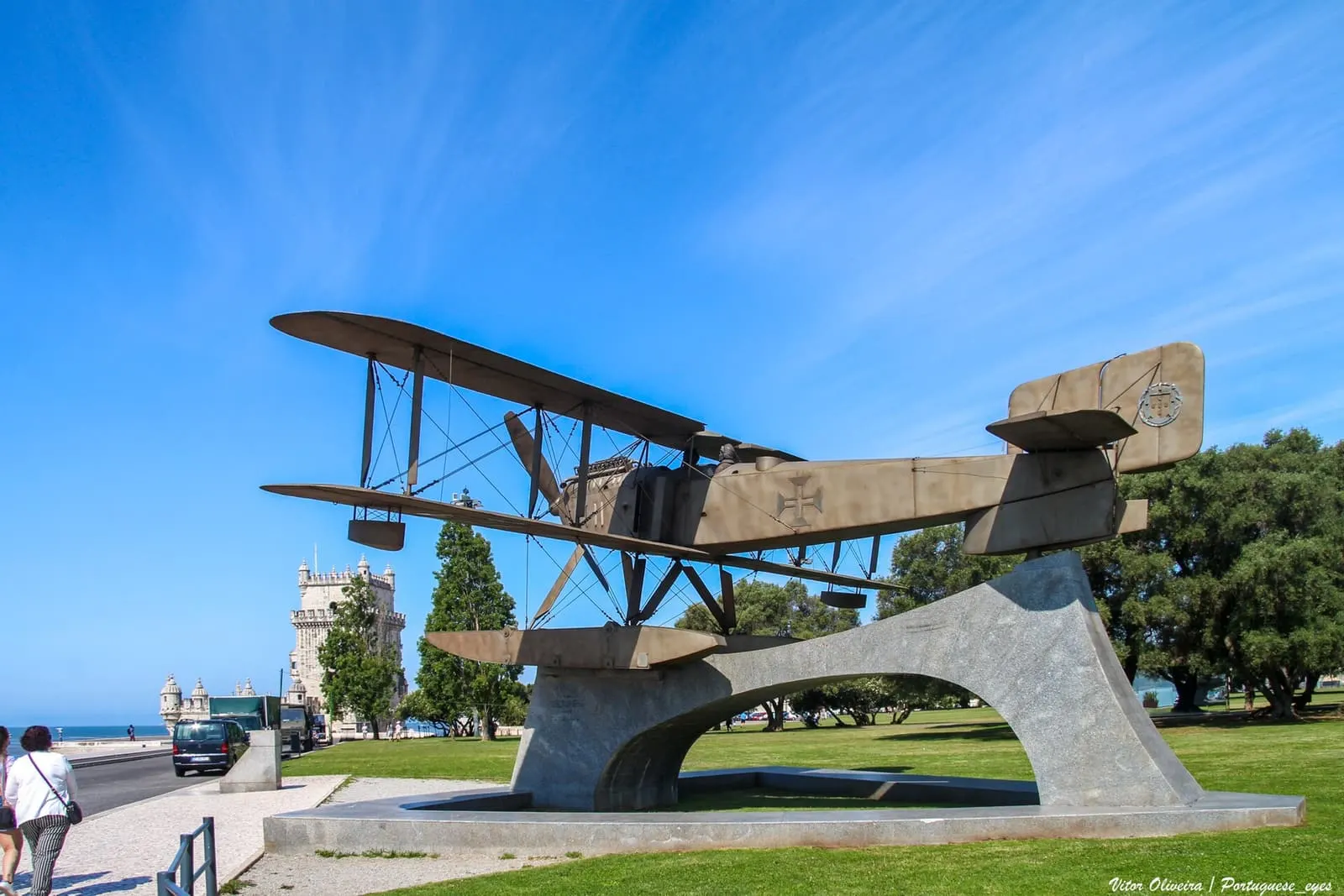
This page’s photograph shows a commemorative monument in Belém, rather than the registered document or an aircraft in flight. Explore Vasco da Gama’s journal to compare how journeys and navigational methods were recorded.
Frequently asked questions
- Was the aircraft or the documentary report registered?
- The reports by Gago Coutinho and Sacadura Cabral were registered in 2011. They are held together under PT/BCM-AH/147/0001; the aircraft and commemorative monument are not the registered documentary object.
- Do the reports date from 1922 or 1923?
- The flight took place from 30 March to 17 June 1922. The nomination and catalogue date the reports to January 1923, in Lisbon.
- Where can I consult the document?
- At the Portuguese Navy Central Library — Historical Archive, using PT/BCM-AH/147/0001. The catalogue lists computer-based consultation; confirm available images and reproduction procedures with the archive.