Memory of the World
Beatus of Liébana: the Lorvão and Alcobaça manuscripts
Explore Lorvão and Alcobaça, the two Portuguese components of the 2015 Iberian Beatus registration, with dates and references for research in Lisbon.
- Document dates
- 1189; 1201–1300 (Portuguese copies)
- UNESCO
- Memory of the World · since 2015
The Manuscripts of Beatus of Liébana’s Commentary on the Apocalypse in the Iberian Tradition entered Memory of the World in 2015, following a joint nomination by Portugal and Spain. The form identifies eleven components, two Portuguese and nine Spanish. The registration is not the entire family of surviving Beatus copies.
One text, different witnesses
Beatus lived in the eighth century. The work attributed to him circulated in later copies: the author’s period does not date every manuscript. The nomination includes codices and fragments, rather than only complete books.
Spanish components include witnesses at El Escorial, the Royal Academy of History, the National Historical Archive, the National Library of Spain, the National Archaeological Museum, and the archives of the Crown of Aragon and the Royal Chancellery of Valladolid. Two Sahagún bifolios with separate shelfmarks form one component in the nomination. References and digital files are not equivalent to registered components.
Lorvão: 1189 and Torre do Tombo
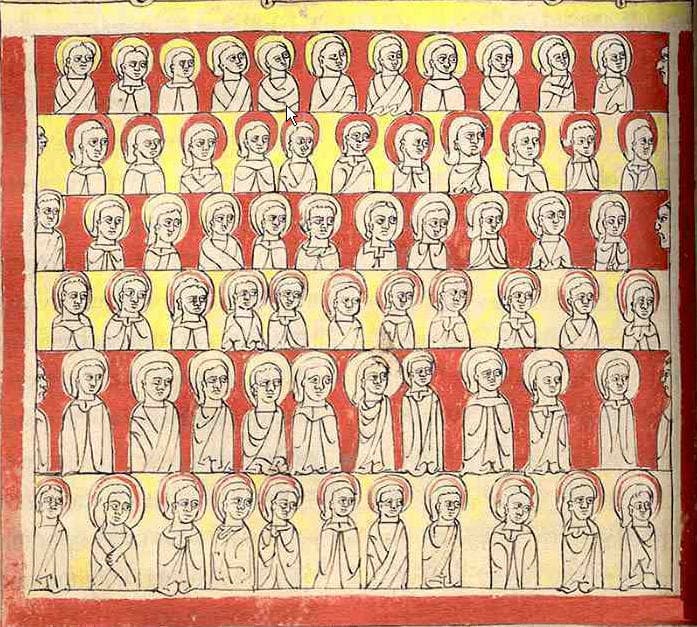
The Lorvão Apocalypse was copied in 1189. Its current record identifies PT/TT/MSML/B/44 as a compound document. Originating at the monastery of São Mamede de Lorvão, it was brought by Alexandre Herculano to Torre do Tombo in Lisbon in 1853.
The codex record identifies illustration subjects and folios. Select a passage and compare image and text: framing, colour and arrangement of figures help explore visual interpretations of the biblical narrative. This page’s photograph shows a detail from this component, rather than the whole Iberian group.
Alcobaça: a thirteenth-century copy
The second Portuguese manuscript is held at the National Library of Portugal, under ALC-247. The National Digital Library dates it to 1201–1300 and describes 183 parchment leaves. These describe this copy, not every Beatus manuscript.
The nomination’s reference to an eighth-century Alcobaça copy conflicts with the library’s dating. Use the custodian’s current record to identify and request the manuscript. Provenance from Alcobaça monastery does not mean that it is held at the monastery today.
Access and different forms of reproduction
Use both references and record the link, folio and image number. Check digital reproductions and reproduction conditions with each institution. A displayed facsimile is not the original codex; registration does not guarantee permanent display.
Compare with the Alcobaça Codex Calixtinus copy, another shared inscription requiring careful identification of individual witnesses and libraries.
Frequently asked questions
- Does registration cover every known Beatus manuscript?
- No. Nomination section 3.1 identifies eleven components: two Portuguese and nine Spanish, including codices and fragments. The wider manuscript tradition is larger.
- Where are the two Portuguese manuscripts?
- Lorvão is at Torre do Tombo under PT/TT/MSML/B/44. Alcobaça is at the National Library of Portugal under ALC-247. Their monastic provenance differs from their present locations.
- Is the Alcobaça manuscript eighth-century?
- No. The eighth century concerns Beatus and the origins of the text. The National Library dates ALC-247 to 1201–1300, in the thirteenth century.