Archaeology
Mirobriga
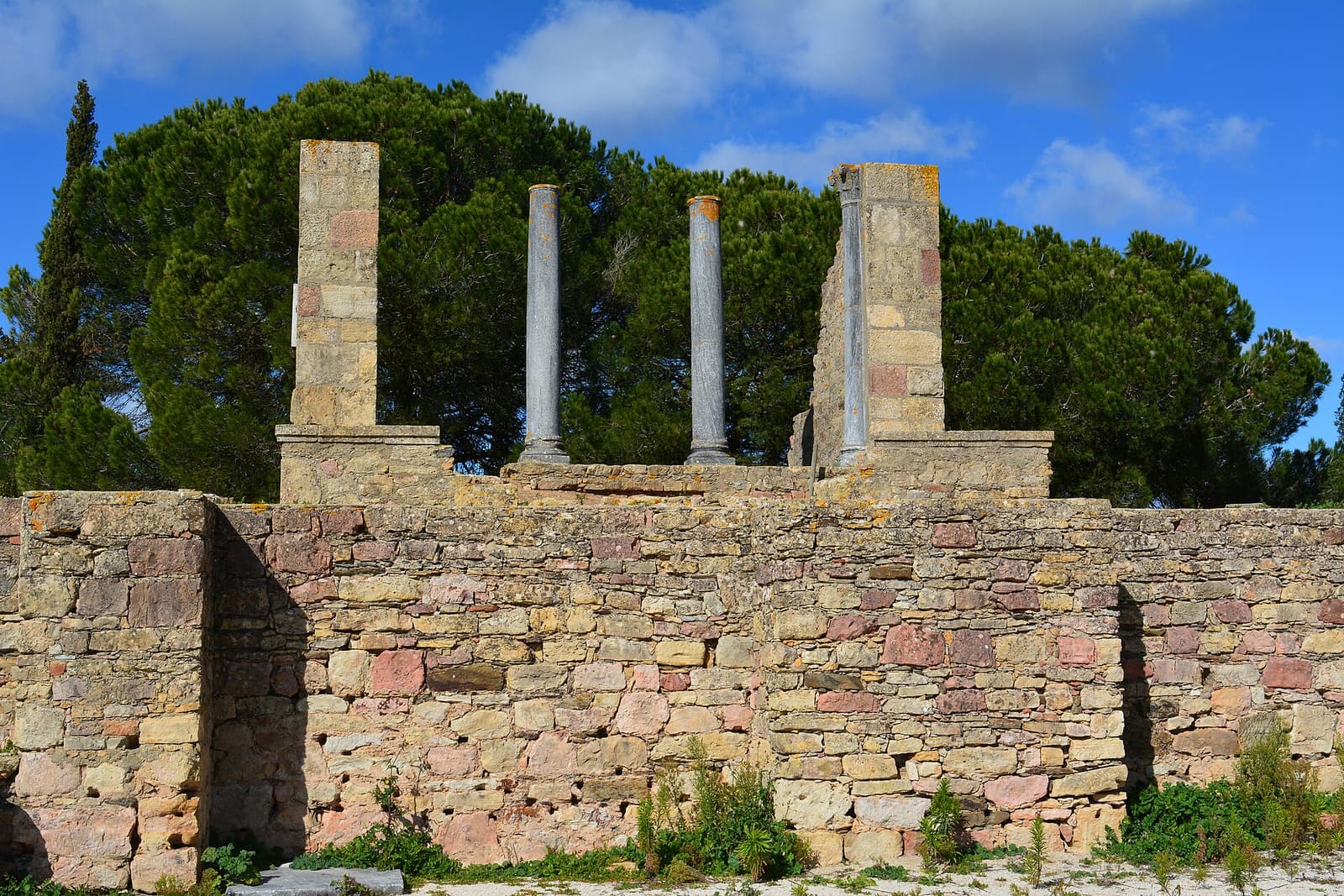
Mirobriga, the Roman city of Santiago do Cacém, with a forum, two bath complexes and the only circus with a known ground plan in Portugal.
- Location
- Santiago do Cacém, Setúbal
- Built
- século I d.C. (cidade romana)
- Style
- Romano
On the hill of Cumeada, on the Chãos Salgados estate, a little over a kilometre from Santiago do Cacém, rise the ruins of Mirobriga, one of the most striking Roman cities of the Alentejo coast. The site combines the memory of an indigenous Iron Age settlement with the monumentality of a fully developed Roman town, offering a rare cross-section of the transition between the pre-Roman world and the Romanisation of the south-western peninsula.
From hillfort settlement to Roman city
The occupation of the Cumeada spur — known locally as Castelo Velho — dates back at least to the 4th–3rd century BC, with roots that some researchers trace to the Late Bronze Age. The place name, of Celtic origin ending in the suffix -briga (“fortified settlement”), betrays this indigenous matrix. With its integration into Rome’s domain, the settlement reorganised itself according to Italic urban models, reaching its peak between the 1st and 4th centuries AD before a slow abandonment. The ruins were already documented in the 16th century by the humanist André de Resende, and the complex has been classified as a Property of Public Interest since 1940.
The forum, the temples and the baths
In the highest area lies the forum, the civic and religious centre of the city, built in the mid-1st century AD. Around it have been identified a temple associated with the imperial cult and a second temple attributed to Venus, as well as market areas and peristyle dwellings that reveal the comfort of the local elite.
In few Portuguese sites is it possible to read, within a single space, the interplay between political power, religious worship and urban leisure that structured a Roman city.
Downstream are preserved two bath complexes, built between the 1st and 2nd centuries AD and considered among the best preserved in the country. Arranged in an L-shape, they include changing rooms, cold rooms (frigidarium) and heated rooms (caldarium and tepidarium), with an ingenious hypocaust system: hot air from a furnace circulated beneath the floors and through the walls by means of pillars and brick arches. A single-arched Roman bridge, built in the early 2nd century AD, linked this northern area to the sector where the circus extends.
The only circus with a known ground plan in Portugal
The most singular element of Mirobriga lies about half a kilometre from the urban centre: a circus intended for chariot races, of which the complete ground plan is known — a unique case in Portuguese territory. This monumental structure confirms the importance of the city and the vigour of Roman public life in the region. The complex is part of the network of sites that document Roman Portugal through archaeology and converses with other great sites of national Roman archaeology.
For the quality of its remains, Mirobriga holds a prominent place alongside centres such as Conímbriga and Ammaia, or isolated monuments such as the Roman temple of Évora, helping to reconstruct the daily life, religion and leisure of the communities of southern Lusitania.
Frequently asked questions
- Where is Mirobriga?
- Mirobriga stands on the hill of Cumeada, on the Chãos Salgados estate, about one kilometre east of Santiago do Cacém, in the district of Setúbal.
- What makes Mirobriga unique among Portuguese Roman sites?
- It is the only site in Portugal where the complete ground plan of a Roman circus, intended for chariot races, is known, and it also preserves two of the best-preserved bath complexes in the country.
- When was Mirobriga inhabited?
- The settlement arose in the Iron Age, with origins going back at least to the 4th–3rd century BC, and developed as a Roman city between the 1st and 4th centuries AD.
Sources
Keep exploring
Heritage nearby
More places to discover from here. Approximate straight-line distances, within 50 km.