Typologies
Watermills and Azenhas
The watermills and azenhas of Portugal: horizontal-wheel rodízios, vertical-wheel azenhas and tide mills that ground the bread of rivers and streams.
- Style
- Engenharia hidráulica tradicional
Before bread could reach the table, someone had to grind the grain. For almost two millennia, that daily task depended on the force of water running in rivers and streams: it was enough to divert part of the flow onto a wooden wheel to set in motion the heavy millstone that reduced the cereal to flour. The watermills and the azenhas are the monuments of that rural economy, today silent beside watercourses all over the country, but for centuries the productive heart of every village.
Rodízio and azenha: two solutions for the same water
This typology divides, first of all, into two technical families. The rodízio mill uses a wheel set horizontally, onto which water is projected by an inclined channel — the seteira or cubo. The axle of that wheel rises directly to the millstone, which thus turns with no need for gears. It is the simplest and the most numerous solution: small buildings of rough construction with a single-pitched roof, suited to the torrential, seasonal waters of mountain streams. They multiplied by the hundreds in the ranges of the interior, where they were an essential element of the family economy.
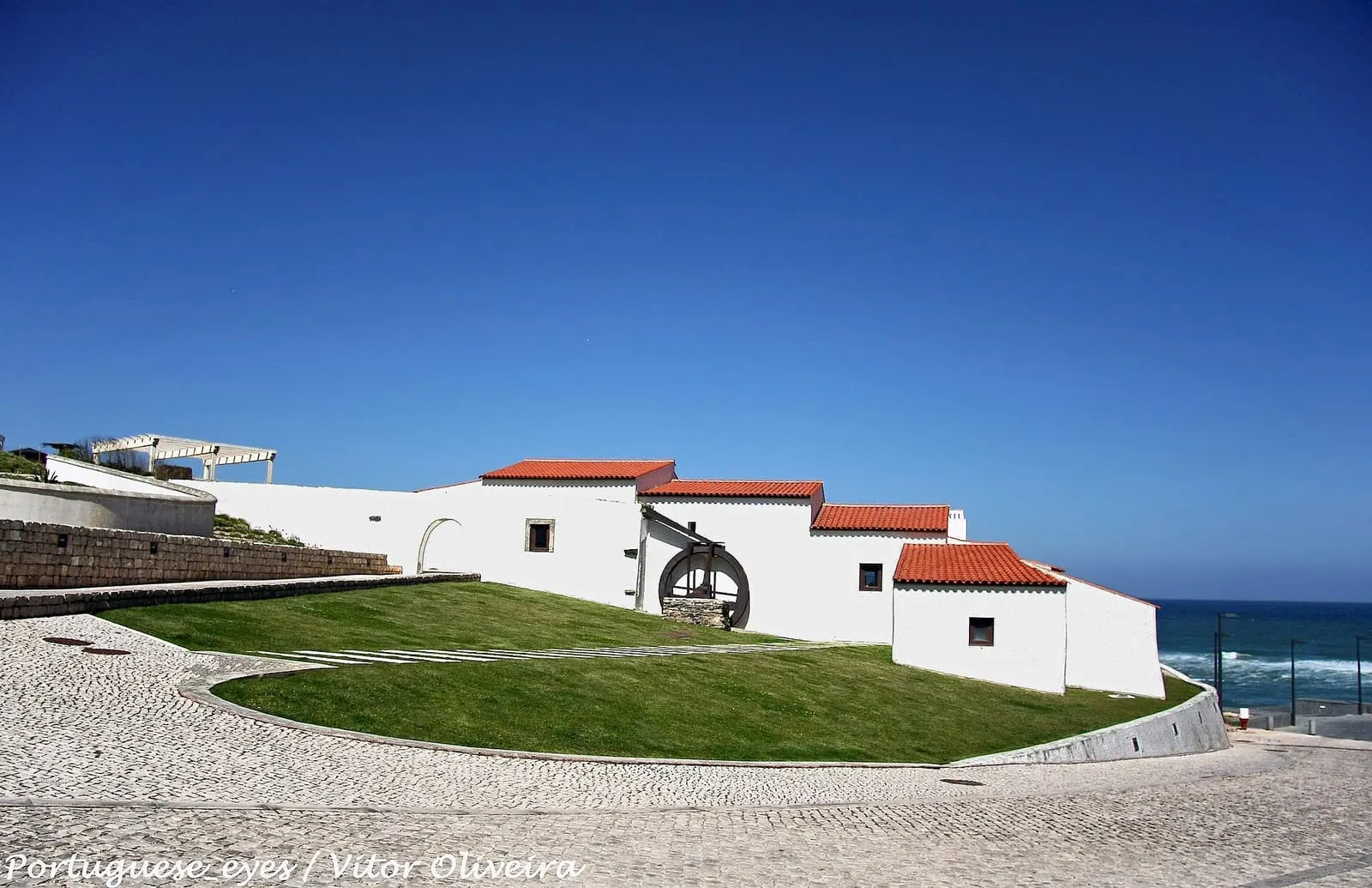
The azenha represents the more elaborate engineering. Its wheel is vertical and external, driven by the current, and the movement is transmitted to the millstone through a system of toothed wheels and a pinion. This mechanism multiplies each turn of the wheel into several rotations of the millstone, making the most of constant flows. They are, for that reason, larger constructions, of good masonry and with a double-pitched roof, installed in the lower course of higher-volume rivers. The very word, of Arabic root (as-sania), recalls that it was probably the Islamic presence that spread the vertical wheel in the Peninsula, while the horizontal rodízio is associated with the Roman legacy.
Rodízio and azenha answer the same question in opposite ways: where water is scarce and irregular, the mechanism is simplified; where it is abundant and constant, one invests in the gearing. The geography of the river designs the architecture of the mill.
The mill of the sea: tide mills
In an ingenious variant, the typology descends to the estuaries. The tide mill does not depend on a river, but on the ocean itself: at high tide, the water fills a vast reservoir held back by sluice gates; at the ebb, it is released in a controlled way over horizontal wheels, much like a rodízio. The estuaries of the Sado and the Tagus hold the most notable examples, such as the Moinho de Maré da Mourisca, in Setúbal, documented since 1601, or that of Corroios, in Seixal, classified as a Property of Public Interest and today the core of an ecomuseum. They are early witnesses to the use of a renewable and predictable energy — that of the sea.
Memory of a forgotten heritage
Water milling accompanied Portuguese life from at least the Early Middle Ages, when charters and monastic documents already referred to mills and azenhas as goods of great value. Through it passed the sustenance of communities: there were no bakeries, and each family took its grain to be milled, paying the miller in flour — the maquia. That world collapsed with the mechanical and industrial milling of the nineteenth and twentieth centuries, which rendered the small millstones of the rivers obsolete.
Many of these contrivances survive in discreet ruin, integrated into the landscape of the schist villages and the mountain valleys, side by side with the memory of the windmills that fulfilled, on the ridges, the same function with another motive force. Part of this legacy is today studied and valued within the framework of industrial heritage, and its technique — diverting and dosing the water with weirs, leats and head-races — is in dialogue with the long tradition of hydraulic engineering that has marked the territory. To restore a mill is not merely to restore stone: it is to preserve a craft that for centuries ground everyone’s bread.
Frequently asked questions
- What is the difference between a rodízio mill and an azenha?
- In the rodízio mill, water falls onto a wheel set horizontally — the rodízio — whose axle rises directly to the millstone, turning it without gears. In the azenha, the wheel is vertical and external, and its movement is transmitted to the millstone through a system of toothed wheels and a pinion, which multiplies each turn of the wheel into several turns of the millstone.
- What is a tide mill?
- It is a hydraulic mill that harnesses the rise and fall of the tides in estuaries. At high tide, the water fills a reservoir held back by a sluice gate; at the ebb, it is released in a controlled way to drive the millstones. The estuaries of the Sado and the Tagus preserve notable examples, such as the Moinho de Maré da Mourisca, in Setúbal, and that of Corroios, in Seixal.
- Do Portugal's watermills still work?
- Most were abandoned with the arrival of mechanical and industrial milling over the course of the nineteenth and twentieth centuries. Some survive, restored as museum centres, ecomuseums or rural lodgings, and a few still grind for demonstration, keeping alive the memory of a centuries-old craft.