Typologies
Windmills
Windmills in Portugal: typology, components, the history of grain milling, and the whitewashed towers that mark the landscape of the Oeste, the Alentejo and…
- Style
- Arquitetura vernacular
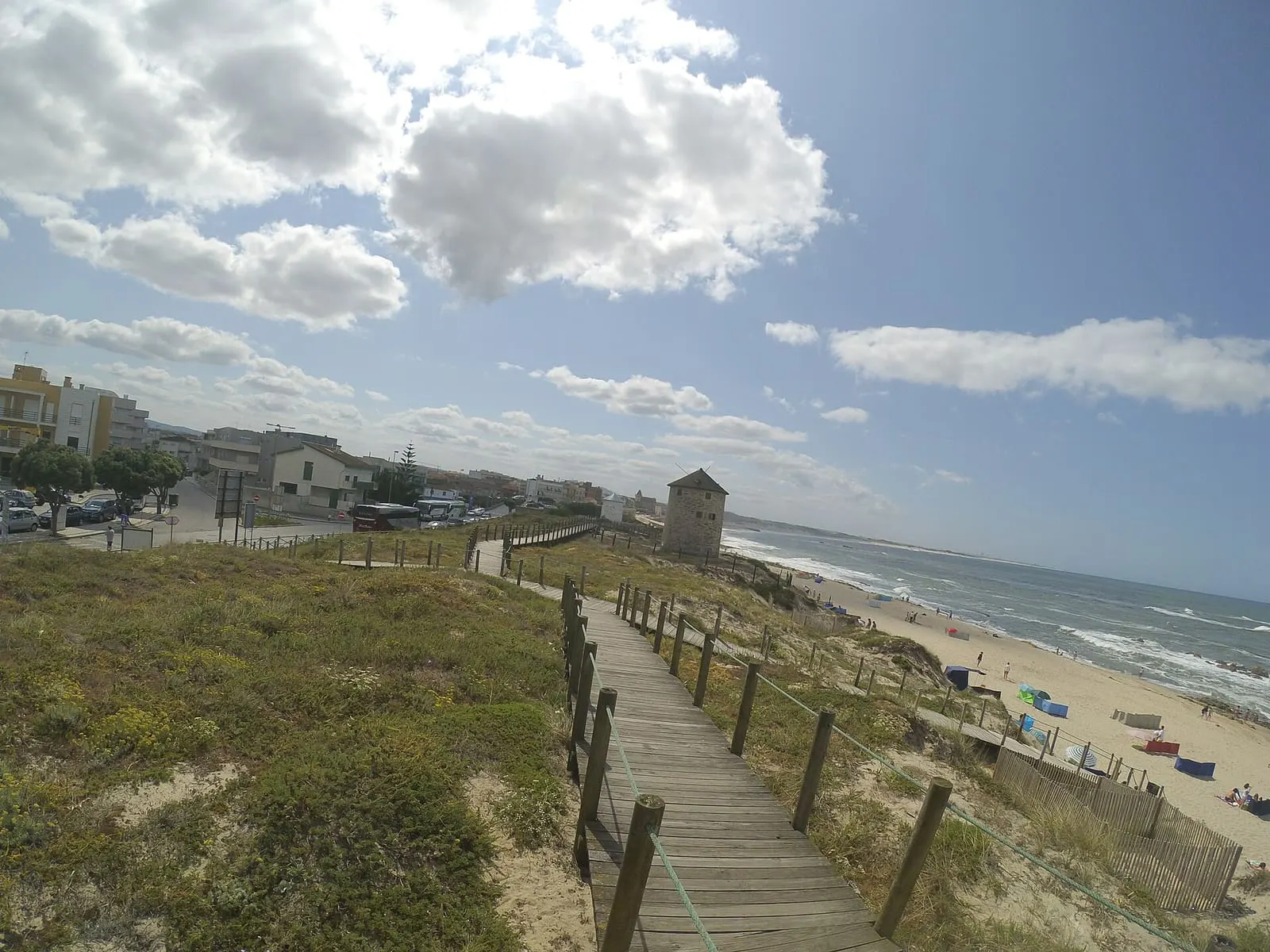
The windmill is one of the most expressive machines of the Portuguese countryside: a tower that turns the force of the air into flour. Converting the movement of its sails into the turning of the millstones, it was for centuries an essential piece of equipment in the subsistence economy, securing the bread of entire villages. Its whitewashed towers, cut out against the sky on windy heights, became a landmark of the landscape of the Oeste, the central coast, the Alentejo and the islands, and today form a remarkable chapter among the typologies of built heritage.
Origin and spread
The existence of windmills in Portugal is documented in a record of 1303, though an earlier introduction is to be assumed. The first examples are believed to have had a vertical axis, with sails arranged around it; that solution was eventually replaced by the horizontal-axis typology we know today. From the sixteenth century onwards, windmills multiplied, above all in the regions exposed to the Atlantic winds, where the rolling relief offered unencumbered hilltops.
Their importance was anything but marginal. In the 1960s it was estimated that some ten thousand mills were at work in Portugal, of which close to three thousand were driven by wind and the rest by water — a figure that gives the measure of the dense milling network covering the country, complementing the watermills and azenhas set up along the streams.
Typologies and construction
Broadly speaking, two great models can be distinguished. The Mediterranean type — the most common in Portugal — rests on a fixed cylindrical stone tower, crowned by a conical wooden cap that turns to orient the sails to the wind; this was the usual solution in the Oeste and the South. The northern European type, with a pyramidal wooden body that turned as a whole, appears among us more rarely. To the family of mills must be added the metal mill of the American type, introduced in the nineteenth century and spread above all in the Azores and the Alentejo.
The miller read the wind by ear: in the clay whistles fixed to the tips of the stocks, the sharp whistling indicated the speed of the sails and warned when it was time to take in cloth before the fury of the storm broke the shaft.
The heart of the machine is simple and ingenious. The wooden shaft, usually octagonal in section, receives four stocks in a cross, to which the triangular cloth sails are fastened; these roll up when the mill is at rest and spread out to catch the wind. The movement of the shaft is transmitted, through the great gear wheel — the entrosa —, to the spindle that turns the upper millstone, the runner, upon the fixed stone, the bedstone. Between the two stones the grain is crushed and emerges already transformed into flour. For the milling, the miller charged a percentage of the grain, the so-called toll, which as a rule ranged between 5 and 10 per cent.
Know-how and heritage
To mill by wind required an art close to that of the sailor: orienting the cap, adjusting the cloth according to the strength of the air, braking in time. That knowledge of the millers, and the craft of the masons and carpenters who raised the towers, belong to the world of vernacular architecture, made of techniques handed down from generation to generation. The flour that came from it was the raw material of traditional Portuguese bread, a direct link between the engineering of the tower and the table.
With the spread of industrial and electric milling over the course of the twentieth century, the overwhelming majority of the mills fell silent. Many fell into ruin, reduced to cylinders of stone without cap or sails; others were restored as elements of industrial heritage and of rural memory, some returned to milling on festival days, others reconverted into lodging or into small museum centres. Preserved or in ruin, the windmills remain unmistakable signatures of the Portuguese landscape and witnesses to a time when bread depended on the air that blew.
Frequently asked questions
- Since when have there been windmills in Portugal?
- Their existence is documented in Portugal at least as far back as 1303, though an earlier introduction is thought likely. From the sixteenth century onwards they multiplied, above all in the regions exposed to the Atlantic winds of the Oeste, the coast and the islands.
- What is the difference between a windmill and a watermill?
- The windmill turns the millstones with the force of the wind captured by sails; the azenha and the watermill use the force of a watercourse acting on a wheel. Both ground grain, but they relied on different sources of energy and stood in different places — windy heights against the banks of streams.
- What are the main parts of a windmill?
- The cylindrical stone tower, crowned by the rotating wooden cap; the shaft with the great gear wheel that transmits the movement; the triangular cloth sails fastened to the stocks; and, inside, the two millstones — the fixed bedstone and the runner that turns upon it.