World Heritage
Alto Douro Wine Region
The Alto Douro Wine Region, a terraced cultural landscape in the Douro valley inscribed by UNESCO in 2001, birthplace of Port wine for more than two millennia.
- Location
- Pinhão (Alijó), Vila Real
- Built
- Vinha cultivada há mais de 2000 anos; socalcos modernos do séc. XIX–XX
- Style
- Paisagem cultural em socalcos
- UNESCO
- World Heritage · since 2001
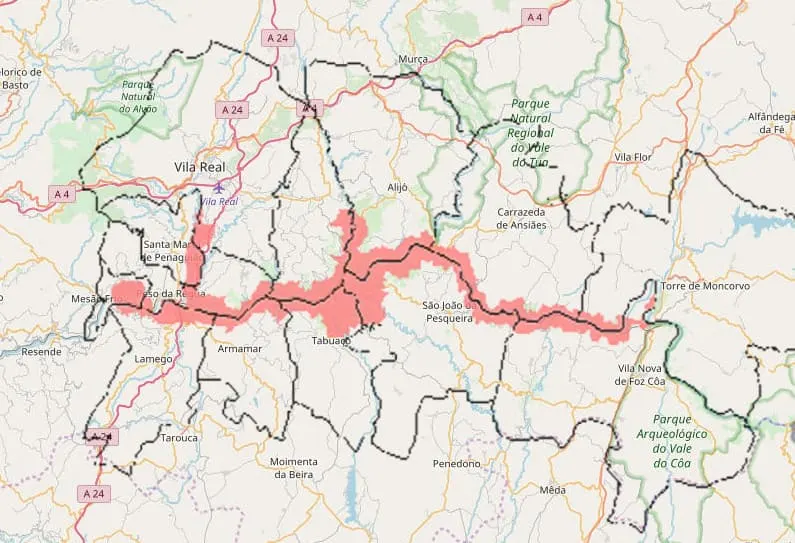
The Alto Douro Wine Region is an evolving, living cultural landscape, carved over more than two thousand years in the steep valley of the river Douro, in north-eastern Portugal. Inscribed on UNESCO’s World Heritage List on 14 December 2001, it covers around 24,600 hectares of vineyards arranged in terraces on schist slopes, across a territory that spans fourteen municipalities and forms the historic heart of Port wine production.
A landscape shaped by human labour
What makes the Alto Douro unique is the radical transformation of mountainous, hostile terrain into cultivable ground. Generation after generation, farmers cut terraces into the steep slopes, held up by dry-stone schist walls, creating the characteristic socalcos that climb from the river to the ridgelines. Different terracing techniques coexist here: the old terraces, narrow and irregular, and the continuous, regular platforms built from the late nineteenth century onwards, in the wake of the devastation caused by the phylloxera plague.
This accumulation of technical, social and economic knowledge over the centuries justified the listing under criteria (iii), (iv) and (v), which recognise the Douro as exceptional testimony to a wine-growing tradition and as an outstanding example of harmonious interaction between humankind and a demanding natural environment.
The river Douro and its tributaries form the backbone of a landscape in which every schist wall represents the effort of countless hands across generations.
The birthplace of Port wine
Vines have been cultivated on these slopes since Roman times, but it was from the eighteenth century onwards that Port wine gained international standing. In 1756, the Marquis of Pombal established the Companhia Geral da Agricultura das Vinhas do Alto Douro, creating the Douro Demarcated Region — one of the oldest regulated wine regions in the world. Its boundaries were physically marked by granite posts, known as marcos pombalinos, several of which survive.
The region is organised into three sub-regions, distinguished by climate and altitude: the Baixo Corgo, the Cima Corgo — where Pinhão lies, in the municipality of Alijó — and the Douro Superior, the last of these extending as far as the Spanish border. Historic estates, manor houses and the architecture of the wine presses and warehouses complete the heritage ensemble.
Visiting the Douro
The Alto Douro Wine Region can be travelled by train along the emblematic Douro Line, by rabelo boat along the river, or by car on winding roads that offer viewpoints over the valley. Nearby, the Mateus Palace, in Vila Real, is a landmark of regional Baroque and a natural extension of the itinerary.
The landscape echoes other distinguished wine-growing landscapes in Portugal, such as the Landscape of the Pico Island Vineyard Culture, in the Azores, likewise based on the building of stone walls to tame a difficult territory. Part of the North of the country, the Douro is today a benchmark destination, where heritage, gastronomy and wine tourism meet in a setting recognised as one of the most beautiful in the world.
Frequently asked questions
- When was the Alto Douro Wine Region listed by UNESCO?
- It was inscribed on the World Heritage List on 14 December 2001 as a cultural landscape, under criteria (iii), (iv) and (v), with reference number 1046.
- Where is the Alto Douro Wine Region?
- It extends along the valley of the river Douro, in north-eastern Portugal, covering fourteen municipalities in the districts of Vila Real, Bragança, Viseu and Guarda, with Pinhão and Peso da Régua as its main centres.
- What is the difference between the Douro Demarcated Region and the Alto Douro Wine Region?
- The Douro Demarcated Region is the entire Port wine production area, created in 1756. The Alto Douro Wine Region listed by UNESCO corresponds to about 24,600 hectares, a representative fraction of that region.
Sources
Keep exploring
Heritage nearby
More places to discover from here. Approximate straight-line distances, within 50 km.