Monuments
National Palace of Queluz
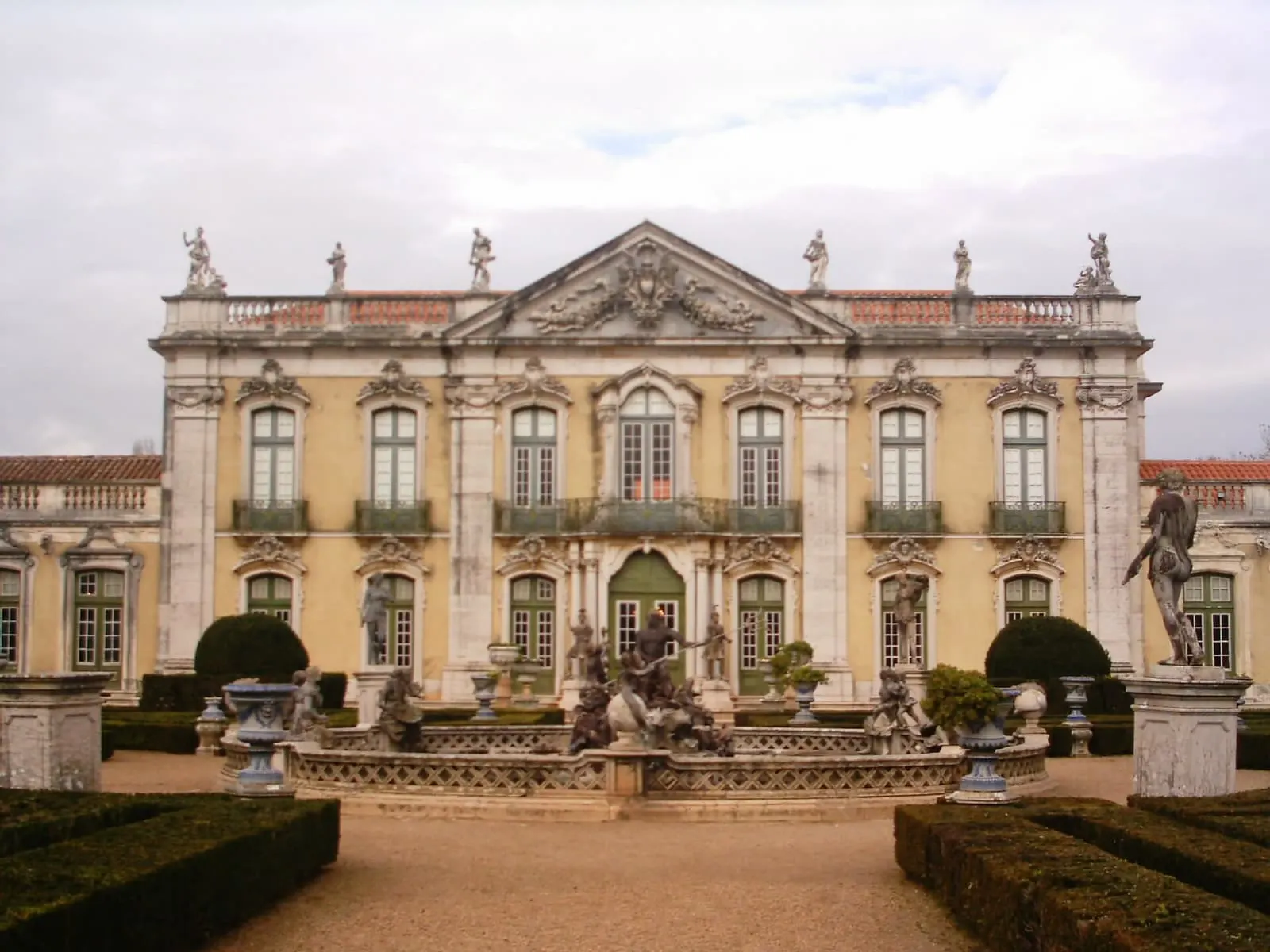
The National Palace of Queluz in Sintra is the grand Rococo residence of the Portuguese court, renowned for its formal 18th-century gardens.
- Location
- Queluz, Lisboa
- Built
- 1747–1786
- Style
- Rococó e neoclássico
The National Palace of Queluz is one of the most elegant Portuguese royal residences of the 18th century and the most complete example of Rococo taste applied to court life. Built in Queluz, in the municipality of Sintra, it stands out for the harmony between the palace buildings and the formal gardens that surround it, an ensemble that earned it the nickname “Portuguese Versailles.” Classified as a National Monument since 1910, it is now one of the main museum complexes managed by Parques de Sintra.
From a leisure estate to a court residence
The palace’s origins trace back to a leisure estate that belonged to the Casa do Infantado. In 1747, the Infante Dom Pedro—future Dom Pedro III, husband and uncle of Maria I—commissioned the transformation of the old country house into a summer residence worthy of a prince. The project was directed by architect Mateus Vicente de Oliveira, trained in the Joanine school that built the Royal Palace of Mafra.
Construction campaigns extended until around 1786, with a significant interruption after the 1755 earthquake, which necessitated rethinking the building’s structural integrity. From 1758 onwards, the Frenchman Jean-Baptiste Robillion, a goldsmith and architect, infused the ensemble with Rococo refinement, visible in the wing that bears his name, the interiors, and the garden staircases.
Interiors and the court of Maria I
When Maria I ascended the throne in 1777, Queluz became a recurring stage for court life. The interiors preserve some of the most remarkable ceremonial spaces of European Rococo: the Ambassadors’ Room, spacious and luminous, designed for diplomatic receptions; the Ballroom, lavishly decorated with gilded woodwork and mirrors; and the Music Room. After the death of Dom Pedro III in 1786 and the queen’s subsequent illness, the palace became her refuge in her final years.
More than a singular palace, Queluz is a dialogue between two temperaments: the restraint of Joanine architecture by Mateus Vicente and the decorative fantasy of the Frenchman Robillion.
The chapel, consecrated in 1752, features grand gilded woodwork, illustrating the continuity between civil architecture and the religious heritage of the period.
The formal gardens
The gardens are an inseparable part of the ensemble. Designed in the French style, with boxwood parterres, statuary, fountains—such as Neptune’s Fountain—and cascades, they also include the famous Tile Canal, lined with figurative panels that form one of the most beautiful collections of 18th-century Portuguese tilework. This formal garden language aligns Queluz with other royal palaces and contrasts with the later Romanticism of the Pena National Palace in the nearby Sintra mountains.
Converted into a museum in 1940, the palace continues to serve state functions, hosting official visits. A visit here naturally complements a tour of the Sintra National Palace, forming an essential itinerary through Portuguese palatial architecture.
Frequently asked questions
- Where is the National Palace of Queluz located?
- It is situated in Queluz, in the municipality of Sintra, Lisbon district, approximately fifteen kilometers northwest of the capital's center.
- Why is it called the 'Portuguese Versailles'?
- The designation stems from its combination of a Rococo court residence with extensive formal geometric gardens, reflecting pools, and statuary, evoking the model of 18th-century French royal residences.
- Who lived in the palace?
- It was the residence of Dom Pedro III and Queen Maria I, who spent her final years there, and later of Dom João VI and Dona Carlota Joaquina.
Sources
Keep exploring
Heritage nearby
More places to discover from here. Approximate straight-line distances, within 50 km.