Monuments
Palace of the Marquises of Fronteira
The Palace of the Marquises of Fronteira in São Domingos de Benfica (Lisbon) preserves the largest collection of 17th-century azulejos in situ in Portugal.
- Location
- Lisboa, Lisboa
- Built
- 1671–1672
- Style
- Barroco seiscentista
The Palace of the Marquises of Fronteira stands in São Domingos de Benfica, on the northeastern slope of the Monsanto hills, and is one of the most complete Portuguese Baroque country houses. Commissioned between 1671 and 1672 by D. João de Mascarenhas, 1st Marquis of Fronteira, it was originally built as a country retreat and hunting lodge, shortly after the Restoration of Independence. The family’s main residence was in central Lisbon; only after the 1755 earthquake destroyed it did the Benfica estate become their permanent home—a situation that continues today, with the palace still inhabited by descendants.
The Azulejos and the Hall of Battles
The palace’s fame rests largely on its tilework, considered the largest preserved 17th-century ensemble in situ in Portugal. The panels cover rooms, staircases, facades, and garden nooks, with iconographic programs ranging from seasons and rural customs to mythological, allegorical, and even comedic figures, such as the famous monkeys.
The highlight is the Hall of Battles, adorned with blue and manganese tiles with touches of yellow and green. The panels narrate, episode by episode, the battles of the War of Restoration—Montijo (1644), Arronches (1653), the Lines of Elvas (1659), Ameixial (1663), and Montes Claros (1665), among others—in one of the rare instances where Portuguese tilework assumes the role of historical chronicle. These panels belong to the same visual culture that the 17th-century patterned azulejo helped disseminate, but elevate it to monumental narrative.
Few places demonstrate as clearly how the azulejo in Portugal evolved from ornament into discourse: walls that recount wars, genealogies, and seasons.
The Garden and the Casa do Fresco
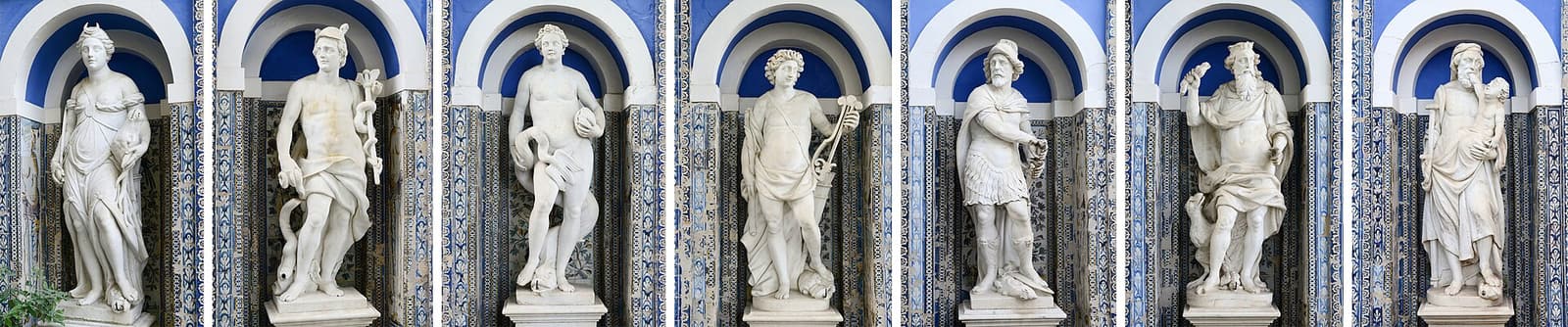
The formal garden, with geometric designs inspired by Italian and French models, features flowerbeds, fountains, and a large pond—the Knights’ Pond. Over its waters runs a gallery of niches with busts of Portugal’s kings, notably omitting the three Philips of Spanish rule. On the pond’s walls, tile panels depict the house’s knights, a symbolic assertion of the lineage’s prestige.
The composition also includes the Casa do Fresco, whose decoration combines tiles with shells, glass fragments, and porcelain, in a mannerist and grotesque-inspired style. The palace complex, with its gardens, orchard, and woodland, has been classified as a National Monument since 1982.
Significance and Visits
The Fronteira Palace is essential reading for understanding the country estates of the Portuguese aristocracy and the role of historic gardens in Ancien Régime culture. Its intimate scale sets it apart from grand royal residences like the National Palace of Queluz, but its tilework program and the integration of architecture, garden, and ornament make it a unique specimen.
Now managed by the Fundação das Casas de Fronteira e Alorna, it remains inhabited and opens its gardens and parts of the interior, including the library, to the public through guided tours. It is a living testament to how a 17th-century noble house has survived intact to this day.
Frequently asked questions
- When was the Palace of the Marquises of Fronteira built?
- The country house was erected between 1671 and 1672 for D. João de Mascarenhas, 1st Marquis of Fronteira, on the slopes of the Monsanto hills in São Domingos de Benfica.
- Why are the palace's azulejos so significant?
- The collection comprises the largest preserved ensemble of 17th-century azulejos in situ in Portugal, including the battle panels in the Hall of Battles dedicated to the War of Restoration.
- Is the palace open to visitors?
- Yes. Although still inhabited by the Fronteira-Alorna family, the gardens and parts of the building, such as the library, can be visited during scheduled hours.
Sources
Keep exploring
Heritage nearby
More places to discover from here. Approximate straight-line distances, within 50 km.